The airline industry five forces analysis is a strategic framework derived from Michael Porter’s model, used to evaluate the competitive intensity and profitability of the aviation sector. By examining the bargaining power of suppliers and buyers, the threat of substitutes, the intensity of rivalry, and the threat of new entrants, stakeholders can assess the inherent structural challenges that dictate long-term airline profitability.
Understanding the Porter Five Forces in Aviation
Michael Porter’s Five Forces model serves as a diagnostic tool for identifying the attractiveness of an industry. In the context of the global airline sector in 2026, the framework helps explain why the industry historically struggles with thin profit margins despite high capital investment. Unlike industries where a clear competitive advantage can be sustained, the airline industry is characterized by structural pressures that often erode the potential for high returns on invested capital.
Each force represents a pillar of external pressure. When these forces are high, they collectively squeeze profitability. When they are low, companies have more room to maneuver, set prices, and retain earnings. In aviation, the complexity arises because many of these forces—such as the power of aircraft manufacturers or the threat of high-speed rail—are largely outside the control of individual airline management teams.
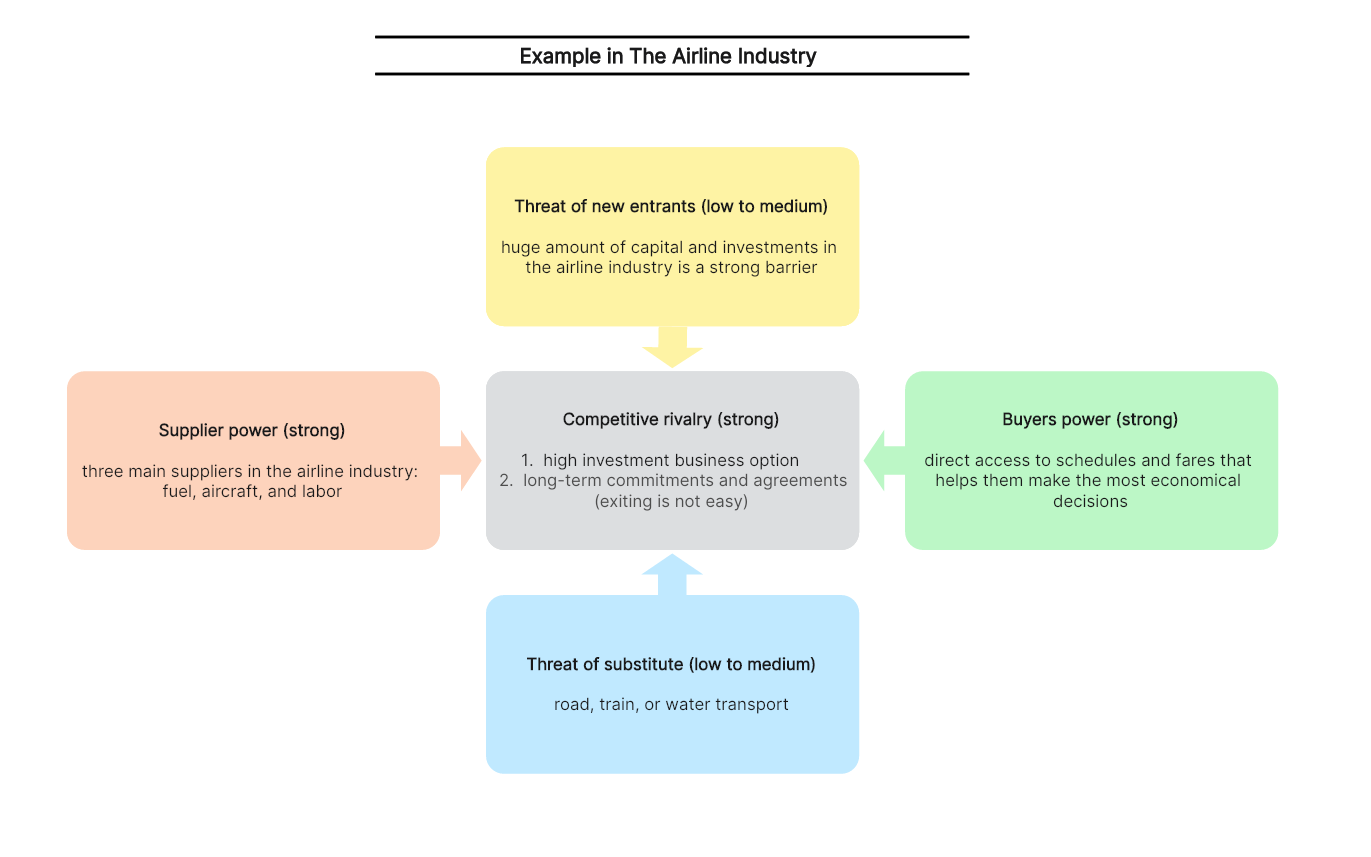
1. Threat of New Entrants: Moderate to Low
The barrier to entry for the airline industry is exceptionally high, primarily due to the astronomical capital requirements, regulatory hurdles, and infrastructure constraints. Despite these barriers, the threat of new entrants persists, particularly from low-cost carriers (LCCs) and regional startups.
- Capital Intensity: Launching an airline requires massive upfront investment in fleet acquisition, leasing, and establishing ground handling operations. In 2026, the cost of next-generation, fuel-efficient aircraft remains a significant barrier for new players.
- Regulatory Hurdles: Aviation is one of the most heavily regulated industries globally. Obtaining an Air Operator Certificate (AOC), securing international landing rights (slots), and meeting stringent safety standards across multiple jurisdictions take years of planning and significant legal expenditure.
- Access to Infrastructure: Established airlines often hold "grandfather rights" to slots at capacity-constrained airports. New entrants struggle to gain access to prime flight times, limiting their ability to attract business travelers.
- Economies of Scale: Legacy carriers leverage decades of operational infrastructure. A startup lacks the network density and loyalty program integration that incumbents use to lock in passenger demand.
2. Bargaining Power of Suppliers: Very High
The airline industry is uniquely vulnerable to a small number of critical suppliers. This concentration of power allows suppliers to exert significant influence over the cost structures of airlines.
- Aircraft Manufacturers: The duopoly of Boeing and Airbus creates a massive power imbalance. Airlines often have multi-year waiting lists for new, fuel-efficient aircraft, limiting their ability to dictate price or delivery schedules. If an airline chooses to switch manufacturers, the retraining costs for pilots and mechanics are prohibitive.
- Fuel Producers: Jet fuel is typically one of an airline's largest operating expenses. Airlines have almost no leverage over the global commodity price of crude oil, which is dictated by geopolitical factors, OPEC+ production quotas, and global demand.
- Labor Unions: Pilots, flight attendants, and ground crew are highly unionized. Their bargaining power is magnified by the fact that airline operations are time-sensitive; a strike or work slowdown can cripple a carrier’s revenue in days.
- Airport Authorities: Many airports operate as natural monopolies. They can increase landing fees and terminal charges with limited recourse for airlines, especially at primary hub locations.
3. Bargaining Power of Buyers: High
In the era of 2026, the passenger has more power than ever before. This is driven by technological transparency and the commoditization of air travel.
- Price Transparency: Global distribution systems and third-party metasearch engines have turned air travel into a commodity. Passengers can compare prices, baggage fees, and flight times across dozens of carriers in seconds, making brand loyalty difficult to maintain.
- Low Switching Costs: For the average leisure traveler, the cost of switching from one airline to another is near zero. If a competitor offers a lower fare or a better schedule, the passenger moves.
- Business Traveler Influence: While business travelers are less price-sensitive than leisure travelers, they demand frequency and flexibility. Corporate travel managers often negotiate deep discounts, utilizing the collective volume of their employees to force airlines into lower pricing tiers.
- Social Media and Reputation: An airline's brand image can be damaged rapidly by viral reports of poor service or operational failure. This creates a "buyer’s market" where the airline must constantly invest in customer experience to justify premium pricing.
4. Threat of Substitute Products: Moderate
While air travel remains the only viable mode for transoceanic or long-distance intercontinental travel, the threat of substitutes is significant for short-to-medium-haul routes.
- High-Speed Rail: In regions with robust rail infrastructure, such as Europe, East Asia, and increasingly in parts of North America, high-speed rail is a formidable competitor. Rail offers city-center-to-city-center service, bypassing the lengthy security and boarding processes of airports.
- Video Conferencing and Digital Collaboration: Since 2020, advancements in virtual meeting technology have permanently altered business travel patterns. While some in-person contact remains necessary, the total volume of "routine" business travel has stabilized at a lower percentage of total air demand than pre-pandemic levels.
- Surface Transportation: For short-haul routes, improved electric vehicle (EV) infrastructure and high-quality bus services have become more attractive to budget-conscious travelers who prefer to avoid the stresses of the airport experience.
5. Intensity of Competitive Rivalry: Extremely High
The competition between existing airlines is the most prominent force, often leading to "price wars" that destroy profitability for the entire sector.
- Fixed Costs vs. Perishable Inventory: Airlines have high fixed costs (planes, gates, staff). Once a flight is scheduled, the seat is a perishable commodity—if it remains empty, that revenue is lost forever. This creates a desperate incentive to lower prices to fill seats, often below the actual cost of operation.
- Industry Concentration: While there are major players in every region, the market remains fragmented enough to prevent true monopoly pricing, except on highly specific routes.
- Differentiation Challenges: Most airlines struggle to offer a unique product. Beyond the "low-cost" vs. "full-service" divide, seating, legroom, and boarding procedures are remarkably similar. This leads to intense competition based solely on price, which is a "race to the bottom."
- Global Alliances: While alliances (like Star Alliance or Oneworld) help, they also normalize service levels, making it harder for an individual airline to stand out as a superior choice.
Comparative Summary of Forces
| Force | Intensity | Primary Driver |
|---|---|---|
| New Entrants | Low to Moderate | High capital requirements and slot scarcity. |
| Suppliers | Very High | Duopoly manufacturers and volatile fuel costs. |
| Buyers | High | Price transparency and commoditization. |
| Substitutes | Moderate | High-speed rail and remote communication. |
| Rivalry | Extremely High | Fixed costs and perishable inventory. |
Strategic Implications for Stakeholders
Analyzing these forces reveals why the airline industry is a perennial challenge for investors. Success in this sector requires mitigating the forces that cannot be changed.
- Ancillary Revenue Streams: To counter the power of buyers and intense rivalry, airlines have pivoted to unbundling fares. By charging separately for baggage, seat selection, and meals, airlines create high-margin revenue that is not easily compared on price-comparison websites.
- Operational Efficiency: Because suppliers (fuel and aircraft manufacturers) hold so much power, the only internal control an airline has is its cost structure. Investing in modern, fuel-efficient fleets (e.g., A321neo or 737 MAX 10) is a necessity to survive high fuel costs.
- Loyalty and Data: Airlines are increasingly acting as tech companies. By leveraging frequent flyer programs to gather customer data, airlines attempt to move away from commodity pricing and toward personalized offers, effectively reducing the "buyer power" of their most loyal customers.
- Niche Focus: Smaller, regional, or premium-specialized carriers often avoid the "intense rivalry" trap by serving routes where they have a near-monopoly or providing a level of service that larger carriers cannot replicate.
Frequently Asked Questions
Why is the threat of new entrants considered low if airlines fail frequently?
While airlines fail, the barrier to entry remains high. A failed airline's assets are usually absorbed by larger carriers, preventing a "new entrant" from easily replacing the lost capacity. Regulatory approvals and airport slots are the primary deterrents that keep the threat of new competition low.
How does the five forces analysis account for oil prices?
The model categorizes oil prices under the "Bargaining Power of Suppliers." Because airlines cannot influence oil prices, it is classified as an external threat that increases the cost of doing business, effectively squeezing the airline's profit margins regardless of how well they manage other parts of their business.
Are digital substitutes a permanent change to the airline industry?
Yes. Digital collaboration tools have permanently reduced the "baseline" demand for business travel. While leisure travel has seen strong post-2020 recovery, airlines have had to pivot their business models to rely more heavily on leisure travelers, who are more price-sensitive and less predictable than corporate clients.
Does government intervention affect these forces?
Government intervention often makes the five forces more complex. For example, state-owned airlines may receive subsidies, which artificially lowers the intensity of rivalry by allowing them to fly routes that are not profitable. This distorts the market for private carriers and makes "five forces" analysis highly specific to the regional regulatory environment.
Can an airline ever escape these forces?
No airline can escape the structural reality of the Five Forces, but they can adapt. The most successful airlines in 2026 are those that have optimized their business models to mitigate the most dangerous forces—specifically by controlling their cost base to manage supplier power and by leveraging digital loyalty to manage buyer power.
How do I use this analysis for an investment decision?
Use this analysis as a baseline for industry health. If you are analyzing a specific carrier, apply these forces to their specific balance sheet. A company that has low debt, a modern fleet, and a dominant position at a major hub is better positioned to withstand these systemic pressures than an airline that is burdened by high fixed costs and a lack of market dominance.
Next Steps for Industry Assessment
To apply this analysis effectively, you should perform a "Force Mapping" exercise for your specific carrier of interest. Determine which of the five forces is currently having the most significant impact on their specific operating region. For instance, an airline operating primarily in the U.S. domestic market faces different competitive pressures than one operating in the highly rail-contested European market. Conduct a detailed review of their 2025/2026 annual report (specifically the "Risk Factors" section) to see how their management team explicitly acknowledges these forces and what specific strategies they have outlined to mitigate them.