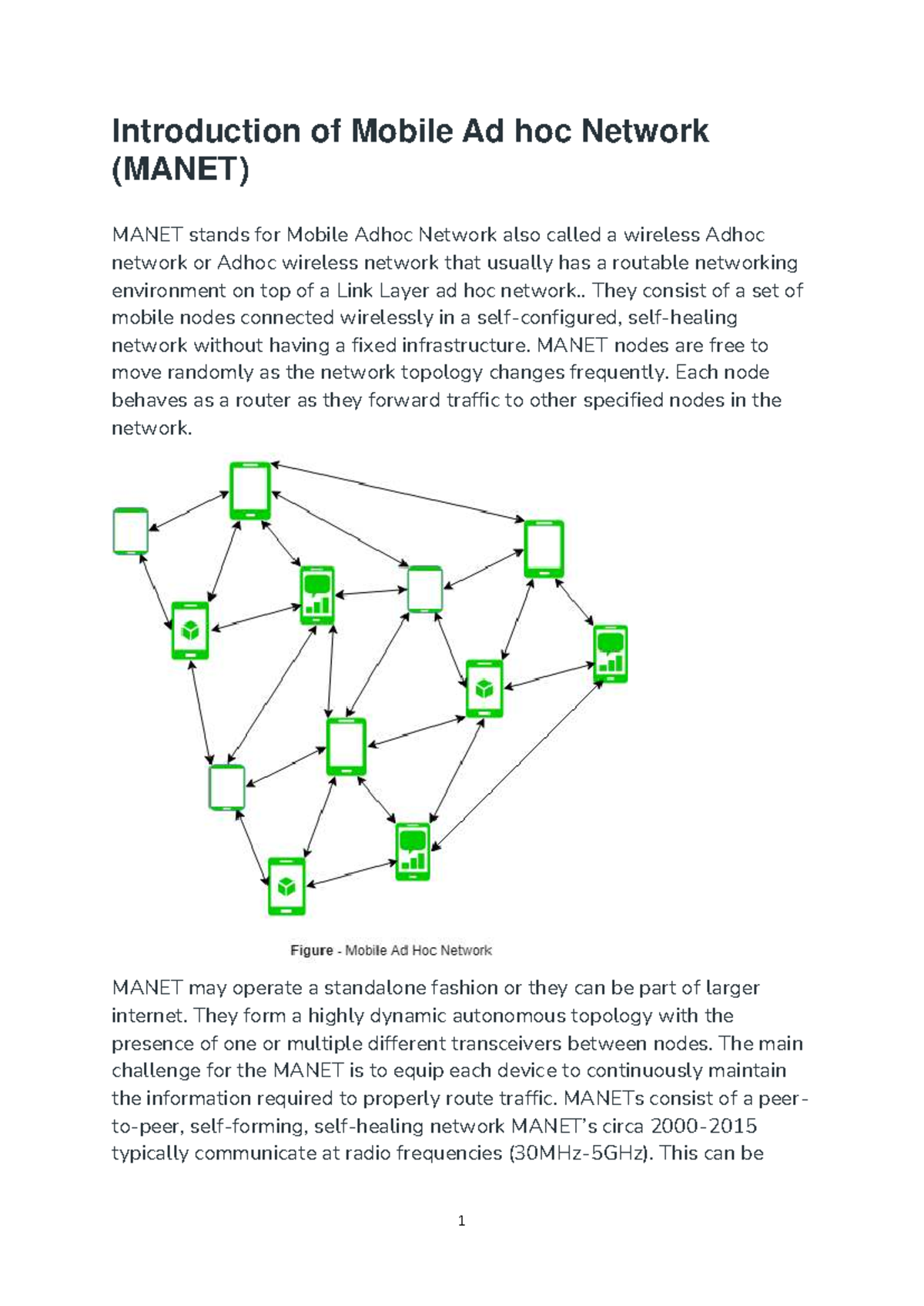
An ad hoc wireless network is a decentralized type of wireless network that does not rely on a pre-existing infrastructure, such as routers or access points in managed wireless networks. Instead, each node participates in routing by forwarding data for other nodes, so the determination of which nodes forward data is made dynamically on the basis of network connectivity and the routing algorithm in use.
The term "ad hoc" is derived from Latin, meaning "for this purpose," implying that these networks are often established spontaneously for a specific task or period. Unlike traditional infrastructure-based networks where a central hub manages all communications, ad hoc networks empower individual devices—ranging from smartphones and laptops to specialized sensors—to act as both hosts and routers. As of 2026, the evolution of these networks has become critical for the deployment of the Internet of Things (IoT), autonomous vehicular systems, and emergency response frameworks where traditional cellular or Wi-Fi infrastructure is unavailable or destroyed.
The Fundamental Definition of Ad Hoc Networking
At its core, an ad hoc wireless network is a self-configuring, multi-hop network. In a standard Wi-Fi setup, your device connects to a Wireless Access Point (WAP), which connects to a wired backbone. In an ad hoc environment, if Node A wants to send a message to Node C but is out of range, it uses Node B as a relay. This "multi-hop" capability is the hallmark of the technology.
These networks are typically classified under the umbrella of Mobile Ad Hoc Networks (MANETs), though the field has branched into specialized areas like Vehicular Ad Hoc Networks (VANETs) and Flying Ad Hoc Networks (FANETs). The defining philosophy is the absence of a central administration. This lack of a "master" node ensures that the network is resilient to single points of failure, but it introduces significant complexity in terms of routing, security, and power management.
Key Characteristics of Ad Hoc Wireless Networks
To understand why ad hoc networks are both powerful and difficult to manage, one must examine their distinct operational characteristics. These features separate them from the structured hierarchies of the public internet and corporate intranets.
1. Dynamic Network Topology
The most prominent characteristic of an ad hoc network is its ever-changing shape. Because nodes are often mobile—carried by people, vehicles, or drones—they frequently enter and leave the transmission range of other nodes. This results in a dynamic topology where links are established and broken continuously. Routing protocols must be robust enough to adapt to these changes in real-time without collapsing the entire communication session.
2. Infrastructure-less Operations
Ad hoc networks do not require specialized hardware like base stations or centralized controllers. The "intelligence" of the network is distributed across all participating nodes. This makes them ideal for rapid deployment in environments where installing cables or fixed towers is impossible, such as deep-sea exploration, space missions, or active combat zones.
3. Multi-hop Routing
Direct communication is only possible between nodes within each other's radio frequency (RF) range. To reach a destination beyond this range, data packets must travel through intermediate nodes. This requires sophisticated algorithms to determine the "best" path, which might be defined by the fewest hops, the highest signal strength, or the lowest battery consumption of the relaying nodes.
4. Autonomous Terminal Behavior
In an ad hoc network, every node is an autonomous entity. Each device must perform its own functions while simultaneously acting as a bridge for others. This dual role requires a high degree of cooperation. If nodes act "selfishly" to save their own battery life, the entire network's connectivity can degrade.
5. Energy and Resource Constraints
Since most nodes in an ad hoc network are mobile devices (smartphones, sensors, or drones), they typically rely on batteries. Energy conservation is a primary design constraint. Communication is the most energy-intensive task a node performs, so protocols are specifically designed to minimize overhead and prevent "hotspots" where a single node's battery is drained because it is positioned at a critical junction of many paths.
6. Limited and Variable Bandwidth
Wireless links are inherently more susceptible to interference, noise, and fading than wired connections. In an ad hoc setting, the effective throughput is often much lower than the theoretical maximum because multiple nodes compete for the same radio spectrum. Furthermore, as the number of hops increases, the available bandwidth for a specific end-to-end connection typically decreases due to the overhead of contention and retransmissions.
Specialized Types of Ad Hoc Networks
While the general principles remain the same, ad hoc networks have specialized into several distinct categories based on their application and movement patterns.
- Mobile Ad Hoc Networks (MANETs): The most common form, where nodes are mobile devices. They are used in tactical military communications and disaster recovery.
- Vehicular Ad Hoc Networks (VANETs): These enable communication between vehicles (V2V) and between vehicles and roadside units (V2I). They are essential for 2026-era autonomous driving safety features, providing real-time data on traffic accidents or road conditions.
- Wireless Sensor Networks (WSNs): These consist of small, often stationary sensors distributed over an area to monitor environmental conditions (temperature, pressure, vibration). They are characterized by extreme energy constraints and low data rates.
- Flying Ad Hoc Networks (FANETs): A subset of MANETs involving Unmanned Aerial Vehicles (UAVs). These networks must handle very high mobility and 3D spatial positioning.
- Smart Phone Ad Hoc Networks (SPANs): Utilizing existing Bluetooth and Wi-Fi hardware in commercial smartphones to create peer-to-peer networks without cellular service.
Routing Protocols in Ad Hoc Environments
Routing is the most significant technical challenge in ad hoc networking. Because the topology changes, a static routing table (like those used in home routers) is useless. Researchers have developed three primary categories of protocols to address this:
Proactive (Table-Driven) Protocols
Proactive protocols, such as Optimized Link State Routing (OLSR), attempt to maintain an up-to-date map of the entire network at all times. Nodes periodically exchange routing information so that when a packet needs to be sent, the path is already known.
- Advantage: Minimal delay in starting a communication.
- Disadvantage: High signaling overhead, which can drain batteries and consume bandwidth even when no data is being sent.
Reactive (On-Demand) Protocols
Reactive protocols, such as Ad hoc On-Demand Distance Vector (AODV) and Dynamic Source Routing (DSR), only search for a path when a node actually has data to send. They initiate a "Route Discovery" process by broadcasting a request.
- Advantage: Lower overhead because the network only works when necessary.
- Disadvantage: Significant "latency" or delay when a new connection is initiated, as the path must be found before the first data packet can move.
Hybrid Protocols
Hybrid protocols, like the Zone Routing Protocol (ZRP), attempt to combine the best of both worlds. They maintain proactive tables for nodes in the immediate vicinity (the "zone") while using reactive discovery for nodes further away.
Comparison: Ad Hoc vs. Infrastructure Networks
| Feature | Ad Hoc Network | Infrastructure Network |
|---|---|---|
| Central Entity | None (Decentralized) | Access Point / Base Station |
| Configuration | Self-configuring | Manual/Centralized setup |
| Cost | Low (no fixed hardware) | High (requires towers/cabling) |
| Deployment Speed | Instant/Spontaneous | Time-consuming |
| Scalability | Complex (performance drops with size) | High (can add more APs) |
| Reliability | No single point of failure | AP failure kills the cell |
| Topology | Highly Dynamic | Static or Semi-static |
Security Challenges in Ad Hoc Networks
The very nature of ad hoc networks—open, decentralized, and wireless—makes them inherently vulnerable to security threats. In 2026, as these networks handle more critical data for autonomous systems, security has become a paramount concern.
- Eavesdropping: Since signals are broadcast through the air, any node within range can potentially capture data packets.
- Black Hole Attacks: A malicious node can claim to have the shortest path to a destination. Once the traffic is routed through it, the node simply drops the packets, effectively "silencing" a part of the network.
- Selfishness (Gray Hole): Nodes may refuse to forward packets for others to save their own battery, leading to network fragmentation.
- Lack of Central Authority: There is no central server to verify the identity of a new node (like a RADIUS server in corporate Wi-Fi). This makes it difficult to implement traditional Certificate Authority (CA) based encryption.
- Wormhole Attacks: Two colluding malicious nodes can create a high-speed "tunnel" between them, making distant nodes appear closer than they are, thus disrupting routing logic.
To combat these, modern ad hoc networks utilize Trust-Based Models and lightweight cryptographic protocols designed for low-power devices. The IETF MANET Working Group continues to standardize these security extensions for global interoperability.
Practical Applications and Use Cases
The utility of ad hoc wireless networks spans several critical sectors where traditional connectivity fails.
Disaster Recovery and Emergency Services
In the aftermath of earthquakes, floods, or hurricanes, communication towers are often the first things to go offline. Search and rescue teams deploy MANETs to coordinate their efforts. Handheld radios and tablets automatically form a network, allowing team members to share GPS coordinates and health data even in "dead zones."
Tactical Military Operations
On the battlefield, soldiers cannot stop to build a cellular tower. Military ad hoc networks allow units to maintain situational awareness. Tanks, drones, and individual soldiers form a mesh that carries voice, video, and sensor data back to a mobile command center.
Smart Cities and IoT
In a smart city, thousands of sensors monitor air quality, traffic flow, and waste levels. It is often cost-prohibitive to wire all these sensors. Instead, they use a Wireless Sensor Network (WSN) to "hop" data from one sensor to the next until it reaches a gateway connected to the internet.
Underwater and Space Exploration
Underwater Acoustic Ad Hoc Networks (UWAANs) use sound waves instead of radio waves to allow autonomous underwater vehicles (AUVs) to coordinate. Similarly, Delay Tolerant Networks (DTNs)—a specialized form of ad hoc networking—are used in space to handle the extreme latencies and frequent disconnects inherent in interplanetary communication.
Frequently Asked Questions
What is the main difference between an ad hoc network and a mesh network?
While the terms are often used interchangeably, there is a technical distinction. An Ad Hoc Network is a broad category of decentralized networks where nodes are typically mobile and the network is formed spontaneously. A Wireless Mesh Network (WMN) is often more structured, with dedicated "Mesh Routers" that stay in fixed positions to provide a backbone for mobile "Mesh Clients." Mesh networks are usually more stable and intended for longer-term use than pure ad hoc networks.
Can I set up an ad hoc network on my smartphone?
Yes. Most modern smartphones (as of 2026) support peer-to-peer (P2P) protocols like Wi-Fi Direct or Bluetooth Mesh. Applications for offline messaging or file sharing utilize these ad hoc capabilities to connect two or more phones directly without using a cellular data plan or a Wi-Fi router.
Why aren't all networks ad hoc?
Ad hoc networks suffer from scalability and management issues. As the number of nodes increases, the "routing overhead" (the amount of data used just to keep the network organized) grows exponentially. For large-scale, high-speed internet access, centralized infrastructure like 5G or 6G base stations is far more efficient and easier to secure than a massive ad hoc mesh.
Is an ad hoc network the same as a hotspot?
Not exactly. When you turn on a "Mobile Hotspot" on your phone, your phone acts as a traditional Infrastructure Access Point. Other devices connect to your phone as if it were a router. In a true ad hoc network, there is no master/slave relationship; every device is an equal participant in managing the network.
How do ad hoc networks handle node failure?
Ad hoc networks are designed to be "self-healing." If a node that was acting as a relay moves out of range or runs out of battery, the surrounding nodes detect the broken link. The routing protocol then triggers a new search for an alternative path. This makes the network highly resilient, provided there is enough node density to offer multiple path options.
Final Recommendation
For organizations looking to implement ad hoc wireless solutions, the primary focus should be on Node Density and Protocol Selection. If the network is too sparse, "network partitioning" occurs, leaving nodes isolated. If the nodes are highly mobile, a Reactive Routing Protocol like AODV is generally preferred to reduce background traffic. For stationary sensor deployments, prioritize Energy-Efficient WSN protocols that allow nodes to sleep when not transmitting. Always ensure that a baseline of end-to-end encryption is implemented to mitigate the inherent security risks of decentralized, open-air communication.