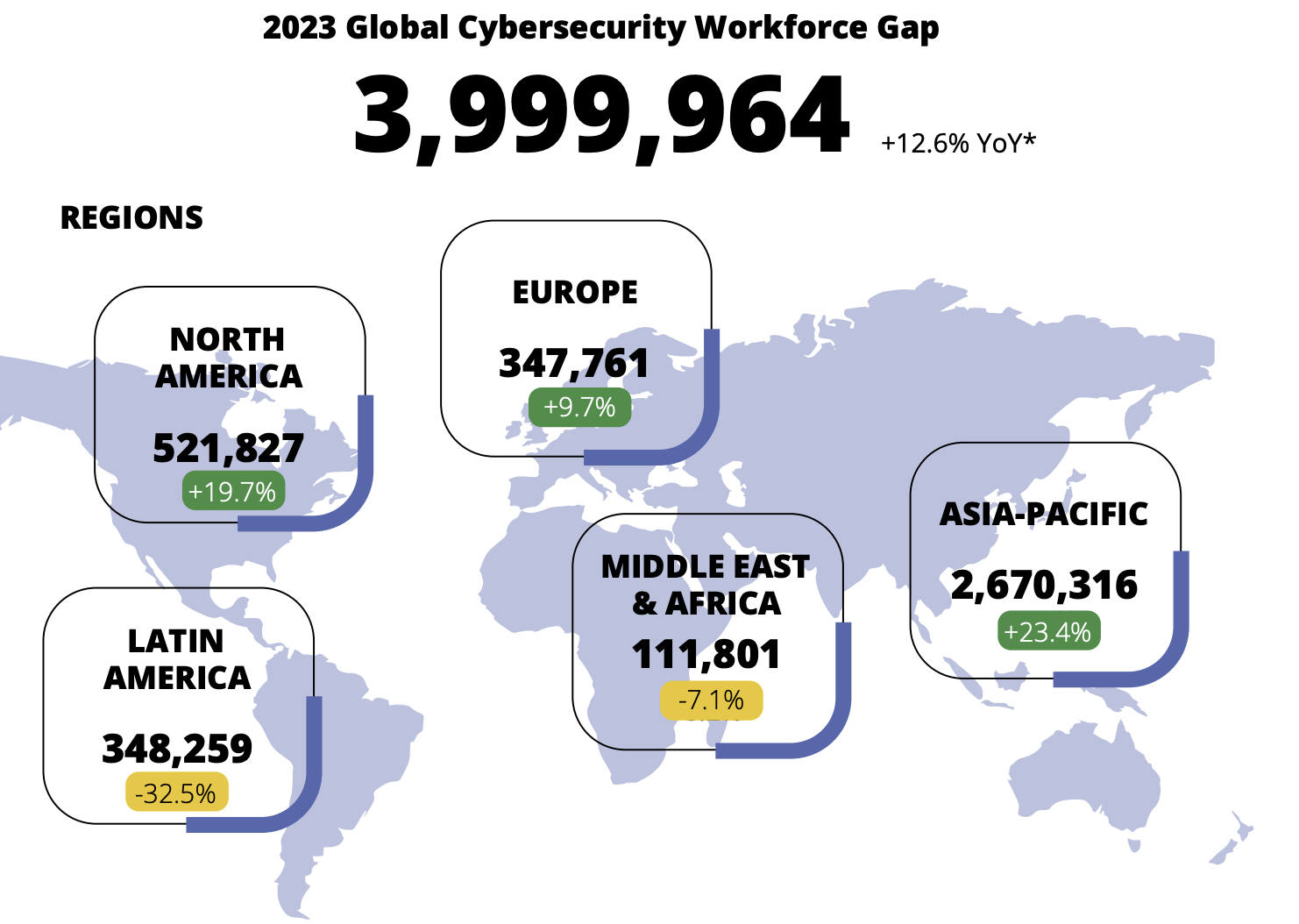
The 2023 ISC2 Cybersecurity Workforce Study revealed a record-high global workforce of 5.5 million professionals, yet the workforce gap simultaneously expanded to nearly 4 million. This disparity highlights a critical imbalance where demand for specialized security expertise continues to outpace the rate of professional entry and skill development.
The 2023 ISC2 Cybersecurity Workforce Study serves as a definitive benchmark for understanding the complexities of the global security profession. Conducted during a period of significant economic fluctuation, the study provides a granular look at why the "talent gap" persists despite a growing number of practitioners entering the field. For organizations and professionals operating in 2026, these findings remain foundational in explaining the structural shifts toward skills-based hiring, the integration of artificial intelligence (AI), and the prioritization of internal professional development.
The Global Workforce vs. The Expanding Gap
One of the most striking revelations of the 2023 study was the simultaneous growth of both the workforce and the talent shortage. The global cybersecurity workforce reached an estimated 5.5 million individuals, representing an 8.7% increase over 2022. This growth added nearly 440,000 new jobs to the global economy. However, the "Cybersecurity Workforce Gap"—the number of additional professionals organizations need to adequately secure their assets—surpassed 4 million.
This 12.6% increase in the gap suggests that while more people are entering the field, the complexity and volume of the threat landscape are accelerating even faster. Organizations are no longer just looking for "generalists"; they are seeking specialists in cloud security, incident response, and governance, risk, and compliance (GRC).
Understanding the Gap Dynamics
The gap is not merely a lack of bodies in seats. It is a nuanced deficiency characterized by three distinct factors:
- The Staffing Gap: A literal shortage of personnel to fill open requisitions.
- The Skills Gap: Existing staff who lack the specific technical or soft skills required to handle modern threats like sophisticated ransomware or AI-driven social engineering.
- The Experience Paradox: A trend where organizations demand 3–5 years of experience for "entry-level" roles, effectively bottlenecking the pipeline of new talent.
Economic Pressures and the "Efficiency" Mandate
The 2023 study was conducted against a backdrop of global economic uncertainty, characterized by high inflation and high-profile layoffs in the broader technology sector. While cybersecurity has historically been viewed as "recession-proof," the 2023 data showed that it was actually "recession-resilient" but not immune.
Approximately 47% of respondents reported that their organizations had experienced some form of cybersecurity-related layoffs, budget cuts, or hiring freezes. These economic constraints forced many teams to do more with less, leading to increased burnout. When security budgets are tightened, the first casualties are often professional development funds and "non-essential" hiring, which directly contributes to the widening skills gap.
The Impact of Layoffs and Budget Freezes
When organizations freeze hiring, the burden falls on the remaining staff. The ISC2 study noted that overworked teams are more prone to making configuration errors and overlooking alerts. Furthermore, the loss of institutional knowledge during layoffs can leave a "security debt" that takes years to repay. In 2026, many organizations are still remediating vulnerabilities that were ignored during the leaner budget cycles of the 2023–2024 period.
The Rise of Artificial Intelligence and Automation
The 2023 study was among the first to capture the industry's sentiment toward the explosion of Generative AI. While the technology was in its relative infancy in terms of enterprise deployment, the workforce already recognized it as a double-edged sword.
Threats vs. Opportunities:
- The Threat: 75% of professionals expressed concern that AI would be used by threat actors to automate attacks, create more convincing phishing campaigns, and develop polymorphic malware.
- The Opportunity: Conversely, professionals viewed AI as a potential solution to the workforce gap. By automating routine tasks like log analysis and basic Tier-1 SOC (Security Operations Center) duties, AI allows human analysts to focus on high-order problem solving and strategic threat hunting.
The study underscored that AI would not replace cybersecurity professionals but would instead change the nature of their work. The demand for "AI literacy" began its ascent here, becoming a mandatory skill set for practitioners by 2026.
Critical Skill Sets in Demand
To bridge the gap, the 2023 study identified several high-priority areas where the shortage was most acute. Organizations shifted their focus from general IT knowledge to specific, high-impact domains.
Cloud Security
As businesses completed their migrations to multi-cloud and hybrid environments, the need for cloud security experts became the top priority. This involves understanding the "shared responsibility model," securing containerized applications (Kubernetes/Docker), and managing Identity and Access Management (IAM) across diverse platforms like AWS, Azure, and Google Cloud.
Governance, Risk, and Compliance (GRC)
With the implementation of stricter data privacy laws (such as evolving GDPR standards and various US state-level privacy acts), GRC moved from a "back-office" function to a frontline necessity. Professionals who can translate technical risks into business impact are now among the most highly compensated in the industry.
Soft Skills: The Communication Bridge
The 2023 report highlighted that technical prowess alone is no longer sufficient. The ability to communicate risk to non-technical stakeholders—such as the Board of Directors or C-suite executives—was ranked as a top-tier requirement. Skills like problem-solving, strategic thinking, and emotional intelligence were cited as critical for effective incident response and organizational resilience.
Diversity, Equity, and Inclusion (DEI) as a Strategic Asset
The 2023 ISC2 study made a compelling case for DEI not just as a social imperative, but as a technical one. Organizations with diverse teams reported higher levels of innovation and better problem-solving capabilities.
However, the data also revealed that the cybersecurity workforce remained less diverse than the general population. Women and minority groups continued to be underrepresented, particularly in senior leadership roles. The study suggested that to close the 4 million-person gap, the industry must look beyond the traditional "computer science degree" demographic. This includes recruiting from community colleges, vocational programs, and "career switchers" from fields like law enforcement, military, and even teaching.
Comparison of Key Workforce Metrics (2022 vs. 2023)
The following table illustrates the shifting landscape as documented by ISC2, showing the growth of the profession alongside the persistent challenges.
| Metric | 2022 Data | 2023 Data | Percentage Change |
|---|---|---|---|
| Global Workforce Size | 4.66 Million | 5.5 Million | +18.0% (Estimated) |
| Global Workforce Gap | 3.4 Million | 4.0 Million | +17.6% |
| North America Gap | 410,000 | 520,000 | +26.8% |
| Asia-Pacific Gap | 2.16 Million | 2.67 Million | +23.6% |
| Top Skill in Demand | Cloud Security | Cloud Security | No Change |
| Reported Staff Shortage | 57% | 67% | +10.0% |
Note: Data derived from the ISC2 2022 and 2023 Cybersecurity Workforce Reports. Figures are rounded for clarity.
Addressing the Entry-Level Barrier
A recurring theme in the 2023 study was the difficulty for new entrants to find their first job. Despite the massive gap, many "entry-level" positions required certifications like the CISSP (Certified Information Systems Security Professional), which requires five years of experience.
To combat this, ISC2 promoted the Certified in Cybersecurity (CC) entry-level certification. The 2023 landscape saw a shift toward "skills-based hiring," where employers began to value demonstrable skills—proven through labs, CTFs (Capture the Flag competitions), and portfolios—over traditional degrees. In 2026, this trend has matured into a standard practice for many Fortune 500 companies.
FAQ
What is the "Cybersecurity Workforce Gap"?
The gap is the calculated difference between the number of available, qualified cybersecurity professionals and the total number of positions required by organizations to properly defend their digital infrastructure. It represents a systemic risk because unfilled roles lead to unmonitored systems and delayed patch management.
Did the 2023 ISC2 study suggest that AI will replace security jobs?
No. The study indicated that AI will act as a "force multiplier." While it may automate lower-level, repetitive tasks, it creates a new demand for professionals who can manage, audit, and secure AI systems. The consensus was that AI will augment human capabilities rather than replace the need for human judgment and ethics.
Why did the gap increase even though the workforce grew?
The increase was driven by several factors: the rapid digital transformation of small and medium enterprises, the increasing complexity of regulatory requirements, and the escalating volume of cyber threats. Essentially, the "attack surface" grew faster than the "defense force."
What are the most important certifications according to the 2023 trends?
While the CISSP remains the "gold standard" for mid-to-senior management, the study highlighted a growing interest in specialized certifications for cloud (e.g., CCSP), forensics, and entry-level validation (e.g., ISC2 CC). Employers are increasingly looking for a combination of vendor-neutral certifications and platform-specific training (like AWS or Azure security certs).
How can organizations reduce burnout among their security staff?
The 2023 report suggested that providing clear career paths, investing in automation to reduce "alert fatigue," and supporting professional development are key. Organizations that prioritize a healthy work-life balance and provide the necessary tools for the job have significantly higher retention rates.
Is a college degree still necessary for a career in cybersecurity?
The study found a gradual shift away from strict degree requirements. While a degree in Computer Science or Cybersecurity is still highly valued, more organizations are accepting relevant certifications, military experience, and proven technical proficiency through hands-on assessments.
Practical Recommendations for 2026
For professionals and hiring managers looking at the landscape from the perspective of 2026, the 2023 ISC2 study provides a roadmap for long-term resilience:
- For Job Seekers: Focus on "adjacent skills." If you are a developer, learn secure coding. If you are in IT ops, focus on cloud security. The 2023 data shows that specialized "T-shaped" professionals (deep expertise in one area, broad knowledge in others) are the most resilient to economic shifts.
- For Employers: Shift to a "build, don't just buy" talent strategy. Instead of competing for a limited pool of expensive senior talent, invest in upskilling your existing IT staff. Use apprenticeships and internal rotations to develop the specific competencies your organization needs.
- For Policy Makers: Support initiatives that lower the barrier to entry for underrepresented groups. The 4 million-person gap cannot be closed without tapping into the full potential of the global population.
The 2023 ISC2 Workforce Study was a clarion call for the industry to move beyond traditional hiring practices and embrace a more dynamic, inclusive, and AI-integrated approach to security. By understanding these shifting dynamics, the global community can better prepare for the threats of tomorrow.