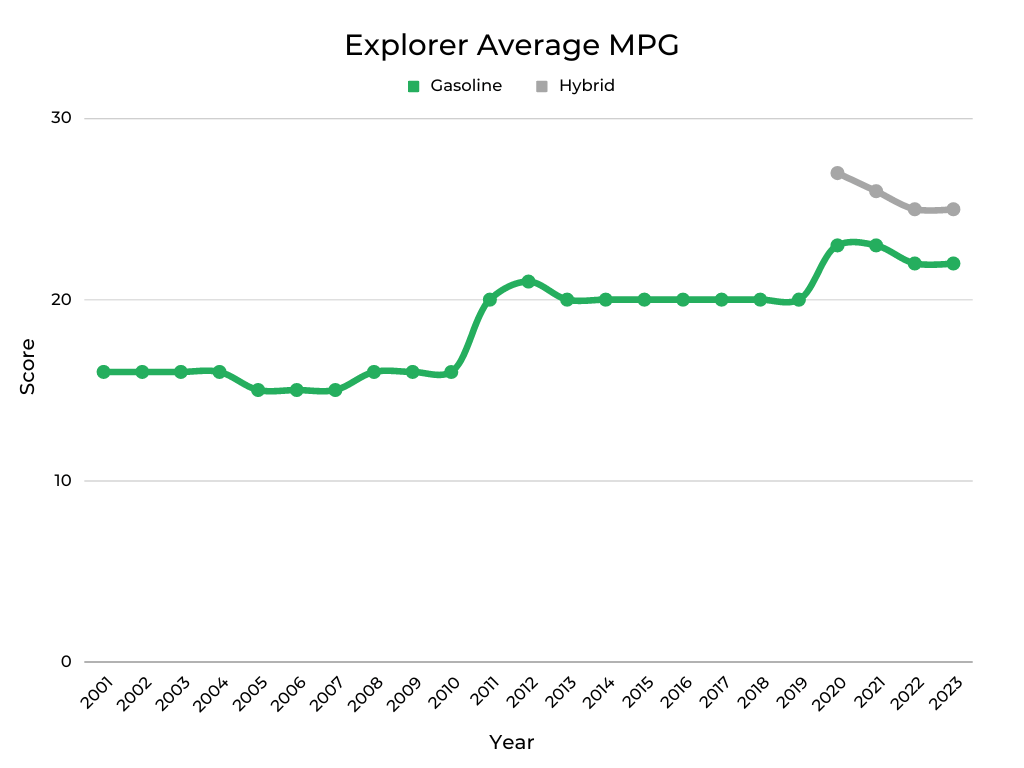
The 2019 Ford Explorer offers varying fuel efficiency ratings depending on the specific engine configuration and drivetrain selected. The base 3.5-liter V6 engine achieves an EPA-estimated 17 mpg city and 24 mpg highway in front-wheel-drive models, while the 2.3-liter EcoBoost four-cylinder engine provides a more efficient profile, reaching up to 19 mpg city and 27 mpg highway. Achieving these figures relies on driving habits, vehicle maintenance, and terrain.
Overview of the 2019 Ford Explorer Powertrain Options
The 2019 Ford Explorer was built during the final year of the fifth-generation platform, a period where Ford offered three distinct engine choices to balance power, towing capacity, and fuel economy. Understanding these options is the first step in determining what kind of fuel efficiency you can realistically expect from your specific vehicle.
The entry-level engine for the base, XLT, and Limited trims was the 2.3-liter EcoBoost I-4. This turbocharged engine was designed as the high-efficiency alternative, utilizing direct injection and turbocharging to produce respectable power while reducing fuel consumption compared to traditional naturally aspirated V6 units.
Mid-range and higher-tier models often featured the 3.5-liter Ti-VCT V6. This is a larger, naturally aspirated engine that prioritizes smooth power delivery and consistent torque. While it is a reliable workhorse, its fuel economy figures are lower than the EcoBoost option due to the displacement and the nature of its combustion cycle.
Finally, the Sport and Platinum trims were equipped with the 3.5-liter EcoBoost V6. This twin-turbocharged engine is the performance leader of the lineup. Because the focus here is on high-output power and towing capability, fuel efficiency is significantly impacted. Owners of these trims generally see the lowest miles-per-gallon figures in the 2019 Explorer family.
EPA-Estimated Fuel Economy Ratings
To establish a baseline, we look at the official Environmental Protection Agency (EPA) estimates for the 2019 model year. These figures are determined in laboratory settings and represent a standardized expectation of fuel usage under controlled conditions.
2.3-Liter EcoBoost I-4
This is generally considered the most "fuel-conscious" choice in the 2019 lineup.
- Front-Wheel Drive (FWD): 19 mpg city, 27 mpg highway, 22 mpg combined.
- Intelligent Four-Wheel Drive (4WD): 18 mpg city, 25 mpg highway, 21 mpg combined.
3.5-Liter Ti-VCT V6
The standard V6 offers a balanced approach for those who prefer naturally aspirated engines.
- Front-Wheel Drive (FWD): 17 mpg city, 24 mpg highway, 20 mpg combined.
- Intelligent Four-Wheel Drive (4WD): 16 mpg city, 22 mpg highway, 18 mpg combined.
3.5-Liter EcoBoost V6 (Twin-Turbo)
Reserved for the high-performance trims, this engine is strictly paired with 4WD.
- Intelligent Four-Wheel Drive (4WD): 16 mpg city, 22 mpg highway, 18 mpg combined.
Factors Influencing Real-World MPG
While the EPA figures serve as a useful benchmark, most drivers find that their real-world experience deviates from these numbers based on several external and internal factors. The 2019 Ford Explorer is a large, three-row SUV; its aerodynamics and curb weight are constant factors that demand significant energy to move.
Driving Habits and Aggression
The primary factor in fuel efficiency is the driver’s right foot. Rapid acceleration, especially in a vehicle of this size, forces the transmission to hold lower gears longer and consumes significantly more fuel. EcoBoost engines, in particular, are highly sensitive to throttle position. Because they use a turbocharger, aggressive acceleration forces the engine into "boost," where it consumes air and fuel at a rate comparable to a larger displacement engine. By accelerating gradually and maintaining steady speeds, drivers can often bring their real-world efficiency closer to or even slightly above the EPA estimates.
Tire Pressure and Maintenance
Tires are the only point of contact between the vehicle and the road. If the tires on your 2019 Explorer are under-inflated, rolling resistance increases dramatically. This forces the engine to work harder just to maintain speed, which decreases fuel efficiency. Regularly checking your tire pressure against the manufacturer’s specification (located on the sticker inside the driver’s side door jamb) is the easiest way to preserve your MPG. Furthermore, engine maintenance—such as ensuring your air filter is clean and your spark plugs are performing correctly—ensures that the combustion process remains efficient throughout the vehicle's lifespan.
Idle Time and Climate Control
The 2019 Ford Explorer is often used as a family hauler, which frequently involves idling in school pickup lines or waiting while passengers load up. Idling results in zero miles per gallon, which effectively drags down your overall average. Additionally, the use of the A/C compressor, particularly in hotter climates, places a constant parasitic load on the engine. While necessary for comfort, understanding that the A/C system requires mechanical energy from the engine to operate helps put your fuel consumption into context.
Comparison Table: 2019 Ford Explorer Fuel Efficiency
| Engine Type | Drivetrain | City MPG | Hwy MPG | Combined MPG |
|---|---|---|---|---|
| 2.3L EcoBoost I-4 | FWD | 19 | 27 | 22 |
| 2.3L EcoBoost I-4 | 4WD | 18 | 25 | 21 |
| 3.5L V6 Ti-VCT | FWD | 17 | 24 | 20 |
| 3.5L V6 Ti-VCT | 4WD | 16 | 22 | 18 |
| 3.5L EcoBoost V6 | 4WD | 16 | 22 | 18 |
The Impact of 4WD Systems
The "Intelligent 4WD" system in the 2019 Ford Explorer is designed to automatically manage torque distribution between the front and rear wheels. While this provides excellent traction in rain, snow, or light off-road conditions, it comes with a fuel economy penalty. The system adds weight to the vehicle through the addition of a transfer case and a rear differential, and it creates additional mechanical drag within the drivetrain.
If you live in a region that does not see regular snow or heavy rain, and you do not engage in towing on loose surfaces, the FWD configuration is objectively more efficient. The choice between FWD and 4WD should be dictated by your local climate and road conditions rather than fuel economy alone, but it is important to acknowledge that the convenience of 4WD carries a recurring cost at the fuel pump.
Strategies for Improving Fuel Economy
If you feel your 2019 Explorer is underperforming in terms of fuel efficiency, consider these practical steps:
- Reduce Cargo Weight: The Explorer is heavy. Removing unnecessary items—such as heavy sports gear, roof racks when not in use, or heavy cargo stored in the trunk—reduces the load on the engine. Every 100 pounds removed can result in a measurable, albeit small, increase in efficiency.
- Use Cruise Control: On highways, utilizing cruise control helps maintain a consistent speed. This eliminates the minor speed fluctuations that occur when humans accidentally press and release the accelerator, which helps keep the transmission in its most efficient gear.
- Plan Your Trips: Combining several short errands into one longer trip allows the engine to reach its optimal operating temperature. An engine is least efficient when cold; the fuel management system runs a "rich" mixture to warm up the catalytic converter, which consumes more fuel.
- Monitor Your Driving Feedback: Use the onboard trip computer to track your current fuel usage. Many Ford drivers find that being aware of their real-time consumption encourages more fuel-efficient driving patterns.
Common Misconceptions Regarding Explorer MPG
A common mistake owners make is comparing the 2019 Explorer’s fuel economy to modern, smaller, or hybrid vehicles. It is vital to remember that the 2019 Ford Explorer was designed during an era when large SUVs were prioritizing interior volume and towing capability. If you compare it to a modern hybrid SUV, the 2019 Explorer will inevitably look inefficient.
Another misconception involves the "EcoBoost" branding. Many users assume that because the engine is labeled "Eco," it will provide hybrid-like fuel economy. In practice, EcoBoost technology is about providing the power of a larger engine with the displacement of a smaller one. Under light loads, it is efficient; under heavy loads or spirited driving, it consumes fuel at a rate that is perfectly consistent with its power output.
FAQ: Addressing Your Fuel Economy Concerns
Q: Can I use regular unleaded fuel in my 2019 Ford Explorer? A: Yes, you can safely use 87-octane regular unleaded fuel in the 2019 Ford Explorer. However, Ford notes that for the EcoBoost engines, using higher-octane fuel (such as 91 or 93) may allow the engine to perform better under high-load conditions or extreme heat, as it helps prevent engine knock. You will not see a significant difference in daily fuel economy, but you might notice a slight improvement in throttle response.
Q: Why does my fuel economy drop significantly during the winter? A: Winter fuel economy drops for several reasons. Engines take longer to reach optimal operating temperatures, the air is denser (which increases aerodynamic drag), and winter-blend gasoline often contains additives that have slightly less energy content than summer blends. Additionally, if you are using 4WD or snow tires, those will further decrease your MPG.
Q: Is it normal for my 3.5L EcoBoost to get worse mileage than the EPA estimate? A: Yes, it is common. The EPA cycle has difficulty accounting for the behavior of turbocharged engines. If you frequently accelerate quickly, the twin-turbochargers pull a significant amount of air, necessitating more fuel. If you are doing short, city-based commutes with the 3.5L EcoBoost, you will likely see figures lower than the 16 mpg city rating.
Q: Does towing heavy trailers destroy my fuel economy? A: Absolutely. Towing creates both wind resistance and mechanical load. When towing, it is not uncommon for fuel economy to drop into the single digits or the low teens, depending on the weight of the trailer and the terrain. This is normal for a vehicle with the displacement and power output of the Explorer.
Q: Should I use fuel system cleaners to improve MPG? A: Using a high-quality fuel system cleaner (often containing PEA) can help clean carbon deposits from the intake valves and fuel injectors. While this is unlikely to provide a massive jump in MPG, keeping the fuel system clean is a good practice for engine longevity and can help maintain the fuel economy you had when the vehicle was newer.
Next Actions for Maintaining Efficiency
To ensure your 2019 Ford Explorer operates as efficiently as possible, start by performing a "baseline check." Check your current tire pressure, inspect your engine air filter, and ensure your oil level is correct. If you suspect an issue, perform a manual calculation of your next two or three tanks of gas—divide the miles driven by the gallons added at the pump—rather than relying solely on the vehicle's trip computer, as it can sometimes be calibrated incorrectly. If you notice a sudden, drastic drop in fuel economy, have a mechanic scan the vehicle for "pending" diagnostic trouble codes, as a failing oxygen sensor or a stuck thermostat can often negatively affect fuel economy without triggering a Check Engine Light.