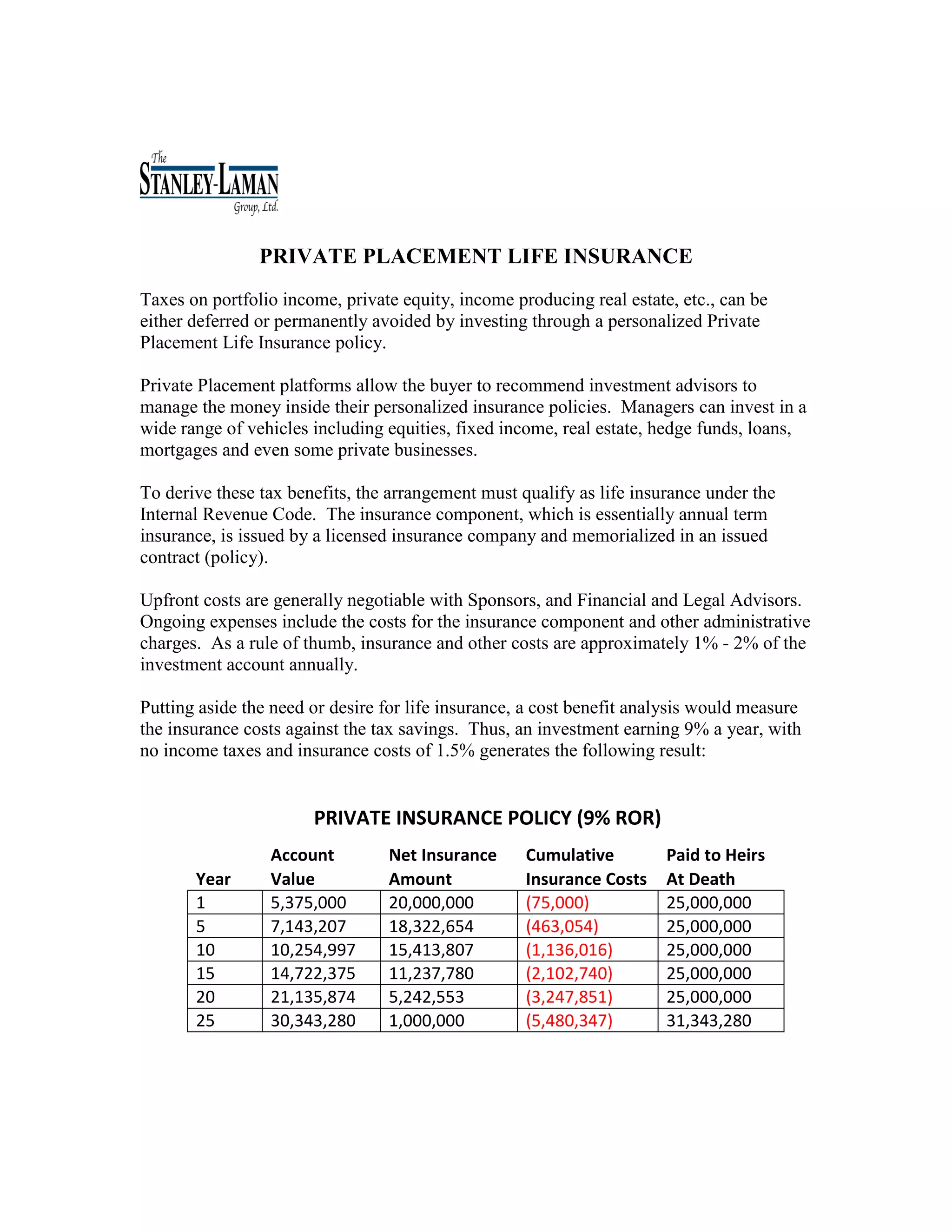
Private placement life insurance (PPLI) stands as an elite wealth-structuring instrument for high-net-worth and ultra-high-net-worth individuals, combining tax-advantaged insurance growth with sophisticated global asset management. Navigating this specialized landscape requires partnering with an experienced fiduciary and structuring specialist, making the 1291 group leading private placement life insurance choice a critical consideration for international families, family offices, and private wealth advisors seeking compliant, multi-jurisdictional financial solutions.
Understanding Private Placement Life Insurance (PPLI)
Private placement life insurance is essentially a variable universal life insurance policy sold on a private placement basis. It is classified as an insurance contract under applicable laws, but its core function acts as a tax-efficient wrapper for a broad array of investments, ranging from traditional public equities and fixed income to alternative assets like hedge funds, private equity, and real estate.
Unlike retail life insurance products, which feature high distribution costs, transparent and rigid investment menus, and standard mortality charges, PPLI is designed for institutional-scale investors. Policies are structured to minimize unnecessary insurance costs by purchasing the minimum amount of pure insurance required by local tax authorities—typically the U.S. Internal Revenue Service (IRS) under Internal Revenue Code Section 7702—to maintain its tax-favored status.
The primary advantages of utilizing a PPLI structure include:
- Tax-Free Growth: Inside the policy, investments grow free of capital gains, dividend, and income taxes.
- Tax-Free Distributions: Policyholders can access accumulated cash value through policy loans and withdrawals, typically structured to avoid triggering income tax events.
- Estate Planning Integration: Upon the insured's death, the policy death benefit passes to named beneficiaries free of income tax, and when combined with an Irrevocable Life Insurance Trust (ILIT), it can bypass estate taxes.
- Asset Protection: In many jurisdictions, assets held within a properly structured insurance policy enjoy robust legal protection from creditors and legal judgments.
Who is the 1291 Group and What is Their Market Position?
The 1291 Group is an international insurance broker, corporate finance advisory, and wealth-structuring firm specializing in life insurance solutions for high-net-worth individuals, family offices, and financial intermediaries. Operating across multiple global financial centers—including Switzerland, the United States, Liechtenstein, and various offshore hubs—the firm focuses on engineering bespoke life insurance and PPLI structures that bridge the gap between traditional wealth management and institutional insurance markets.
The firm's market positioning as a leading choice for private placement life insurance stems from several distinct operational capabilities:
- Independence: As an independent broker, the 1291 Group is not tied to a single insurance carrier. They source and negotiate policy terms across multiple global issuing companies, ensuring clients secure competitive pricing, robust financial ratings, and tailored contract conditions.
- Cross-Border Expertise: International families frequently face complex tax and regulatory hurdles when moving assets across borders. The 1291 Group specializes in multi-jurisdictional compliance, aligning PPLI policies with the tax laws of the policyholder's home country and the location of the underlying assets.
- Dedicated Dedicated Asset Management Integration: PPLI policies require specialized insurance-dedicated funds (IDFs) or separately managed accounts (SMAs) to comply with investor control doctrines. The 1291 Group assists in establishing and coordinating these compliant investment vehicles.
Core Criteria for Evaluating PPLI Providers and Platforms
Selecting the right partner and platform for private placement life insurance involves rigorous due diligence across financial stability, regulatory compliance, cost transparency, and asset flexibility. When financial advisors and family offices evaluate the market, they typically measure providers against several foundational benchmarks.
| Evaluation Dimension | Key Considerations & Requirements |
|---|---|
| Carrier Financial Rating | Assessment of the issuing insurance company's balance sheet strength, solvency margins, and credit ratings from agencies like A.M. Best, Moody's, or Standard & Poor's. |
| Jurisdictional Stability | Legal security of the issuing domicile (e.g., Switzerland, Liechtenstein, Delaware, South Dakota) and its adherence to international transparency rules. |
| Investment Flexibility | Availability of Insurance-Dedicated Funds (IDFs), Separately Managed Accounts (SMAs), and permission to hold alternative asset classes safely. |
| Fee Structure | Transparency regarding premium loads, administrative fees, mortality charges, and asset-management expenses over the life of the policy. |
| Regulatory Compliance | Adherence to local tax rules (such as investor control and diversification requirements under IRC Section 817(h) in the United States). |
Key Regulatory and Compliance Guardrails
Implementing a PPLI structure is not merely an investment decision; it is a strict legal and tax compliance exercise. Tax authorities worldwide enforce stringent rules to ensure that PPLI policies function as genuine insurance contracts rather than tax shelters disguised as insurance.
1. The Investor Control Doctrine
A foundational rule governing PPLI, particularly in the United States, is that the policyholder cannot possess legal or practical control over the underlying investments within the policy. If a policyholder directs specific trades or acts as the investment manager without an independent third-party advisor, the IRS can deem the policyholder the actual owner of the investments, stripping away the tax-deferred status and triggering immediate tax liabilities and penalties.
2. Diversification Requirements (IRC Section 817(h))
In the U.S. market, the investments underlying a PPLI policy must maintain adequate diversification. Specifically, no single investment can represent more than 55% of the value of the total assets in the segregated asset account, no two investments can represent more than 70%, no three can represent more than 80%, and no four can represent more than 90%. Failure to maintain this diversification quarterly results in the loss of tax-favored status.
3. The 702 / 7702A Corridor Tests
Policies must maintain a specific ratio between the cash value and the death benefit. If a policy accumulates too much cash relative to the death benefit, it transitions into a Modified Endowment Contract (MEC), permanently altering the tax treatment of withdrawals and loans.
Step-by-Step Implementation Process
Structuring a private placement life insurance policy through an advisory group like the 1291 Group follows a methodical, multi-stage wealth-planning lifecycle.
- Initial Discovery and Tax Mapping: Wealth advisors, tax attorneys, and the structuring team analyze the client's asset base, cross-border footprint, liquidity needs, and long-term estate planning objectives.
- Jurisdictional Selection: The team determines the optimal legal domicile for the issuing insurance carrier and the policy structure, balancing domestic protections with international tax treaties.
- Carrier and Product Selection: The advisory firm solicits proposals from top-tier international insurance carriers, comparing mortality charges, administrative fees, and asset custody terms.
- Asset and IDF Architecture: Selection or creation of Insurance-Dedicated Funds (IDFs) or Separately Managed Accounts (SMAs) to house the client’s preferred investment managers and asset classes without violating investor control rules.
- Underwriting and Issuance: The insured individual undergoes medical underwriting if necessary, and capital is transferred to fund the policy in compliance with anti-money laundering (AML) and know-your-customer (KYC) standards.
- Ongoing Administration and Compliance: Continuous monitoring of diversification rules, investment management reporting, and annual tax accounting.
Advantages and Limitations of PPLI Structures
While PPLI offers unrivaled wealth-planning utility for ultra-high-net-worth portfolios, it is not universally appropriate. Understanding its limitations is essential for informed decision-making.
Advantages
- Elimination of "Drag" from Taxes: By removing annual capital gains taxes on portfolio rebalancing, compounding returns accelerate significantly over long investment horizons.
- Simplified Reporting: In many jurisdictions, holding complex alternative investments inside an insurance wrapper streamlines annual tax reporting compared to owning foreign partnerships or direct offshore structures.
- Asset Consolidation: Families can consolidate diverse asset classes—private equity, hedge funds, cash, and equities—under a single administrative umbrella.
Limitations and Risks
- High Entry Thresholds: PPLI policies are restricted to accredited investors or qualified purchasers. Minimum initial premium commitments typically start at $1 million to $5 million, depending on the carrier and jurisdiction.
- Illiquidity in Early Years: Early surrender charges and administrative fees mean that withdrawing capital within the first few years can result in substantial financial loss. PPLI is strictly a long-term holding strategy.
- Regulatory Risk: Tax laws governing insurance wrappers are subject to legislative changes. Changes in tax codes could alter the benefits of existing policies, though grandfathering rules often apply.
Frequently Asked Questions
What is the typical minimum investment required to open a PPLI policy?
Most institutional insurance carriers require minimum initial premium contributions ranging from $1 million to $5 million. For multi-faceted structures involving multiple family members or trusts, aggregate commitments often scale higher.
Can I manage my own investments inside a PPLI policy?
No. To comply with tax regulations regarding investor control, the policyholder cannot direct the day-to-day investment decisions of the underlying accounts. Investments must be managed by independent, qualified asset managers utilizing designated Insurance-Dedicated Funds or compliant separately managed accounts.
How does the 1291 Group assist with cross-border wealth planning?
The 1291 Group provides cross-border structuring by aligning the life insurance contract with the legal and tax requirements of multiple jurisdictions. This ensures that families living, investing, or holding citizenship across different countries remain fully compliant while maximizing tax efficiency.
What happens to a PPLI policy when the insured passes away?
Upon the death of the insured, the insurance carrier pays the specified death benefit to the designated beneficiaries or trust structure. This payout is generally exempt from income tax, and when structured correctly via an irrevocable trust, it can also bypass estate taxes.
Are PPLI policies safe if the insurance carrier fails?
PPLI assets are typically held in segregated asset accounts or bankruptcy-remote structures separate from the general operating funds of the insurance carrier. This legal separation is designed to protect policyholders' cash values from the general creditors of the insurance company.
Conclusion and Recommended Next Actions
Private placement life insurance represents a powerful convergence of institutional asset management and advanced estate planning. For ultra-high-net-worth individuals and family offices navigating complex global portfolios, working with an experienced, independent specialist like the 1291 Group ensures that insurance solutions are engineered for strict compliance, cost efficiency, and long-term generational security.
To evaluate whether PPLI is appropriate for your portfolio, begin by consulting with your cross-border tax attorney and financial advisor to audit your current asset allocation, liquidity horizons, and jurisdictional exposure. Once preliminary eligibility is confirmed, engage with an independent structuring firm to model long-term tax drag comparisons and review tailored carrier proposals.