IRS Form 1040 Schedule C is the foundational tax document used by sole proprietors, independent contractors, single-member LLC owners, and statutory employees to report profit or loss from a business. When filing taxes for the 2025 tax year, understanding how to accurately calculate gross receipts, claim legitimate ordinary and necessary business expenses, and navigate self-employment tax obligations is essential for maintaining compliance and optimizing your overall tax liability.
Understanding IRS Form 1040 Schedule C and Its Purpose
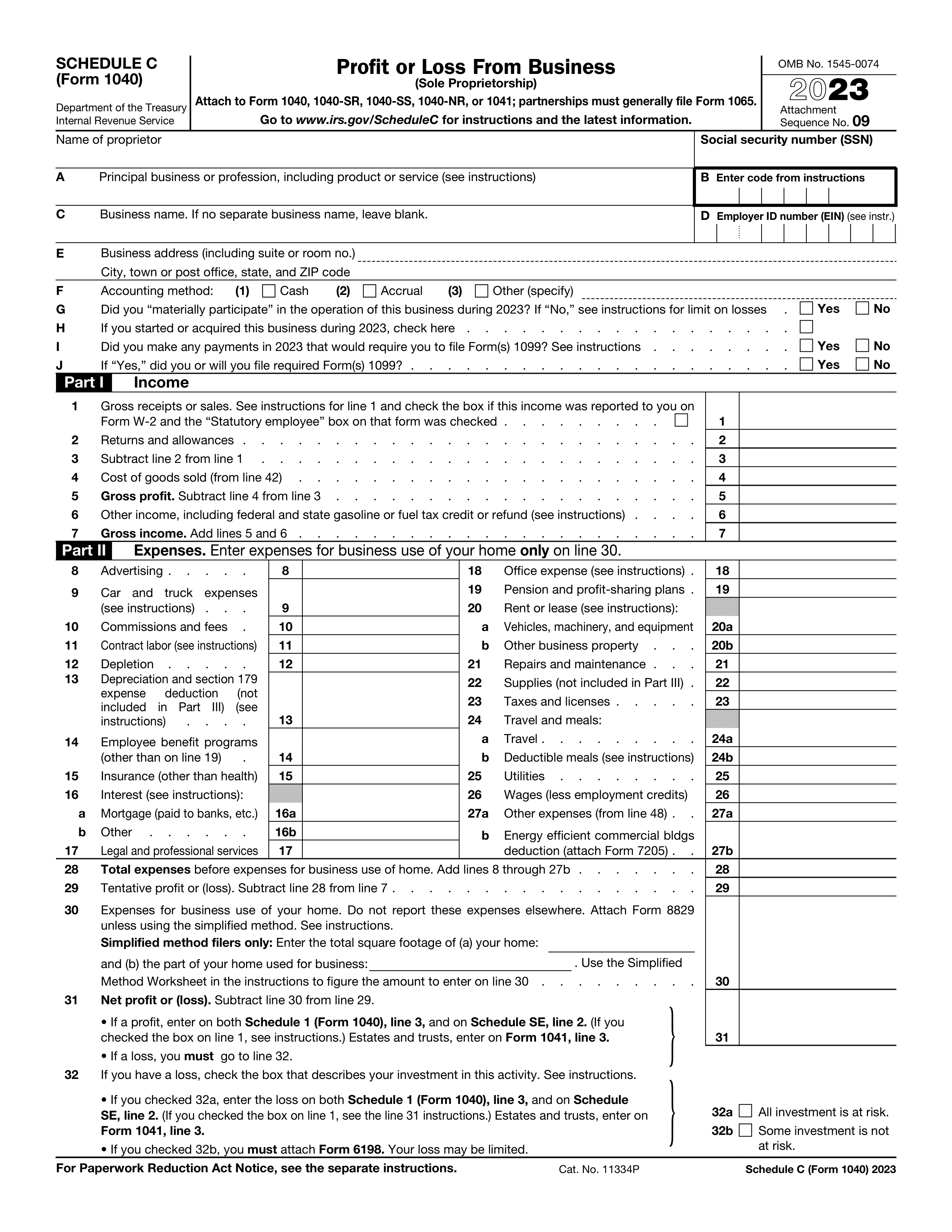
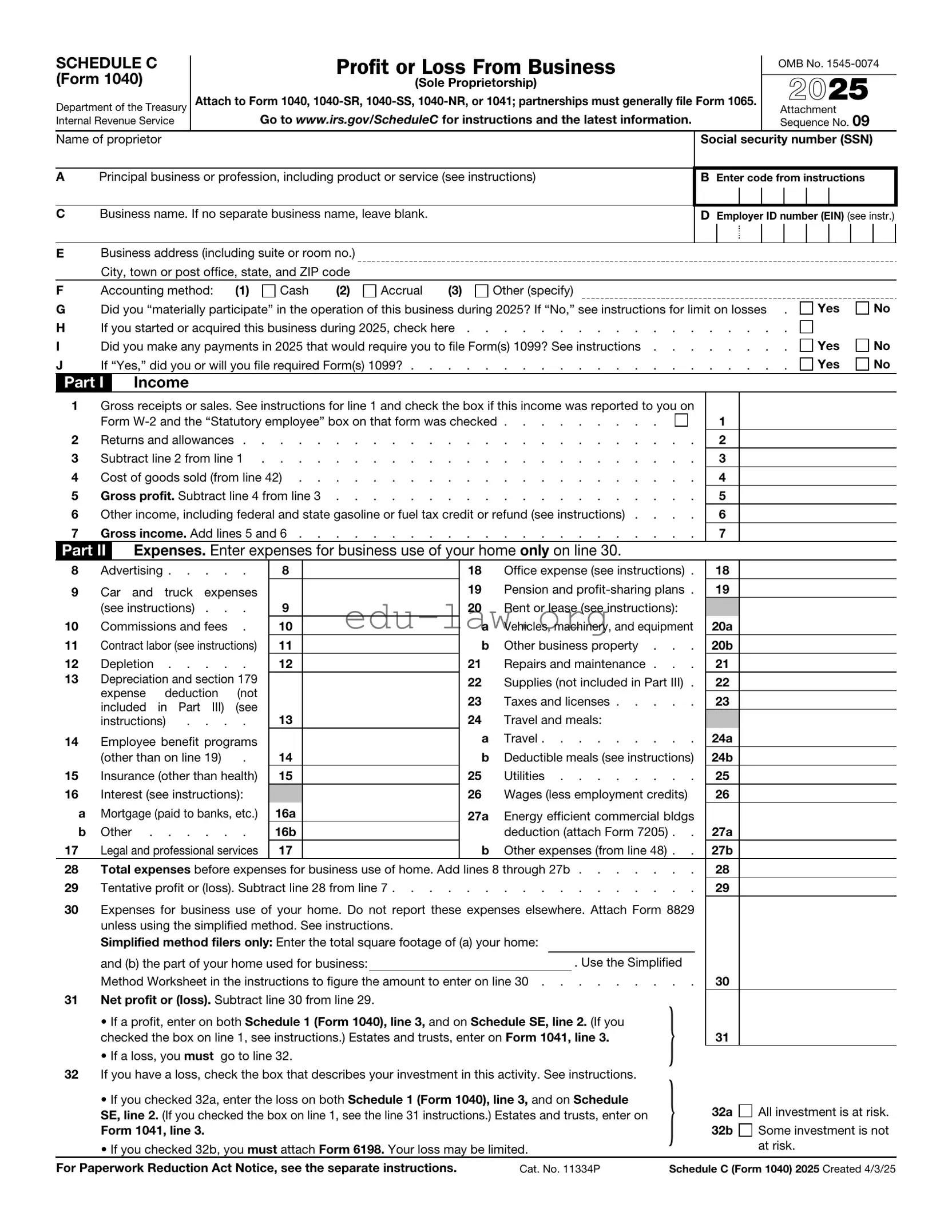
Form 1040 Schedule C, officially titled "Profit or Loss From Business (Sole Proprietorship)," serves as the primary mechanism through which the Internal Revenue Service captures the financial activity of unincorporated micro-enterprises and freelancers. If you operated a trade or business as a sole proprietor or performed services as an independent contractor during the 2025 tax year, you generally must file a separate Schedule C for each distinct business activity you engaged in.
The core function of this document is to bridge the gap between your raw business earnings and your personal income tax return. By subtracting allowable business deductions from your gross business income, Schedule C calculates your net profit or net loss. This net amount then flows directly onto your main Form 1040 (or Form 1040-SR) and serves as the baseline calculation for Schedule SE, which computes your self-employment tax covering Social Security and Medicare obligations.
Ambiguity often arises among taxpayers regarding who precisely must file this form. Single-member limited liability companies (LLCs) that have not elected to be treated as corporations default to disregarded entity status for tax purposes, meaning their financial activity must also be reported on Schedule C. Conversely, if you operate a partnership or a corporation, you will utilize different informational returns, such as Form 1065 or Form 1120, rather than a Schedule C.
Who Must File Schedule C for the 2025 Tax Year?
Determining your filing requirement depends heavily on your professional classification and revenue thresholds. Generally, you must file Schedule C if you meet any of the following criteria during the 2025 tax year:
- You operated a business as a sole proprietor or practiced a profession as a self-employed individual.
- You received income as an independent contractor, freelancer, or gig economy worker, typically documented on a Form 1099-NEC or Form 1099-K.
- You are a single-member LLC owner who has not elected corporate tax treatment.
- You received statutory employee income, meaning you are classified as an employee by statute for tax withholding purposes but report income and expenses on Schedule C.
It is a common misconception that you only need to file Schedule C if your net earnings exceed a certain dollar amount. However, the IRS requires you to file a Schedule C to report business income and expenses even if your business operated at a net loss. Furthermore, if you had net earnings from self-employment of $400 or more—even if that income was secondary to a full-time W-2 job—you are required to file Schedule SE and pay self-employment tax.
Structure and Anatomy of Schedule C
Schedule C is structured into five distinct parts, each capturing a specific dimension of your business operations. Navigating these sections methodically ensures that you capture every eligible deduction while providing the IRS with a transparent financial overview.
| Schedule C Section | Primary Purpose & Contents |
|---|---|
| Part I: Income | Reports gross receipts, sales, returns, and other miscellaneous business income. |
| Part II: Expenses | Details ordinary and necessary business deductions (advertising, rent, supplies, etc.). |
| Part III: Cost of Goods Sold | Calculates cost of goods sold for businesses dealing in physical inventory. |
| Part IV: Information on Vehicle | Captures mandatory data regarding business vehicle usage and mileage tracking. |
| Part V: Other Expenses | Lists miscellaneous business deductions that do not fit into standard categories in Part II. |
Part I: Income
In this section, you report your gross receipts or sales. This includes all income reported to you on Form 1099-NEC, Form 1099-K, cash, checks, and digital payments received from clients or customers. You must also account for any returns and allowances that reduced your gross revenue.
Part II: Expenses
Part II contains the bulk of standard business deductions. The IRS allows you to deduct "ordinary and necessary" expenses. An ordinary expense is one that is common and accepted in your field, while a necessary expense is one that is helpful and appropriate for your trade. Categories range from advertising and legal fees to office supplies and travel.
Part III: Cost of Goods Sold (COGS)
If your business manufactures products or purchases items for resale, you must complete Part III. This section calculates your beginning inventory, cost of purchases, labor costs, and ending inventory to determine your true Cost of Goods Sold, which is then subtracted from gross receipts in Part I to establish gross profit.
Parts IV and V: Vehicles and Other Expenses
Part IV requires specific documentation if you claim vehicle expenses, such as total miles driven, commuting miles, and business miles. Part V acts as a catch-all for ordinary business expenses that lack a dedicated line item in Part II, such as ongoing software subscriptions or professional association dues.
Step-by-Step Instructions for Completing Schedule C
Completing Schedule C requires precise record-keeping and a systematic approach to transferring financial data onto the IRS form. Before beginning, gather your profit and loss statements, bank statements, receipts, and any information returns like Form 1099-NEC or Form 1099-K issued to you for 2025.
Step 1: Complete General Business Identification Information
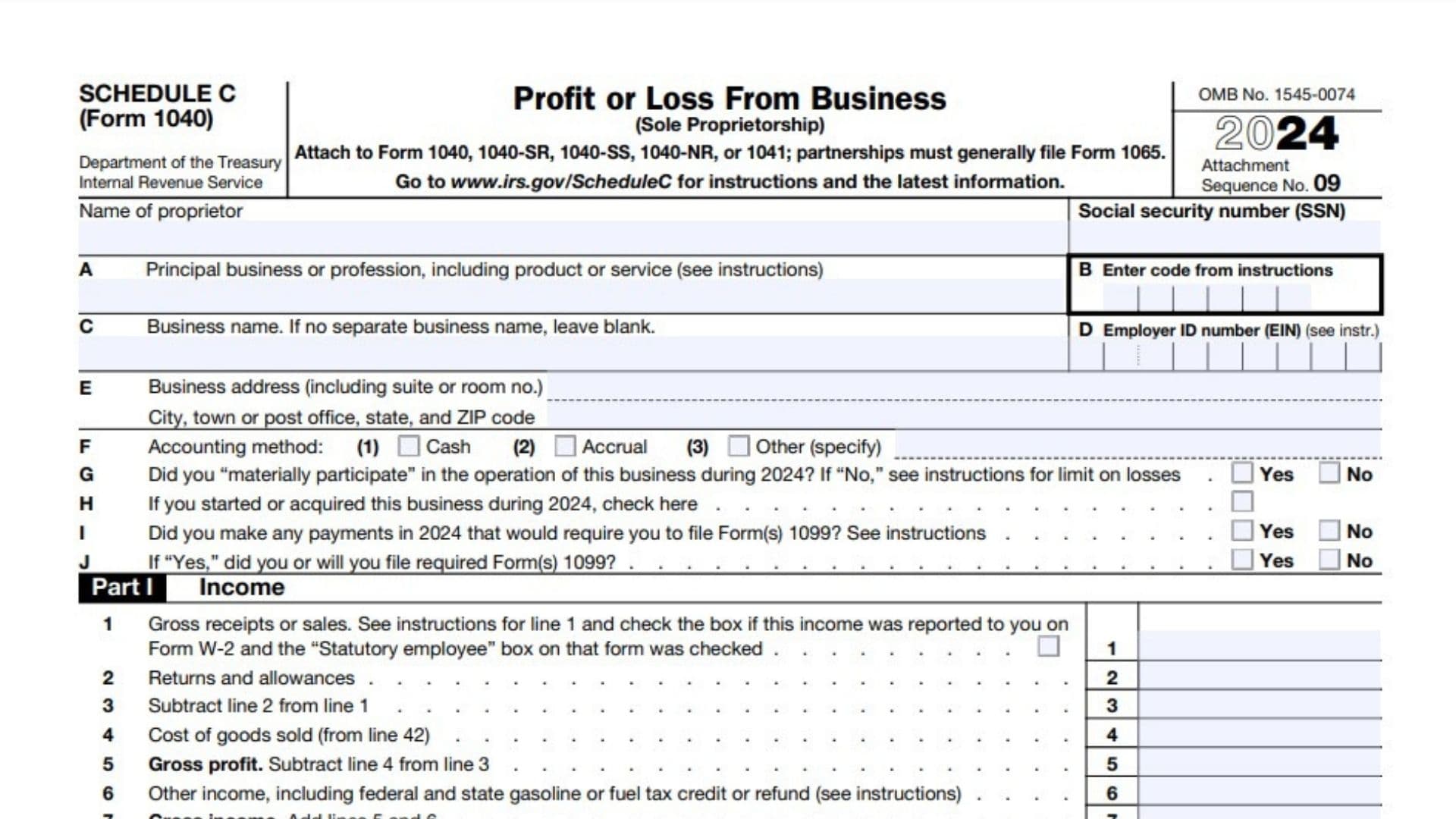
At the top of the form, enter your legal name and Social Security Number (SSN) or Employer Identification Number (EIN). In Line A, enter your principal business or profession, followed by the six-digit Principal Business Activity Code in Line B. These codes are listed in the official IRS instructions and categorize your industry. Provide your business name and address in Lines C and D, and indicate your accounting method on Line F (either cash or accrual). Finally, answer the yes/no questions regarding material participation and Form 1099 filing requirements in Lines G through J.
Step 2: Calculate Gross Income (Part I)
Enter your total gross receipts or sales on Line 1. If you manage inventory, calculate your gross profit by subtracting your Cost of Goods Sold (from Part III, Line 42) from your gross receipts. Add any other business income, such as tax-exempt interest or state tax refunds, on Line 6 to arrive at your total gross income on Line 7.
Step 3: Tabulate Business Deductions (Part II)
Go through your financial records and assign every business expenditure to the corresponding line item in Part II. Ensure that personal expenses are strictly excluded. Total these expenses on Line 28 to determine your total expenses before taking the deduction for your home office or business use of your home, if applicable.
Step 4: Calculate Net Profit or Loss
Subtract your total expenses (Line 28) from your total gross income (Line 7). If your income exceeds your expenses, enter the net profit on Line 31 and on Schedule 1 (Form 1040), line 3, as well as on Schedule SE. If your expenses exceed your income, you have a net loss; note that passive activity loss rules or at-risk limitations may restrict your ability to deduct that loss against other personal income.
Navigating Key Deductions and Common Tax Rules
Maximizing your legitimate deductions is one of the most effective ways to lower your tax burden as a self-employed individual. However, understanding the boundaries established by the IRS prevents costly audit adjustments and penalties.
Ordinary and Necessary Standards
To be deductible, an expense must be both ordinary and necessary for your specific trade. For example, buying specialized design software is ordinary and necessary for a freelance graphic designer, but it would not be deductible for a freelance landscaper whose primary tools are physical equipment.
Home Office Deduction
If you use a specific area of your home exclusively and regularly for conducting business, you may qualify for the home office deduction. You can calculate this using either the simplified method (multiplying square footage up to 300 square feet by $5 per square foot) or the regular method, which involves prorating actual household expenses such as mortgage interest, utilities, insurance, and depreciation based on the square footage of your office relative to the entire home.
Vehicle Expenses: Standard Mileage vs. Actual Expenses
When claiming vehicle expenses, you generally have two choices for the 2025 tax year:
- Standard Mileage Rate: Multiply your business miles driven by the IRS standard mileage rate for 2025. This rate is published annually by the IRS and covers gas, oil, repairs, and depreciation.
- Actual Expense Method: Deduct the actual costs of operating the vehicle, including gas, oil, insurance, repairs, lease payments, and depreciation, multiplied by the percentage of total miles driven for business purposes.
Maintain a contemporaneous mileage log recording the date, destination, business purpose, and miles driven for every trip to substantiate your deduction.
Common Mistakes to Avoid When Filing Schedule C
Filing Schedule C introduces several compliance pitfalls that frequently trigger IRS notices or audits. Being aware of these errors helps safeguard your filing status.
- Mixing Personal and Business Expenses: Using business accounts for personal purchases or failing to keep dedicated business bank accounts makes substantiation difficult and can invalidate deductions during an audit.
- Failing to Report All Income: The IRS cross-references Schedule C filings with third-party reporting documents like Form 1099-NEC and Form 1099-K. Omission of any reported income stream almost invariably triggers an automated underreporting notice.
- Incorrectly Calculating Cost of Goods Sold: Failing to account for ending inventory properly distorts your cost of goods sold, artificially inflating or deflating your net profit.
- Neglecting Self-Employment Tax Obligations: Forgetting that net profit on Schedule C subjects you to self-employment tax via Schedule SE leads to unexpected tax bills and underpayment penalties.
Disclaimer: Tax laws are complex and subject to change based on individual financial circumstances and legislative updates. Readers should consult with a certified public accountant (CPA) or qualified tax professional before filing their tax returns.
Frequently Asked Questions
What is the difference between Form 1099-NEC and Schedule C?
Form 1099-NEC is an informational document issued by clients to report payments made to you as an independent contractor during the year. Schedule C is the tax form you file with the IRS where you report all your business income—including 1099-NEC income, cash, and digital payments—alongside your business expenses to calculate net profit or loss.
Can I file Schedule C if I have a net loss?
Yes, you must file Schedule C even if your business operated at a net loss for the year. Reporting a loss allows you to track your business activities correctly, though your ability to use that loss to offset other income, such as W-2 wages, depends on passive activity loss and at-risk rules.
Do I need an EIN to file Schedule C?
An Employer Identification Number (EIN) is not strictly required for a sole proprietorship unless you have employees, operate a pension plan, or certain other specific conditions apply. Many sole proprietors simply use their personal Social Security Number (SSN) on Schedule C. However, obtaining an EIN is free and helps protect your SSN from exposure on client invoices and 1099 forms.
What records should I keep to support my Schedule C deductions?
You should retain all receipts, invoices, canceled checks, digital payment logs, bank statements, and contemporaneous mileage logs that substantiate every item of income and expense reported on Schedule C. The IRS generally recommends keeping tax records for at least three years from the date you filed your return.
How does Schedule C affect my Social Security benefits?
Net earnings from self-employment reported on Schedule C (and subsequently taxed through Schedule SE) contribute to your earnings record with the Social Security Administration. Paying self-employment tax ensures you build credits toward future Social Security retirement, disability, and survivor benefits.
Next Actions and Recommendations
To ensure a seamless tax filing experience for the 2025 tax year, compile all your income records, including every Form 1099-NEC and 1099-K you received. Reconcile your business bank accounts and categorize all expenditures into appropriate tax categories before sitting down to fill out Schedule C or entering data into tax preparation software. If your business financial situation has grown complex, involving inventory, substantial asset depreciation, or home office calculations, schedule a consultation with a licensed tax professional to review your documents prior to submission.