The world of ultra-luxury spirits offers a fascinating intersection of rare craftsmanship, historical prestige, and tangible liquid assets. When exploring the 10 most expensive spirits worth buying, collectors and investors look beyond mere bottle aesthetics to evaluate provenance, historical significance, liquid age, and secondary market liquidity. This guide examines ten of the most notable high-end spirits available in the global marketplace, analyzing what makes them exceptional and whether their substantial price tags translate to intrinsic drinking pleasure or long-term value retention.
Understanding the Ultra-Luxury Spirits Market
The market for high-end spirits has evolved from a niche hobby for passionate connoisseurs into a multi-billion-dollar alternative asset class. Unlike traditional investments such as equities or real estate, ultra-luxury spirits—spanning rare Scotch whisky, vintage Cognac, aged Tequila, and collectible Bourbons—combine finite physical consumption with historical scarcity.
When evaluating whether a high-priced spirit is truly "worth buying," experts generally divide motivations into two categories: liquid enjoyment for the palate and asset appreciation for the portfolio. While standard spirits depreciate the moment a seal is broken, ultra-aged or historically significant bottles often trade in specialized auction houses like Sotheby's, Christie's, and Bonhams. However, buyers must navigate authenticity concerns, storage requirements, insurance costs, and fluctuating market trends.
Criteria for Evaluating Expensive Spirits
Before committing capital to a five- or six-figure bottle, collectors evaluate several technical and historical parameters to determine value.
- Provenance and Traceability: The absolute paper trail of a bottle's ownership history significantly influences its market worth, particularly for pre-Prohibition or pre-war releases.
- Cask Strength and Natural Presentation: Bottles that are bottled at cask strength without chill-filtration or artificial coloring generally hold higher regard among serious collectors and purists.
- Packaging and Presentation: For ultra-luxury tiers, crystal decanters crafted by houses like Baccarat or Lalique, often embellished with precious metals or gemstones, add substantial baseline manufacturing costs to the product.
- Distillery Legacy and Closure: The operational status of the distillery matters immensely. "Silent distilleries"—those that have closed down permanently—instantly elevate the scarcity and desirability of their remaining liquid stocks.
The 10 Most Expensive Spirits Worth Buying
The following curated selection represents exceptional expressions across major spirit categories that command top-tier pricing due to age, historical weight, and exceptional liquid quality.
1. Macallan 1926 Valerio Adami Edition (Single Malt Scotch)
Distilled nearly a century ago, the Macallan 1926 is widely considered the holy grail of single malt Scotch whisky. Aged in sherry-seasoned oak casks for 60 years before being bottled in 1986, only 40 bottles were ever produced from Cask #263. Twelve of these featured labels designed by pop artist Valerio Adami. Bottles from this legendary cask have commanded upwards of $2 million at major international auctions. For the ultra-elite collector, its value lies in its status as an untouchable pinnacle of traditional Scottish distilling.
2. Isabella's Islay (Blended Scotch Whisky)
Priced at approximately $6.2 million, Isabella’s Islay represents the ultimate marriage of luxury craftsmanship and aged liquid. The spirit itself is a magnificent, ultra-rare cask-strength Islay single malt. However, the staggering valuation is largely driven by its decanter: crafted from fine English crystal, encrusted with over 8,500 diamonds, nearly 300 rubies, and finished in white gold. It serves as a striking example of jewelry meeting high-end mixology.
3. Cognac Grande Champagne Henri IV Dudognon Heritage
Valued at around $2 million, this Cognac is aged for an astonishing 100 years in barrels that have been seasoned with air-dried French oak. The liquid is exceptionally smooth, complex, and rich in history. The bottle is dipped in 24-karat yellow gold and sterling platinum, then decorated with 6,500 brilliant-cut diamonds by master jeweler Jose Fernandez. It is less a beverage and more a museum-grade artifact that happens to contain world-class eau-de-vie.
4. Diva Vodka
Diva Vodka sits at the intersection of extreme filtration and ultra-luxury presentation. Triple-distilled through traditional ice, the spirit is then filtered through Nordic birch charcoal and finally passed through a bed containing precious and semi-precious stones, including diamonds, sapphires, and emeralds. Retailing at over $1 million depending on the gemstone configuration of the central wand housed inside the bottle, it appeals to collectors seeking contemporary luxury statement pieces.
5. Mendis Coconut Brandy (Clément Special)
As the world’s first commercially available ultra-premium coconut brandy, this spirit is distilled from the sap of coconut flowers and aged in double-charred halmilla wood casks for a minimum of seven years. Individual special-edition bottles, hand-signed and numbered by the founder, have commanded prices up to $1 million, largely driven by novelty, exotic sourcing, and bespoke presentation cases.
6. Tequila Ley .925 Diamante
Crafted from 100% pure highland agave and aged for seven years in French oak barrels, this extra añejo Tequila is a masterclass in agave maturation. However, the $3.5 million price tag is anchored by its platinum and diamond-encrusted bottle design, created by artist Alejandro Gomez Oropeza. For high-net-worth tequila enthusiasts, it offers a rare glimpse into the absolute peak of Mexican distillation art.
7. Dalmore 62 Single Highland Malt Scotch
With only 12 bottles produced, the Dalmore 62 contains rare components dating back to 1868, 1876, 1926, and 1939, blended by master distiller Richard Paterson. Each bottle is named individually—such as "Matheson" or "The Jean Shand"—and comes in a bespoke wooden presentation case that requires custom hand-forged tools to open. Fetching hundreds of thousands of dollars at auction, it is prized for its profound aromatic complexity and historical lineage.
8. Penfolds 514 Sealed Ampoule (Australian Wine-Spirit Hybrid)
While technically a fortified wine rather than a distilled spirit, the Penfolds 514 Ampoule occupies a unique space in high-end collecting. Priced at $168,000, it contains a 2004 block 42 Cabernet Sauvignon from the historic Barossa Valley. The wine is housed inside a hand-blown glass ampoule suspended within a bespoke Jarrah wood cabinet crafted by renowned artisans. When a buyer wishes to open it, a senior winemaker travels to perform a specialized ceremonial opening using a custom tungsten-heated glass-cutting tool.
9. Patrón Gran Platinum Extra Añejo Tequila (Bespoke Crystal Edition)
While standard bottles of Patrón Gran Platinum are readily accessible to high-end bar patrons, custom jewel-encrusted editions produced for charity auctions and private collectors have reached six-figure valuations. The triple-distilled, oak-aged spirit delivers a velvety texture with prominent notes of citrus and fresh oak, proving that ultra-luxury agave can balance immaculate presentation with traditional craftsmanship.
10. Macallan M Decanter (6-Liter Imperiale)
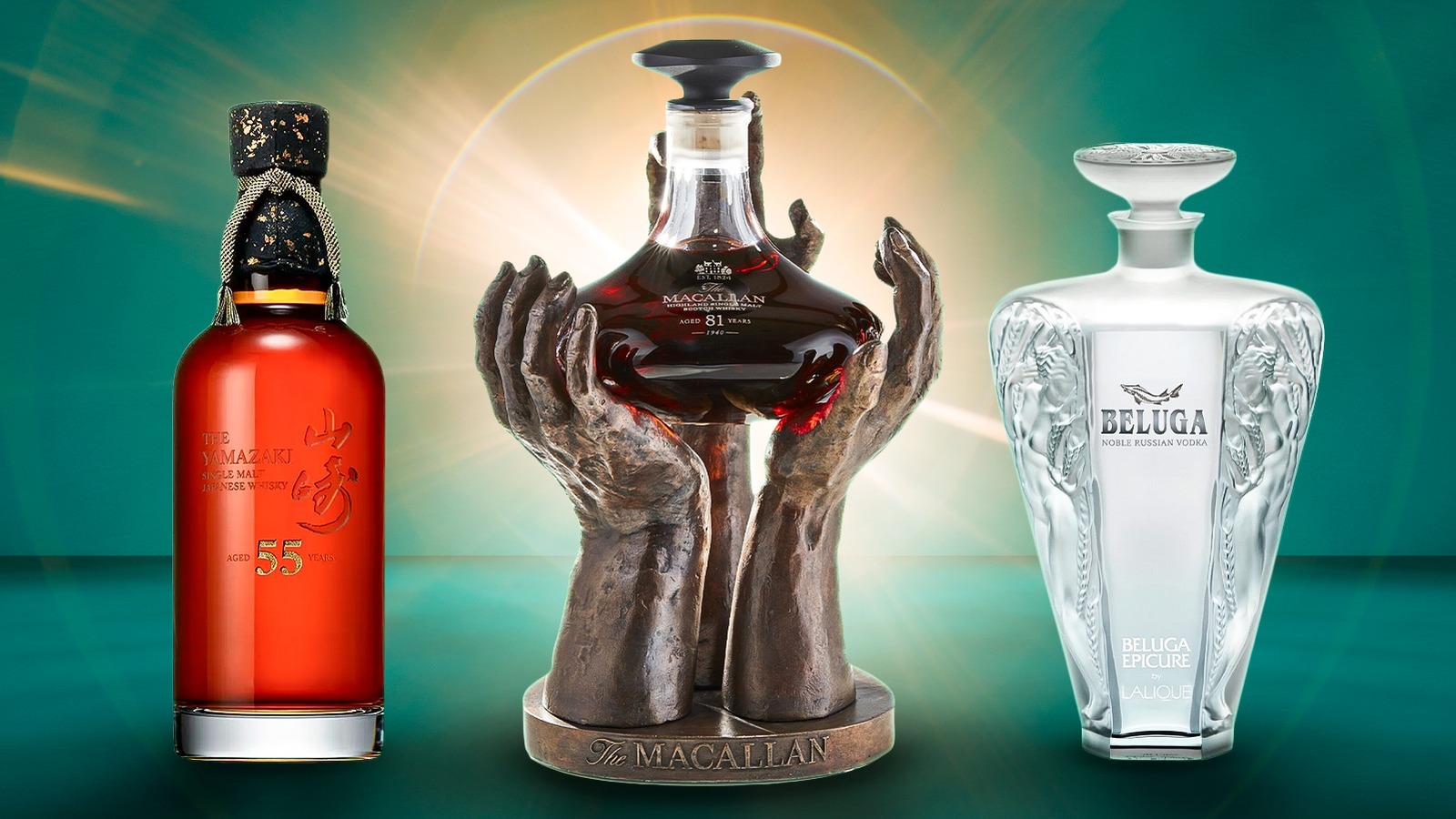
Standing as a monument to large-format luxury packaging, the Macallan M Imperiale is a six-liter crystal decanter crafted by Lalique, containing an exceptional blend of rare, heavily-sherried single malts aged in first-fill Spanish oak casks. At a Sotheby's charity auction, a single decanter fetched $628,000. It offers investors not only an immense volume of world-class liquid but also a masterpiece of decorative glassware.
Comparison of Ultra-Luxury Spirit Categories
To better understand where to allocate capital or palate interest, the following table compares key characteristics across major high-end spirit categories.
| Spirit Category | Typical Aging Range | Primary Value Driver | Liquidity / Auction Performance | Recommended For |
|---|---|---|---|---|
| Single Malt Scotch | 30 to 80+ Years | Distillery rarity, cask history, silent status | Extremely High | Serious investors & traditional purists |
| Cognac | 50 to 100+ Years | Length of oak contact, generational blending | Moderate to High | Collectors valuing historic French provenance |
| Tequila | 3 to 10+ Years | Gemstone packaging, long barrel aging | Emerging / Niche | Luxury lifestyle buyers & modern collectors |
| Vodka | Unaged / Infused | Precious stone filtration & custom crystal | Low | Novelty collectors & luxury display buyers |
Common Pitfalls and Investment Risks
Purchasing ultra-expensive spirits involves risks distinct from traditional financial instruments. Understanding these hazards protects collectors from substantial financial loss.
- Counterfeiting and Fraud: The high secondary market value of rare spirits has attracted sophisticated counterfeiters. Buyers must insist on unbroken seals, verified provenance documents, and expert authentication from reputable auction houses or independent spirit specialists.
- Storage and Environmental Control: Unlike wine, spirits do not improve significantly inside the bottle once removed from the wood cask, but improper storage can ruin them. Direct sunlight, extreme temperature fluctuations, and dry environments can degrade corks, leading to evaporation (the "angel's share") or liquid spoilage.
- Insurance and Custodianship: Standard homeowner insurance policies rarely cover six-figure luxury spirits adequately. Collectors must secure specialized fine-art and asset insurance riders, often requiring climate-controlled off-site vault storage.
- Liquidity Constraints: Selling a $50,000 bottle of Scotch is not instantaneous. Finding the right private buyer or waiting for a specialized seasonal auction requires patience and planning.
Frequently Asked Questions
Do expensive spirits taste better than mid-range bottles?
While ultra-luxury spirits undergo rigorous aging and selection processes that yield remarkable complexity, taste remains subjective. After a certain price threshold—typically around $200 to $500 for a standard bottle—price increases are driven primarily by rarity, historical significance, brand prestige, and expensive packaging (such as crystal or gold) rather than linear improvements in flavor profile.
How should rare spirits be stored for long-term preservation?
Rare spirits should be stored vertically rather than horizontally. Because high-proof alcohol is corrosive, prolonged contact with the cork will eventually degrade it, causing the cork to disintegrate into the liquid and ruin the flavor. Bottles should be kept in a dark, climate-controlled environment with stable temperatures between 55°F and 65°F (13°C to 18°C).
Can ultra-luxury spirits be treated as reliable financial investments?
Yes, but with caveats. Over the past two decades, rare Scotch whisky and vintage Cognac have outperformed many traditional asset classes on specialized indexes. However, returns depend entirely on brand selection, economic climate, and condition. Investors should treat spirits as a passion asset rather than a guaranteed wealth-generation tool.
What is a "silent distillery" and why does it matter?
A silent distillery refers to a whisky or spirits production facility that has been permanently closed, dismantled, or mothballed. Because no new liquid can ever be produced from these stills, the existing inventory in global circulation is finite. As bottles are consumed or lost over time, the remaining supply dwindles, driving up market value exponentially.
Is it safe to drink a spirit that is 100 years old?
Yes, provided the seal has remained intact and the cork has not failed. High-proof spirits (typically 40% ABV or higher) inhibit microbial growth. However, oxygen exposure over decades can lead to oxidation, altering the flavor profile. Some very old spirits may taste "over-oaked" or slightly muted compared to their youth, yet they remain entirely safe for consumption.
Conclusion and Next Actions
Investing in or acquiring any of the 10 most expensive spirits worth buying requires a balanced approach combining financial due diligence, aesthetic appreciation, and clear personal goals. Whether your objective is to anchor a private collection with a historic Macallan or to secure a stunning Baccarat-housed Cognac for celebratory milestones, verify all documentation, engage with reputable auction houses, and ensure proper insurance is in place before finalizing your acquisition.