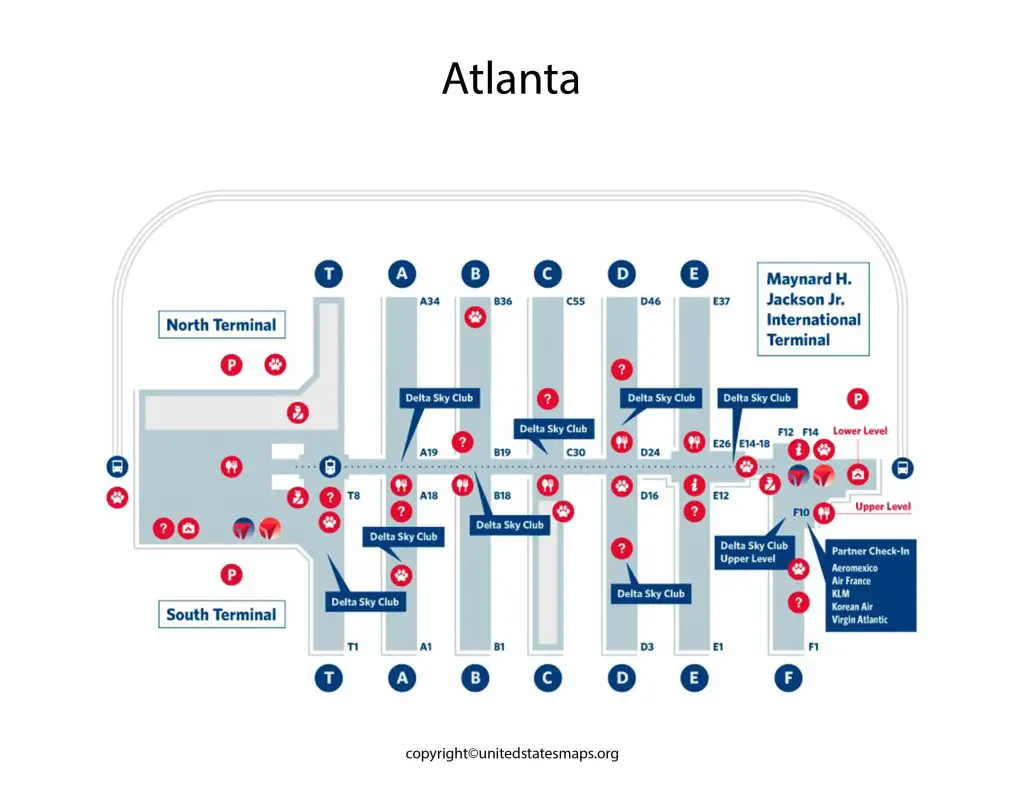
Hartsfield-Jackson Atlanta International Airport (ATL) remains the primary global benchmark for aviation volume, consistently ranking as the world’s busiest airport by passenger count. In 2026, understanding its traffic requires looking at the intersection of its 100-million-plus annual passengers, its status as a primary Delta Air Lines hub, and its complex ground transportation network.
The Global Standing of Hartsfield-Jackson (ATL) in 2026
As of 2026, Hartsfield-Jackson Atlanta International Airport continues to dominate global aviation rankings. The "traffic" at ATL is a multi-dimensional metric that includes total passenger throughput, aircraft movements (takeoffs and landings), and the sheer volume of cargo processed through its southern gates. For over two decades, with only a brief interruption during the peak of the global pandemic, ATL has held the title of the world's busiest airport.
The reason for this dominance is largely geographic. Atlanta is situated within a two-hour flight of 80% of the United States population. This makes it the ultimate "hub-and-spoke" focal point. While point-to-point carriers have grown in other markets, the efficiency of connecting through Atlanta remains unmatched for domestic and international transit. In the context of 2026, the airport has successfully integrated new biometric boarding processes and AI-driven baggage handling to manage a volume that exceeds 105 million passengers annually.
Comparing ATL to other major hubs like Dubai International (DXB) or Dallas/Fort Worth (DFW) reveals a distinct profile. While DXB often leads in international passenger numbers, ATL’s massive domestic feed keeps its total traffic numbers higher. The airport functions as a city within a city, employing over 60,000 people and generating an economic impact for the Southeast region that exceeds $60 billion.
Air Traffic Dynamics: The Hub-and-Spoke Powerhouse
To understand air traffic in Atlanta, one must look at the airfield's layout. ATL operates five parallel runways, all oriented east-to-west. This configuration is a masterpiece of civil engineering, allowing for simultaneous landings and departures even during heavy traffic periods. Unlike airports with intersecting runways that create "bottlenecks," Atlanta’s linear design maximizes the number of operations per hour.
The primary driver of air traffic is Delta Air Lines. Utilizing Atlanta as its primary global fortress hub, Delta accounts for approximately 75% to 80% of the airport's total passenger traffic. This creates "waves" of traffic throughout the day. A morning wave of arrivals from the West Coast and Europe is met by an afternoon surge of departures to smaller regional markets.
In 2026, the integration of NextGen satellite-based navigation has further tightened the spacing between arriving aircraft. This allows the Federal Aviation Administration (FAA) controllers at ATL to maintain high throughput even during the frequent afternoon thunderstorms characteristic of the Georgia climate. When analyzing traffic "in context," it is important to realize that a delay in Atlanta doesn't just affect Georgia; it creates a "butterfly effect" that can ground flights in New York, Los Angeles, and London due to the sheer number of connecting airframes.
Terminal Traffic: Managing the Human Flow
Once passengers deplane, the focus shifts from air traffic to terminal traffic. ATL’s terminal complex is divided into the Domestic Terminal (North and South) and the Maynard H. Jackson Jr. International Terminal. Between them lie seven concourses (T, A, B, C, D, E, and F), connected by the underground "Plane Train" and a pedestrian walkway.
Managing the flow of 300,000 people a day requires sophisticated logistics. The Plane Train is one of the busiest automated people mover (APM) systems in the world, running on sub-two-minute headways during peak hours. In 2026, recent upgrades to the Plane Train’s tunnel extension have improved the turnaround time at the domestic end, reducing platform crowding which was a significant pain point in previous years.
Security checkpoint traffic remains a primary concern for travelers. The airport utilizes three main checkpoints in the domestic terminal: Main, North, and Lower Level. The context of "traffic" here involves the balance between TSA PreCheck, CLEAR, and standard lanes. Data shows that the North Checkpoint often handles the bulk of international travelers and those using specialized screening, while the South Checkpoint is heavily utilized by Delta’s premium medallions and SkyPriority flyers.
Ground Transportation and Perimeter Access
The "traffic" context extends beyond the runways to the interstate highways surrounding the airport. Located at the intersection of I-85, I-75, and I-285, the airport is a magnet for vehicular congestion. The "Airport Loop" is notoriously difficult to navigate during Atlanta’s rush hours (typically 7:00 AM – 9:30 AM and 3:30 PM – 7:00 PM).
In 2026, the shift toward electric vehicles (EVs) and autonomous ride-share fleets has necessitated changes in the curb-side layout. The ride-share pickup zones, located at the Economy North and South lots, require a short walk or shuttle ride from the terminal, a move designed to reduce the "gridlock" of thousands of Uber and Lyft vehicles attempting to reach the front curb simultaneously.
For those looking to bypass vehicular traffic, the Metropolitan Atlanta Rapid Transit Authority (MARTA) provides a direct rail link into the domestic terminal. The MARTA station is located at the end of the western concourse, offering a 20-minute transit to Downtown Atlanta. In the context of 2026 urban planning, this rail link is the most reliable way to predict arrival times, as it is immune to the unpredictable accidents on the I-85 corridor.
Comparative Traffic Metrics: Global Hubs in 2026
To understand ATL's scale, it is helpful to view its operational statistics alongside other major global entities. The following table provides a snapshot of how Atlanta compares to other high-traffic hubs in 2026.
| Metric | Hartsfield-Jackson (ATL) | Dallas/Fort Worth (DFW) | Denver (DEN) | London Heathrow (LHR) |
|---|---|---|---|---|
| Annual Passengers | ~105 Million | ~85 Million | ~82 Million | ~80 Million |
| Primary Function | Global Hub/Connection | Domestic/Regional Hub | Domestic/Connecting | International Gateway |
| Number of Runways | 5 (Parallel) | 7 (Diverse) | 6 (Diverse) | 2 (Parallel) |
| Peak Hourly Ops | ~90-100 Arrivals | ~80-90 Arrivals | ~75-85 Arrivals | ~45 Arrivals |
| MARTA/Rail Link | Direct (Terminal) | Direct (TEXRail/DART) | Direct (A-Line) | Direct (Piccadilly/Liz) |
Note: Data reflects typical 2026 operational capacity and ACI (Airports Council International) projections.
Infrastructure Projects Impacting Traffic Flow
A major component of "traffic in context" is the ongoing construction as part of the "ATLNext" modernization program. By 2026, several key projects have altered how people move through the airport:
- Concourse D Widening: This multi-year project has addressed one of the narrowest and most congested concourses in the system. By widening the concourse from 60 feet to nearly 100 feet, the airport has increased "dwell space," reducing the feeling of human "gridlock" during peak connection windows.
- Cargo Expansion: To the south of the runways, new cargo facilities have increased the volume of heavy-duty truck traffic. This is segregated from passenger traffic but impacts the surrounding surface streets, particularly near Loop Road.
- The Sixth Runway Discussion: While still in the planning and environmental review phases in 2026, the discussion surrounding a sixth runway highlights the airport's struggle with its own success. The current five-runway system is nearing peak theoretical capacity.
- Terminal Canopy Maintenance: The massive illuminated canopies over the North and South departures have undergone significant structural maintenance in 2026, occasionally causing temporary lane closures for passenger drop-offs.
Strategic Guidance for Navigating Atlanta Traffic
For the individual traveler, "traffic" is not a statistic; it is a hurdle. To navigate Hartsfield-Jackson efficiently in 2026, one must use a layered approach to timing and technology.
First, the use of the official ATL airport website or mobile app is essential for real-time security wait times. These times can fluctuate by 30 minutes in a matter of moments. Second, travelers should consider the "International Terminal Bypass." If you are not checking a bag and have your boarding pass, you can be dropped off at the Maynard H. Jackson Jr. International Terminal even for a domestic flight. The security lines there are often significantly shorter, and you can take the Plane Train "backwards" to the domestic concourses (T, A, B, C, D).
Third, parking traffic has become more complex. The "South Economy" and "North Economy" lots often reach capacity by Tuesday mornings due to business traveler volume. Utilizing off-site parking with shuttle services or reserving a spot in the ATL West Parking deck (connected via the ATL SkyTrain) is now the standard recommendation for local travelers.
Environmental and Noise Context
Traffic isn't just about movement; it’s about impact. The environmental context of Atlanta’s traffic includes its carbon footprint and noise pollution. In 2026, the airport has implemented a rigorous "Green Gates" program, encouraging airlines to use electric Ground Support Equipment (eGSE).
The noise contours for the surrounding communities of College Park, East Point, and Hapeville are strictly monitored. The "traffic" of departures is managed through specific headings that attempt to minimize the decibel impact on these residential areas. This occasionally limits the "flow" of departures during late-night hours, as the airport adheres to noise abatement procedures that prevent certain runways from being used for high-thrust takeoffs after midnight.
Frequently Asked Questions
Why is Atlanta the busiest airport if it isn't the biggest city?
Atlanta’s status is due to its role as a "connecting hub" rather than just a "destination airport." Because of its geography and the dominance of Delta Air Lines, a vast percentage of its traffic consists of passengers who never leave the airport, but rather switch planes to reach their final destination. This creates a volume that far exceeds the local population's travel needs.
How early should I arrive for a flight at ATL in 2026?
The standard recommendation is 2.5 hours for domestic flights and 3.5 hours for international flights. However, during "peak traffic" periods—such as Monday mornings or Thursday afternoons—adding an extra 30 minutes is advisable to account for potential gridlock on I-85 or surges at the TSA checkpoints.
Does the "Plane Train" run 24/7?
The Plane Train operates whenever there is scheduled flight activity, typically pausing for only a few hours in the very early morning (around 2:00 AM to 4:00 AM) for maintenance. During these hours, a shuttle bus or the pedestrian walkway (located one level below the train) serves as the primary connection between concourses.
Is it faster to use MARTA or ride-share to reach the airport?
This depends entirely on the time of day. During rush hour (7:30 AM or 5:30 PM), MARTA is almost always faster because it bypasses the highway congestion. During "off-peak" hours, a ride-share may be faster for those coming from the suburbs, though the walk from the ride-share drop-off zone must be factored into the total time.
Can I change concourses without going through security again?
Yes. All seven concourses (T, A, B, C, D, E, and F) are connected "airside." Once you clear security at any checkpoint, you can move freely between all concourses using the Plane Train or the walking tunnels without exiting the secure zone.
Final Recommendation
When dealing with Atlanta airport traffic in 2026, the most effective strategy is diversification of access. Do not rely solely on the main domestic terminal entrance. Check the international terminal wait times, consider using MARTA to bypass the I-85/I-75 merge, and always verify your gate via the airline app before arriving, as ATL is prone to gate changes due to high aircraft turnaround volume. For the most seamless experience, aim to arrive at the airport "counter-cyclical" to the major hub waves—typically mid-morning or late evening.