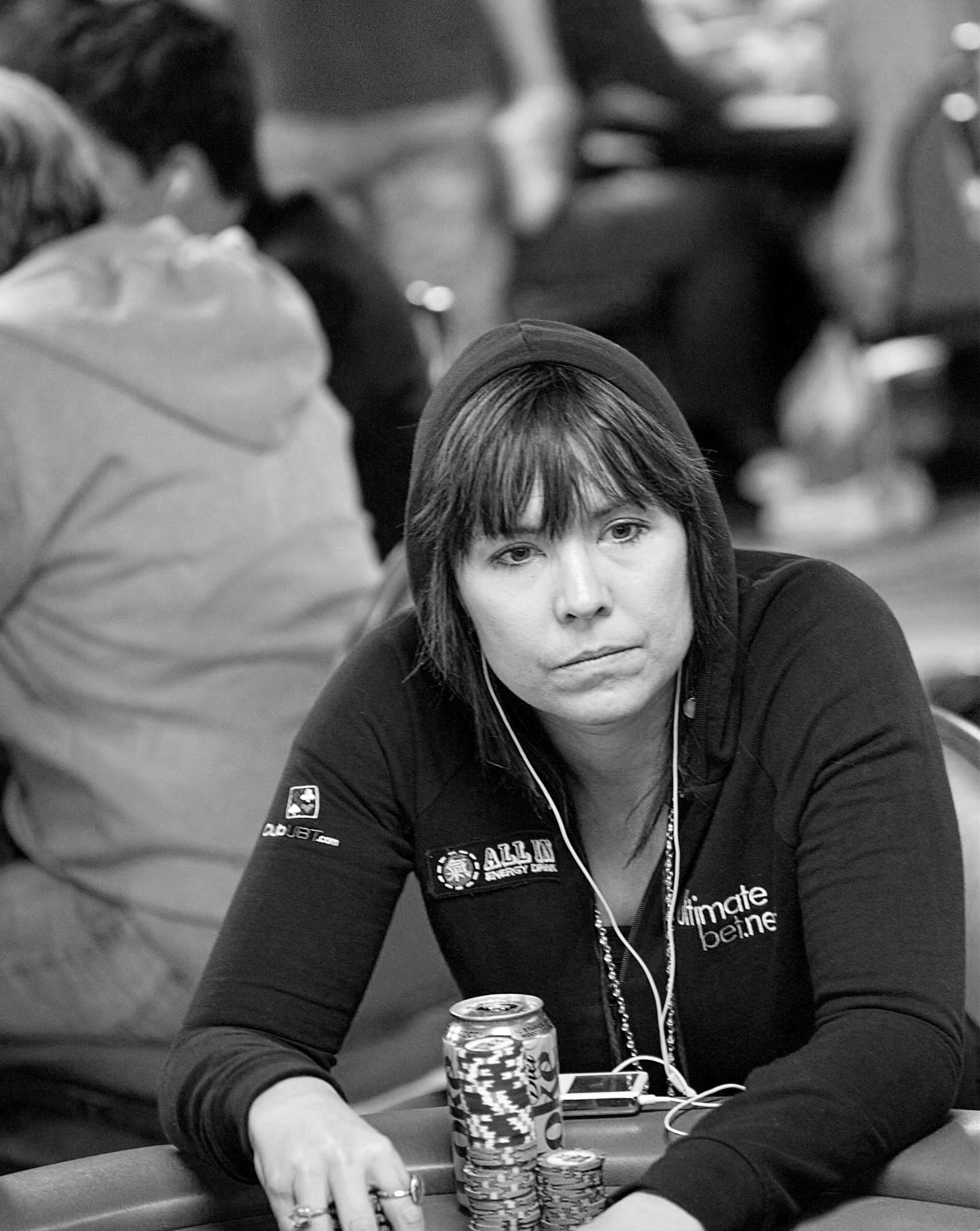
Annie Duke is a former professional poker player who became one of the most successful female tournament players in history, winning a World Series of Poker (WSOP) bracelet and over $4.2 million in live tournament earnings. She later transitioned into a corporate speaker, consultant, and bestselling author specializing in cognitive psychology and decision-making strategy.
Early Life, Academic Background, and Entry into Professional Poker
Annie Duke (born Anne LaBarr Lederer on September 13, 1965, in Concord, New Hampshire) grew up in an environment steeped in competitive card play and academic rigor. Her father, Richard Lederer, was an author and linguist who taught at St. Paul’s School, and her brother, Howard Lederer, also went on to become one of the premier high-stakes professional poker players of the late 1990s and 2000s.
Duke attended Columbia University, where she earned a double major in English and psychology. She subsequently pursued graduate studies at the University of Pennsylvania, focusing on cognitive psychology and psycholinguistics under a National Science Foundation fellowship. Her doctoral research centered on how children acquire language, examining cognitive processes, pattern recognition, and information processing under uncertainty.
Just as she was completing her Ph.D. dissertation in 1992, severe health challenges—specifically severe stomach ailments requiring surgery—forced her to take a temporary medical leave from academia. Married to Ben Duke and residing in Montana, she sought a way to earn income without returning immediately to the classroom. Encouraged by her brother Howard, who had established himself in the New York and Las Vegas poker scenes, Duke began playing low-stakes card games in local Montana taverns.
Mentorship and Early Cash Games in Montana
In the early 1990s, cardrooms in Billings and legal poker venues across Montana provided a gritty, practical proving ground. Unlike contemporary online players who learn through computer simulations, solver outputs, and online databases, Duke honed her foundation through live cash play, observation, and direct feedback from her brother.
Howard Lederer provided critical strategic advice, analyzing hand histories over the telephone, correcting positional mistakes, and instilling strict bankroll management principles. Duke recognized that her background in cognitive psychology complemented the incomplete-information nature of Texas Hold'em and Omaha Hi-Lo. By 1994, armed with a small starting bankroll, she traveled to Las Vegas to compete in her first World Series of Poker event, signaling her formal transition from academic researcher to professional poker player.
Major Tournament Victories and Career Highlights
| ANNIE DUKE: CAREER AT A GLANCE | |
|---|---|
| Lifetime Live Tournament Earnings | Exceeds $4,270,000 |
| WSOP Bracelets | 1 (2004 - $1,500 Omaha Hi-Lo Split 8/Better) |
| WSOP Tournament of Champions | Winner (2004 - $2,000,000 Prize) |
| NBC National Heads-Up Champion | Winner (2010 - $500,000 Prize) |
| Best Main Event Finish | 10th Place (2000 WSOP Main Event) |
| Primary Published Books | Thinking in Bets (2018), How to Decide (2020), Quit: The Power of Knowing When to Walk Away |
Annie Duke’s competitive poker career spanned nearly two decades, during which she consistently ranked among the top tournament earners in the world. Her breakthrough came at the 1994 WSOP, where she finished in the money in three separate events, including a 13th-place finish in the $10,000 No-Limit Hold'em Main Event while pregnant with her first child.
The 2004 WSOP Omaha Hi-Lo Victory
While Duke was widely known for her skills in No-Limit Texas Hold'em, her technical expertise was particularly pronounced in split-pot variants. In 2004, she earned her first World Series of Poker gold bracelet in Event #18, the $1,500 Omaha Hi-Lo Split 8 or Better tournament.
Omaha Hi-Lo requires complex mathematical calculations, precise equity evaluation between the high and low halves of the pot, and disciplined hand selection to avoid "getting scooped" (losing both halves of the pot). Outlasting a field of 234 players, Duke captured the $137,860 first-place prize, cementing her standing as a elite mixed-game practitioner.
The Inaugural 2004 WSOP Tournament of Champions
Later in 2004, ESPN and the WSOP organized the inaugural Tournament of Champions—an invitation-only, winner-take-all event featuring ten of the world’s most famous and accomplished players. The field included legendary figures such as Doyle Brunson, Johnny Chan, Phil Hellmuth, Howard Lederer, Daniel Negreanu, and Chip Reese.
Duke navigated the ten-player field over a grueling final table broadcast live. In the final heads-up duel, she faced long-time rival Phil Hellmuth. Duke systematically extracted value, neutralized Hellmuth’s aggressive play style, and secured the victory, claiming the $2,000,000 purse. At the time, it was the largest single cash prize won by a female player in live tournament history.
The 2010 NBC National Heads-Up Poker Championship
Duke demonstrated her longevity and adaptability in 2010 by winning the prestigious NBC National Heads-Up Poker Championship. The 64-player bracket-style tournament brought together elite online pros, seasoned live legends, and defending champions.
To claim the title and the $500,000 first prize, Duke had to defeat six consecutive world-class opponents in direct heads-up play:
- Round 1: Defeated Paul Wasicka (2006 WSOP Main Event runner-up).
- Round 2: Defeated Darvin Moon (2009 WSOP Main Event runner-up).
- Round 3: Defeated Paul Volpe.
- Quarterfinals: Defeated Andrew Feldman.
- Semifinals: Defeated Dennis Phillips.
- Finals: Defeated Erik Seidel in a best-of-three matches final sweep (2-0).
This victory reaffirmed her ability to adjust her tactical ranges against aggressive, short-handed specialists.
Comprehensive Summary of Major Tournament Results
The following table outlines Annie Duke’s most notable high-stakes tournament performances, illustrating her versatility across limit, no-limit, and pot-limit formats:
| Year | Tournament Event | Field Size | Finish / Position | Prize Money (USD) |
|---|---|---|---|---|
| 1994 | WSOP $10,000 No-Limit Hold'em Main Event | 268 | 13th Place | $16,800 |
| 1996 | WSOP $2,500 Pot-Limit Hold'em | 110 | 2nd Place | $49,000 |
| 1999 | WSOP $2,500 Limit Seven Card Stud | 136 | 2nd Place | $55,500 |
| 2000 | WSOP $10,000 No-Limit Hold'em Main Event | 512 | 10th Place | $52,160 |
| 2003 | WSOP $2,500 Limit Hold'em | 143 | 2nd Place | $54,900 |
| 2004 | WSOP $1,500 Omaha Hi-Lo Split 8 or Better | 234 | 1st Place (Bracelet) | $137,860 |
| 2004 | WSOP Tournament of Champions (Winner-Take-All) | 10 | 1st Place | $2,000,000 |
| 2005 | WPT Championship $25,000 No-Limit Hold'em | 520 | 48th Place | $45,000 |
| 2008 | WPT Celebrity Invitational | 425 | 2nd Place | $75,000 |
| 2010 | NBC National Heads-Up Championship | 64 | 1st Place | $500,000 |
Strategic Framework and Playing Style
Annie Duke’s poker success relied on a analytical, cold, and mathematically grounded approach to decision-making under uncertainty. Long before solver engines standardized optimal board coverage and explicit pot odds, Duke operated on fundamental principles derived from economics and cognitive research.
DUKE'S CORE DECISION FRAMEWORK
- Decouple Outcomes from Decision Quality (Resulting)
- Estimate Probabilities in Incomplete Environments
- Manage Bankroll & Expected Value (EV) Exposure
- Exploit Cognitive Biases & Tilt in Opponents
Mastery of Split-Pot and Fixed-Limit Formats
In split-pot games like Omaha Hi-Lo 8 or Better, amateur players frequently make the mistake of chasing "half-pots," betting aggressively with hands that can only win the high or low side without possessive backup for the other half. Duke mastered the concept of "scooping"—playing hands that possess strong potential to win both halves simultaneously.
Her positional awareness in limit games focused heavily on:
- Pot Equity Realization: Ensuring that her hand entry ranges retained high equity across three streets of fixed betting.
- Reduction of Reverse Implied Odds: Folding medium-strength hands that were cheap to call on early streets but exposed her to escalating costs on later streets when beaten.
- Fold Equity Exploitation: Leveraging position to force opponent errors when pots were contested passively.
Exploitative vs. Game-Theory Orientations
During the peak of her playing career, modern Game Theory Optimal (GTO) software did not exist. Players relied on exploitative strategies—identifying tendencies in opponents and structuring betting lines to capitalize on those specific flaws.
Duke excelled at identifying structural biases in her opponents:
- Risk Aversion in High-Stakes Situations: Recognizing when players were playing "above their bankroll" and using aggressive, multi-barrel pressure to force folds.
- Pattern Recognition: Categorizing opponents into explicit archetypes (e.g., tight-passive, loose-aggressive) and adjusting call/raise thresholds accordingly.
- Emotional Control (Anti-Tilt): Controlling personal cognitive biases, refusing to let previous bad beats affect future independent probabilistic events.
Online Poker Era and Business Controversies
Annie Duke’s public profile extended beyond tournament venues into corporate sponsorships and poker business ventures. However, her commercial associations exposed her to significant industry controversy, particularly surrounding UltimateBet and the Epic Poker League.
The UltimateBet Cheating Scandal
Duke served as a prominent spokesperson, consultant, and sponsored professional for UltimateBet (UB), an online poker platform owned by parent company IEBL and later Tokwiro Enterprises. Between 2004 and 2008, an extensive insider cheating scandal unfolded on the site. Key figures, including former WSOP champion Russ Hamilton, utilized unauthorized software tools (often referred to as "god mode" accounts) that allowed them to view opponents' hole cards in real time, defrauding players out of millions of dollars.
When official investigations exposed the misconduct, public outcry devastated the platform's reputation. Duke faced intense criticism from the poker community due to her ongoing representation of the brand during this timeframe. Leaked audio recordings released years later in 2013 captured internal executive discussions regarding the scandal, in which Duke’s name was mentioned in connection with delayed hand history access.
Duke maintained that she had no technical access to the back-end servers, possessed no knowledge of the illegal cheating software, and was purely a commercial endorsement figure. Nevertheless, her association with UltimateBet permanently damaged her standing among a significant segment of hardcore poker enthusiasts.
The Epic Poker League and Bankruptcy
In 2011, Duke partnered with former chief executive of the WSOP Jeffrey Pollack to launch the Epic Poker League (EPL) under the parent company Federated Sports & Gaming (FS&G). The initiative was designed as a professional league restricted to top-ranked poker players based on historical tournament criteria, featuring rake-free tournaments and a promised $1,000,000 championship event.
Despite initial publicity and broadcast deals with CBS Sports, the venture was financially unsustainable. In February 2012, less than a year after its inception, Federated Sports & Gaming filed for Chapter 11 bankruptcy reorganization. The promised $1 million championship freeroll was canceled, leaving qualified players without their expected prize pool. The sudden collapse drew severe backlash, and Duke stepped away from active poker management shortly thereafter.
Transition to Decision Strategist, Speaker, and Author
Following her retirement from competitive poker around 2012, Duke pivoted fully to applying her expertise in probability, psychology, and strategic analysis to business management, executive decision-making, and public speaking.
She leveraged her background in cognitive psychology alongside her practical experience managing uncertainty at high-stakes poker tables to address a common corporate flaw: confusing outcome quality with decision quality.
POKER THEORY VS. DECISION SCIENCE
| Poker Concept | Corporate Equivalent |
|---|---|
| Incomplete Information | Market Ambiguity |
| Hand Selection & Fold Equity | Resource Allocation |
| Avoiding "Resulting" | Post-Mortem Audits |
| Expected Value (+EV) Calculation | Expected ROI |
Major Publications
Duke authored several books that established her as a prominent voice in decision science:
Thinking in Bets: Making Smarter Decisions When You Don't Have All the Facts (2018):
- Core Thesis: Life is more like poker than chess. Chess contains no hidden information and very little luck; poker involves hidden information and significant stochastic variance.
- Key Concept ("Resulting"): Duke defined "resulting" as the cognitive bias where people evaluate the quality of a past decision based solely on its final outcome rather than the quality of the process used to make it.
- Application: Executives are urged to establish probabilistic thinking, construct "decision pods" to eliminate confirmation bias, and frame predictions in percentages rather than binary guarantees.
How to Decide: Simple Tools for Making Better Choices (2020):
- Core Thesis: A practical workbook containing tactical tools for decision-makers.
- Key Concepts: Provides concrete frameworks like "decision trees," "pre-mortems" (imagining failure before launching a project), and explicit methods for mapping out unknown variables to streamline organizational choices.
Quit: The Power of Knowing When to Walk Away (2022):
- Core Thesis: Modern society over-values grit and persistence, often driving people to double down on failing projects due to the sunk cost fallacy.
- Key Concept: Duke demonstrates that knowing when to walk away—whether from a poker hand, an investment, or a career—is an essential skill for long-term success. She outlines the use of "kill criteria" (pre-determined triggers to abandon a course of action) to eliminate emotional bias.
Academic and Philanthropic Work
Beyond writing and corporate consulting, Duke co-founded How I Decide, a non-profit organization dedicated to teaching critical thinking, decision-making skills, and financial literacy to youth. She later served as a board member for the Alliance for Decision Education, working alongside leading psychologists and economists to incorporate decision-making science into standard high school curricula.
Frequently Asked Questions
Did Annie Duke win a World Series of Poker Main Event?
No. While Annie Duke never won the WSOP Main Event, she achieved high finishes in the tournament, including a 13th-place finish in 1994 and a 10th-place finish in 2000. Her single WSOP bracelet was won in 2004 in the $1,500 Omaha Hi-Lo Split 8 or Better event.
Are Annie Duke and Howard Lederer related?
Yes, Annie Duke and Howard Lederer are siblings. Both became premier professional poker players during the 1990s and 2000s, with Lederer earning two WSOP bracelets and two World Poker Tour titles.
What is the main thesis of Annie Duke's book "Thinking in Bets"?
The core thesis of Thinking in Bets is that decisions made under uncertainty should be evaluated based on the rigor of the decision-making process rather than the ultimate outcome. Duke argues that treating choices as probabilistic bets helps individuals reduce cognitive bias, embrace uncertainty, and avoid the trap of "resulting."
How much money did Annie Duke win in poker tournament play?
Annie Duke accumulated over $4.27 million in live, officially recorded tournament earnings throughout her professional poker career. Her single largest payout was $2,000,000 for winning the 2004 WSOP Tournament of Champions.
Why did Annie Duke leave professional poker?
Duke retired from professional poker around 2012 to focus on cognitive decision-making, executive consulting, public speaking, and writing. Her transition coincided with the financial collapse of the Epic Poker League and a personal desire to apply cognitive science to broader corporate and academic fields.
Practical Takeaways for Decision-Makers
Annie Duke’s career trajectory offers practical lessons for high-stakes poker players, corporate leaders, and risk analysts looking to make better choices in uncertain environments:
- Separate Process from Outcome: Avoid judging a strategy solely on whether it succeeded or failed on a single attempt. A good decision can lead to a bad result due to variance, just as a poor decision can produce a lucky outcome.
- Establish Pre-Mortems and Kill Criteria: Before launching a project or making an investment, define explicit conditions under which you will alter or abandon your plan. This helps neutralize emotional attachment and the sunk cost fallacy.
- Think in Probabilities, Not Certainties: Replace binary statements ("This will work") with explicit probabilistic ranges ("This has a 65% chance of achieving target ROI").
- Build Decision Assemblies: Surround yourself with peers who challenge your assumptions and hold you accountable to a rigorous, objective evaluation process.