The Angular front-end framework offers enterprise development teams a complete, opinionated architecture powered by native TypeScript support, robust dependency injection, built-in routing, forms handling, and modern fine-grained reactivity via Signals. While it provides unparalleled structural consistency and long-term maintainability for large-scale applications, its trade-offs include a steep learning curve, a larger initial baseline bundle size, and ongoing migration overhead for legacy codebases transitioning from traditional patterns.
Architectural Evolution of Modern Angular
Angular has undergone a massive architectural shift to streamline developer experience while maintaining its enterprise-grade foundation. Originating as a monolithic, module-heavy framework centered on NgModule declarations and Zone.js change detection, modern Angular has evolved into a streamlined platform emphasizing standalone components, fine-grained reactivity, and server-side performance optimization.
At the center of this transformation is the decoupling of framework features from mandatory boilerplates. Developers no longer need to manage complex module dependency trees just to render a basic view. Instead, standalone components, directives, and pipes allow for direct imports and explicit dependency declarations, simplifying mental models and enabling more aggressive tree-shaking by build tools.
(Remember: NO code fences per instructions!)
Wait, make sure not to include any code blocks at all.
Simultaneously, the introduction of Angular Signals has fundamentally altered how the framework tracks and responds to state changes. Historically, Angular relied on Zone.js to monkey-patch asynchronous browser APIs, triggering change detection across component trees whenever an asynchronous event occurred. While effective for basic synchronization, this approach often caused unnecessary re-evaluations across non-updated UI elements. Signals introduce fine-grained reactivity, allowing the framework to pinpoint exactly which DOM node depends on which state value and update only the precise elements that changed.
This architectural maturation places Angular at a unique intersection: it retains the architectural discipline required for large, multi-team engineering projects while adopting the lightweight, ergonomic developer experiences pioneered by alternative front-end solutions.
Primary Strengths of the Angular Framework
Angular’s enduring popularity in enterprise engineering stems from its comprehensive approach to front-end development. Rather than acting as a simple view library, Angular provides an integrated platform designed to solve common application architecture challenges out of the box.
Integrated "Batteries-Included" Ecosystem
Unlike libraries that require engineering teams to assemble disparate packages for routing, form management, state synchronization, and HTTP communication, Angular ships with curated, first-party solutions for core application requirements:
- Reactive and Template-Driven Forms: Built-in form modules handle complex validation, dynamic control generation, state tracking, and accessibility out of the box.
- Integrated Router: A declarative routing system supporting lazy loading, route guards, preloading strategies, and dynamic path matching without relying on third-party packages.
- HttpClient Module: A feature-rich HTTP client providing type-safe API requests, interceptor pipelines for authentication and logging, and simplified testing mocks.
- Standardized Build and Testing Tooling: The Angular CLI enforces standardized project configurations, build pipelines, unit testing execution, and code generation across disparate engineering teams.
This unified ecosystem guarantees that disparate teams working on distinct micro-frontends or sub-modules follow uniform architectural patterns, drastically reducing onboarding overhead and maintenance fragmentation.
Enterprise-Grade Dependency Injection
Angular features a built-in hierarchical Dependency Injection (DI) framework. DI decouples service instantiations from component logic, enabling clean separation of concerns, testability, and modular design. Services can be scoped globally at the application root, isolated to specific component subtrees, or bound to route lifecycles.
(Note: Do not use code blocks anywhere in text)
Through token-based injection and hierarchical injectors, developers can easily swap implementations for mock environments, implement singleton data stores, and inject contextual configuration settings without hardcoding dependencies inside component classes.
Fine-Grained Reactivity with Signals
The integration of Signals provides a synchronous reactivity primitive that simplifies state management without requiring heavy boilerplate. Signals wrap state values and notify consumers when those values mutate, establishing clear dependency graphs automatically.
Key benefits of Angular Signals include:
- Predictable Synchronous Execution: Eliminates timing bugs often associated with complex asynchronous event loops.
- Granular Change Detection: Reduces runtime computational overhead by updating only DOM nodes directly bound to altered signals.
- Simplified Interoperability: Bridges seamless data flow between RxJS asynchronous streams and synchronous component render state via conversion utilities like
toSignalandtoObservable.
Strongly Typed Infrastructure via Native TypeScript
Angular was built from the ground up to leverage TypeScript. Type safety is not an afterthought or an optional layer; it extends through component classes, services, template expressions, reactive forms, and routing parameters. Strict template type checking identifies missing properties, mismatched types, and null pointer risks during compilation rather than at runtime in production environments.
Essential Trade-Offs and Architectural Challenges
While Angular provides significant benefits for complex systems, engineering leaders must weigh these advantages against inherent operational and technical trade-offs.
Steep Learning Curve and Conceptual Surface Area
Angular possesses one of the broadest API surface areas among contemporary web frameworks. Mastering Angular requires developers to understand not only standard JavaScript and HTML, but also specialized framework concepts:
- Hierarchical dependency injection contexts and provider scoping rules.
- RxJS operators, observables, and asynchronous stream orchestration.
- Signal reactivity primitives, effect scheduling, and computed value caching.
- Custom structural directives, control flow syntax, and view container refs.
- Complex build-time configurations, ahead-of-time (AOT) compilation rules, and hybrid rendering targets.
For junior developers or teams transitioning from lighter view libraries like React or Vue, mastering this breadth of concepts requires a significant investment of time and training.
Framework Footprint and Baseline Bundle Overhead
Because Angular includes comprehensive runtime mechanisms—such as the runtime dependency injector, component lifecycle managers, and change detection engines—its initial baseline bundle size is higher than minimal view libraries.
While tree-shaking improvements and standalone primitives have reduced production bundle sizes significantly, lightweight applications (such as simple marketing landing pages or low-complexity micro-apps) may still experience unnecessary payload overhead compared to minimal frameworks like Svelte or solid micro-libraries.
Migration Friction and Architectural Legacy
Angular’s rapid modernization has created an architectural rift between legacy and contemporary codebases. Applications constructed prior to recent major releases often rely heavily on NgModule hierarchies, Zone.js change detection, and complex RxJS pipelines for basic state propagation.
Upgrading these legacy systems to modern standards (such as standalone components, zone-less architecture, and signal-based inputs/outputs) demands systematic refactoring. While Angular provides automated CLI schematics to assist with migrations, large enterprise applications with deep technical debt face non-trivial upgrade efforts.
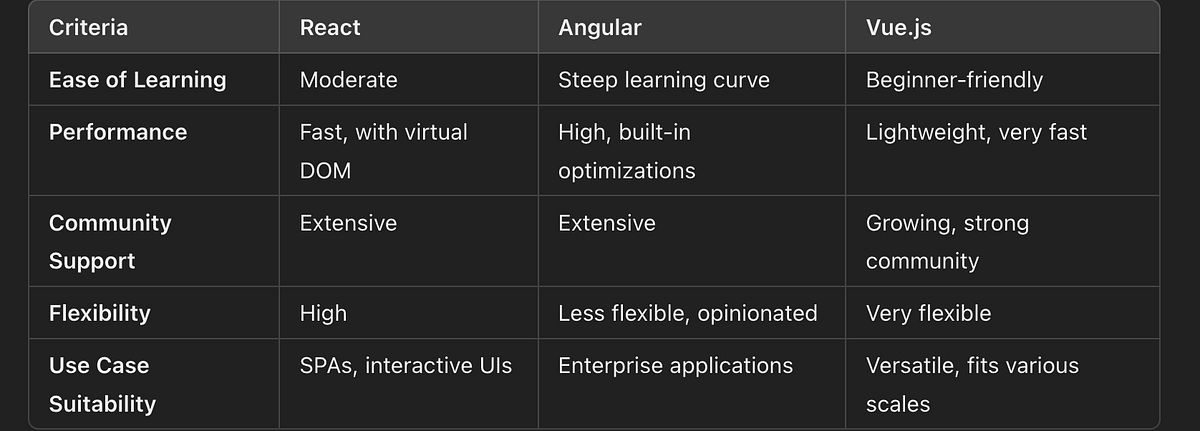
Detailed Framework Comparison Matrix
The table below highlights key architectural differences between Angular and alternative front-end technologies to assist teams evaluating framework suitability.
| Evaluation Dimension | Angular | React | Vue.js |
|---|---|---|---|
| Primary Architectural Scope | Full-fledged enterprise framework | UI rendering library | Progressive front-end framework |
| Language Foundation | Native TypeScript | JavaScript / JSX / TypeScript | JavaScript / TypeScript |
| State Reactivity Model | Signals + RxJS Observables | Virtual DOM + Hooks / Explicit State | Fine-grained Reactivity (Reactivity API) |
| Dependency Injection | Built-in, hierarchical DI system | Context API / External Libraries | Provide / Inject API |
| Core Ecosystem Modules | First-party Routing, Forms, HTTP, CLI | Community-driven (React Router, etc.) | Official Routing (Vue Router), Pinia |
| Change Detection Mechanism | Signals & Optional Zone.js | Virtual DOM reconciliation | Proxy-based reactivity tracking |
| SSR & Hydration | Built-in SSR with Event Replay | Next.js / Custom Server Integration | Nuxt.js / Custom Server Integration |
| Learning Curve | High (Broad API & structural concepts) | Moderate (Focuses primarily on JSX/Hooks) | Low to Moderate (Approachable templates) |
Open Questions and Unresolved Engineering Challenges
As Angular continues its modernization trajectory, several strategic and technical questions remain actively debated across the web development community.
1. The Long-Term Coexistence of RxJS and Signals
One of the most prominent open questions in the Angular community revolves around the role of RxJS in modern application design. For years, RxJS was the indisputable backbone of reactivity in Angular, powering everything from HTTP requests to route parameters and component state.
With Signals managing local state and synchronous data derivation cleanly, the boundary between when to use Signals versus RxJS observables has shifted. While Signals excel at synchronous, in-memory state synchronization, RxJS remains superior for complex asynchronous event streams, cancellation logic, race conditions, and debounce operations. Determining where to draw the line between these two reactivity models is an evolving architectural challenge for engineering leads structuring new codebases.
2. Transitioning Enterprise Ecosystems to Fully Zone-Less Architectures
The framework's move toward optional Zone.js execution promises improved runtime performance, lower memory usage, and clearer stack traces during debugging. However, completely removing Zone.js from established enterprise applications presents non-trivial challenges:
- Third-party UI component libraries built on traditional change detection must be audited and updated to support zone-less rendering.
- Legacy dynamic component loading patterns that relied on automatic tick cycles may require explicit signal bindings or manual change detection triggers.
- Engineering teams must adapt their unit testing strategies, as traditional asynchronous testing helpers (such as
fakeAsyncandtick) are deeply bound toZone.jsbehavior.
3. Competing in Edge Rendering and Ultra-Lightweight Footprints
As web architecture shifts toward server-side edge rendering, micro-frontends, and server-driven UI implementations, framework startup speed and cold-boot payload sizes have become critical metrics.
While Angular's hydration features—including non-destructive DOM hydration and incremental event replay—have improved initial render performance for server-side rendered (SSR) apps, questions remain regarding how lightweight Angular can become. Can Angular effectively compete with novel meta-frameworks designed explicitly for edge execution, or will it remain primarily tailored for complex, desktop-grade web applications and enterprise portals?
4. Codebase Fragmentation Across Framework Generations
The continuous stream of developer-experience improvements (standalone APIs, modern control flow syntax like @if and @for, Signal inputs, functional route guards) has created variance in how Angular code is written across different organizations.
A codebase written in 2020 looks drastically different from a modern codebase. This generational shift raises pragmatic questions for enterprise teams:
- How fast should organizations refactor working legacy code to modern patterns?
- How can teams prevent internal codebases from becoming fragmented hybrid structures containing mixed architectural paradigms?
Practical Recommendations for Decision-Makers
Selecting Angular depends heavily on organizational goals, team composition, and project longevity requirements. The following guidelines assist technical leads in determining whether Angular is the optimal choice.
Ideal Use Cases for Angular
- Large Enterprise Portals: Organizations building large-scale software platforms with multi-team contributions benefit from Angular's strict conventions and standard directory structures.
- Long-Lived Software Products: Enterprise applications requiring multi-year stability, backwards compatibility guarantees, and structured CLI migration tooling.
- Domain-Driven Applications with Complex Forms: Complex administrative dashboards, financial tools, and data-entry platforms that rely on sophisticated form validations and dynamic fields.
- TypeScript-Centric Development Teams: Engineering organizations that prioritize strict compile-time safety and unified architectural standards across backend and frontend codebases.
When to Consider Alternative Solutions
- Simple Content Websites or Landing Pages: Smaller projects where framework runtime overhead outweighs architectural benefits; lightweight static site generators or minimal UI libraries are often more suitable.
- Highly Heterogeneous UI Micro-Apps: Projects where micro-frontend modules must maintain ultra-small, isolated footprints with zero shared framework runtime overhead.
- Teams Seeking Unconstrained Architectural Flexibility: Organizations that prefer building bespoke application stacks by pairing light view libraries with custom state-management tools and routing packages.
Frequently Asked Questions
What is the primary difference between Angular Signals and RxJS Observables?
Angular Signals are designed for synchronous state management, tracking value changes directly to update specific DOM nodes efficiently. RxJS Observables, by contrast, excel at managing complex asynchronous data streams, handling events over time, network request orchestration, and data transformation operators like filtering, debouncing, and merging.
Can legacy Angular apps using NgModules adopt modern features like Signals and Standalone Components?
Yes. Modern Angular releases maintain complete backward compatibility. Standalone components can be imported directly into legacy NgModule declarations, and Signals can be seamlessly integrated into existing components alongside traditional Zone.js change detection and RxJS subscriptions.
How does Angular handle Server-Side Rendering (SSR) and Hydration?
Angular provides built-in SSR capabilities integrated into its build pipeline. It uses non-destructive hydration, meaning the client-side framework reuses the server-rendered HTML DOM structure rather than destroying and re-creating nodes. Features like event replay capture user interactions that occur while the JavaScript bundle is loading and replay them once hydration completes.
Why is Dependency Injection (DI) considered a major strength in Angular?
Dependency Injection decouples class implementations from their instantiated dependencies. This architectural pattern promotes clean separation of concerns, simplifies unit testing by allowing developers to inject mock services easily, and enables granular service scoping across routes, component trees, or application instances.
Does modern Angular still require Zone.js for change detection?
No, Zone.js is now optional. By leveraging Signals for reactivity, developers can configure applications to run in a zone-less mode. This reduces overall bundle size, improves runtime rendering efficiency, and simplifies stack traces during debugging.
Implementation Next Steps
When adopting or updating Angular within an enterprise environment, engineering leads should execute a structured rollout strategy to maximize maintainability:
- Establish Clear Architectural Standards: Define clear team guidelines on state management, detailing exactly when to use synchronous Signals versus asynchronous RxJS streams.
- Automate Upgrades via Angular CLI: Utilize official CLI migration schematics to update codebases incrementally, converting traditional control flow statements and modules to standalone structures.
- Implement Modern Control Flow Syntax: Modernize templates by replacing legacy directives like
*ngIfand*ngForwith native control flow syntax (@if,@for,@switch) to enhance template readability and type-checking performance. - Audit Third-Party Dependencies: Evaluate external libraries to ensure compatibility with standalone APIs, fine-grained reactivity, and zone-less rendering targets.
By combining Angular's robust foundation with its modern reactivity primitive, organizations can construct resilient, high-performance web applications capable of scaling seamlessly over time.