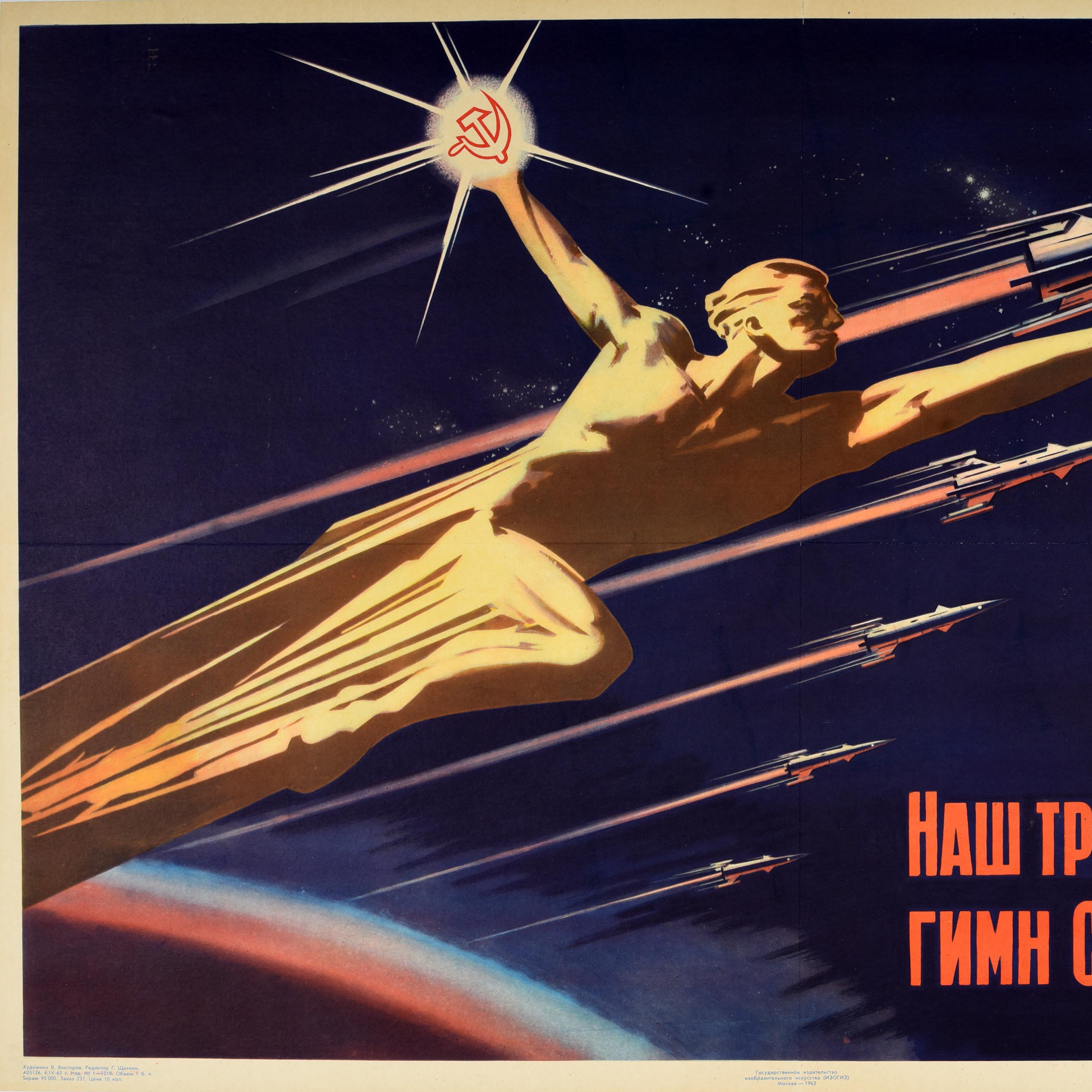
The Cold War-era Space Race was a 20th-century competition between the United States and the Soviet Union to achieve superior spaceflight capability. While the USSR achieved early milestones like the first satellite and human in orbit, the U.S. ultimately reached the Moon first in 1969, fundamentally reshaping global technology, military strategy, and geopolitics.
The Ideological Roots of the Space Race
The competition for space supremacy was never merely about scientific discovery; it was a high-stakes proxy for the ideological struggle between Western capitalism and Soviet communism. Following the end of World War II, both the United States and the Soviet Union recognized that the technology used to launch rockets into orbit was fundamentally the same technology required to deliver nuclear warheads across continents. Consequently, space achievements served as a visible metric for national security and technological superiority.
The race began in earnest as both nations scrambled to recruit former Nazi scientists who had developed the V-2 rocket, the world’s first long-range guided ballistic missile. The United States secured Wernher von Braun through Operation Paperclip, while the Soviet Union captured significant hardware and secondary technicians. These two groups of scientists would become the primary architects of the early space age, leading the American and Soviet programs through their most formative years.
By the mid-1950s, both nations had publicly announced their intentions to launch artificial satellites during the International Geophysical Year (1957–1958). However, the world was largely unprepared for the speed with which the Soviet Union would translate these intentions into reality.
Early Soviet Dominance: From Sputnik to Vostok
On October 4, 1957, the Soviet Union successfully launched Sputnik 1, the world's first artificial satellite. Although the satellite was a simple sphere equipped with four radio antennas, its rhythmic "beep-beep-beep" transmitted across the globe signaled a massive technological shift. In the United States, this event triggered the "Sputnik Crisis," a period of public anxiety and political upheaval that led directly to the creation of the National Aeronautics and Space Administration (NASA) in 1958.
The Soviet Union maintained its momentum through a series of "firsts" that left the United States struggling to catch up:
- First Animal in Orbit: On November 3, 1957, the dog Laika was launched aboard Sputnik 2. While she did not survive the mission, the flight proved that living organisms could endure the conditions of launch and weightlessness.
- First Lunar Impact: In 1959, the Luna 2 probe became the first man-made object to reach the Moon, impacting the lunar surface and proving that Earth's gravity could be overcome for interplanetary travel.
- First Human in Space: On April 12, 1961, Yuri Gagarin orbited the Earth aboard Vostok 1. This 108-minute flight made Gagarin an international icon and cemented the USSR's lead in the eyes of the global public.
These achievements were facilitated by the "Chief Designer" Sergei Korolev, whose identity remained a state secret until his death in 1966. Korolev’s ability to maximize limited resources and leverage powerful R-7 rocket derivatives allowed the Soviets to maintain their lead throughout the early 1960s.
The American Pivot: Project Mercury and JFK’s Mandate
The United States initially struggled with highly publicized launch failures, such as the Vanguard TV3 explosion in late 1957. However, the American approach eventually shifted from reactive to proactive. In May 1961, just weeks after Gagarin's flight, President John F. Kennedy addressed Congress and committed the nation to the goal of "landing a man on the Moon and returning him safely to the Earth" before the end of the decade.
This mandate transformed NASA from a nascent agency into a massive industrial-scientific complex. The effort was divided into three distinct phases:
- Project Mercury: Designed to test if humans could survive and function in space. Alan Shepard became the first American in space (suborbital) in May 1961, and John Glenn became the first American to orbit the Earth in February 1962.
- Project Gemini: A critical bridge program that focused on perfecting the techniques required for a lunar mission, including long-duration flight, extravehicular activity (spacewalks), and orbital rendezvous and docking.
- Project Apollo: The final phase aimed at the lunar landing.
Project Gemini is often overlooked, but it was the period when the United States technically overtook the Soviet Union. By performing the first successful orbital docking during Gemini 8 and logging hundreds of hours of flight time, NASA proved it had the operational maturity to attempt a lunar voyage.
Technical Comparison: Saturn V vs. N1 Rocket
The climax of the Space Race centered on the development of super-heavy-lift launch vehicles. For the Americans, this was the Saturn V; for the Soviets, it was the N1. The divergent fates of these two rockets determined the outcome of the race to the Moon.
| Feature | Saturn V (USA) | N1 Rocket (USSR) |
|---|---|---|
| Height | 110.6 meters (363 ft) | 105 meters (344 ft) |
| First Stage Thrust | 7.6 million pounds | 10.2 million pounds |
| Engines (Stage 1) | 5 (F-1) | 30 (NK-15) |
| Successful Launches | 13 | 0 |
| Fuel Type | RP-1 / Liquid Oxygen | RP-1 / Liquid Oxygen |
| Payload to LEO | 140,000 kg | 95,000 kg |
The Saturn V remains one of the most successful engineering feats in history. Its F-1 engines were massive and complex, but because NASA had the funding to conduct extensive "static" ground testing of the entire rocket stage, they identified and solved vibration issues before launch.
In contrast, the Soviet N1 program suffered from chronic underfunding and internal rivalries. The N1 used 30 smaller engines on its first stage because the USSR lacked the facilities to build a single engine as powerful as the F-1. The plumbing required to synchronize 30 engines was incredibly complex. The N1 failed in all four of its test launches between 1969 and 1972, effectively ending the Soviet lunar ambitions.
Apollo 11 and the Conclusion of the "Race"
On July 20, 1969, the United States achieved the primary goal set by Kennedy. Neil Armstrong and Buzz Aldrin landed the Apollo 11 Lunar Module, Eagle, at the Sea of Tranquility. This achievement was watched by an estimated 650 million people worldwide.
The Soviet Union initially tried to downplay the American success, pivoting their focus to long-term orbital presence. However, the "race" in its original form—a competition for spectacular firsts—largely concluded with the Apollo-Soyuz Test Project in 1975. This was the first joint U.S.-Soviet space flight, where an American Apollo capsule docked with a Soviet Soyuz capsule in orbit. The symbolic handshake between commanders Thomas Stafford and Alexei Leonov signaled the beginning of a period of cooperation that would eventually lead to the International Space Station (ISS).
The Legacy of the Race in 2026
As we look back from 2026, the legacy of the original Space Race is visible in almost every facet of modern life. The technologies developed for the Moon missions—integrated circuits, advanced water filtration, satellite telecommunications, and high-strength materials—became the backbone of the modern economy.
However, the geopolitical landscape has shifted. The binary competition between America and Russia has evolved into a multipolar environment.
The Decline of Roscosmos
In the current decade, the Russian space agency, Roscosmos, has faced significant challenges. Sanctions and budgetary constraints following the geopolitical shifts of the early 2020s have slowed their domestic programs. While Russia remains a partner in the ISS through 2028, they have increasingly looked toward partnerships with China to maintain a presence in deep-space exploration, specifically through the International Lunar Research Station (ILRS) project.
The Rise of NASA’s Artemis Program
NASA has moved beyond the Apollo era with the Artemis program. By 2026, the goal is no longer just to "land" but to establish a sustainable presence on the Moon and in lunar orbit via the Gateway station. Unlike the 1960s, this effort is heavily supported by commercial partners like SpaceX and Blue Origin, highlighting a shift from government-only missions to a thriving space economy.
New Competitors
While the "America vs. Russia" narrative is historically dominant, the 2020s have seen the emergence of the China National Space Administration (CNSA) as the primary rival to U.S. space interests. China's successful Tiangong space station and their robotic lunar landings have created a new "Moon Race" dynamic that mirrors the 1960s in intensity but involves entirely different technological and political stakes.
Frequently Asked Questions
Who officially won the Space Race?
The winner depends on the metric used. The Soviet Union won the "early race" by achieving the first satellite (Sputnik), first animal in space, and first human in orbit (Yuri Gagarin). However, the United States is widely considered the winner of the "Space Race" as historically defined, because they achieved the ultimate goal of landing humans on the Moon and returning them safely, a feat the Soviet Union never replicated.
Why did the Soviet Union never go to the Moon?
The Soviet lunar program failed primarily due to the death of Sergei Korolev in 1966, internal bureaucratic infighting, and the failure of the N1 rocket. The USSR also lacked the massive economic resources that the U.S. poured into the Apollo program (which at its peak consumed nearly 4% of the U.S. federal budget).
Was the Space Race a military project?
Yes, largely. Both nations used their civilian space programs as a "front" for the development of Intercontinental Ballistic Missiles (ICBMs). The rockets that launched satellites were essentially modified versions of weapons designed to carry nuclear warheads.
Is there a new Space Race happening in 2026?
Yes, though the participants have changed. The current race is primarily between the United States (and its Artemis Accords partners) and China (and its ILRS partners). This new race focuses on resource extraction on the Moon, such as lunar ice, and establishing a staging point for missions to Mars.
How did the Space Race affect the Cold War?
The Space Race acted as a "safety valve" for the Cold War. It allowed the two superpowers to compete for prestige and technological dominance without engaging in direct military conflict. It also forced both nations to invest heavily in science, technology, engineering, and mathematics (STEM) education, which had long-term benefits for their respective societies.
Practical Recommendations for Space Enthusiasts
For those looking to explore the history or current status of space exploration in 2026, several resources provide verified, high-quality data:
- Visit Official Repositories: The NASA History Office offers digitized logs, original blueprints of the Saturn V, and transcripts from the Apollo missions.
- Museum Exhibits: The Smithsonian National Air and Space Museum in Washington, D.C., houses the original Apollo 11 command module and a backup Sputnik 1 satellite.
- Track Current Launches: Use apps like "Space Launch Now" or follow official agency channels to monitor the progress of the Artemis missions and the decommissioning phases of the ISS.
- Academic Study: For those interested in the engineering failures of the Soviet program, the memoirs of Boris Chertok, Rockets and People, provide the most detailed primary-source account of the Soviet side of the race.
The America vs. Russia Space Race was a unique moment in human history where the limits of technology were pushed by the weight of national survival. While the names of the agencies and the destinations have evolved, the spirit of competition continues to drive the next generation of explorers toward Mars and beyond.