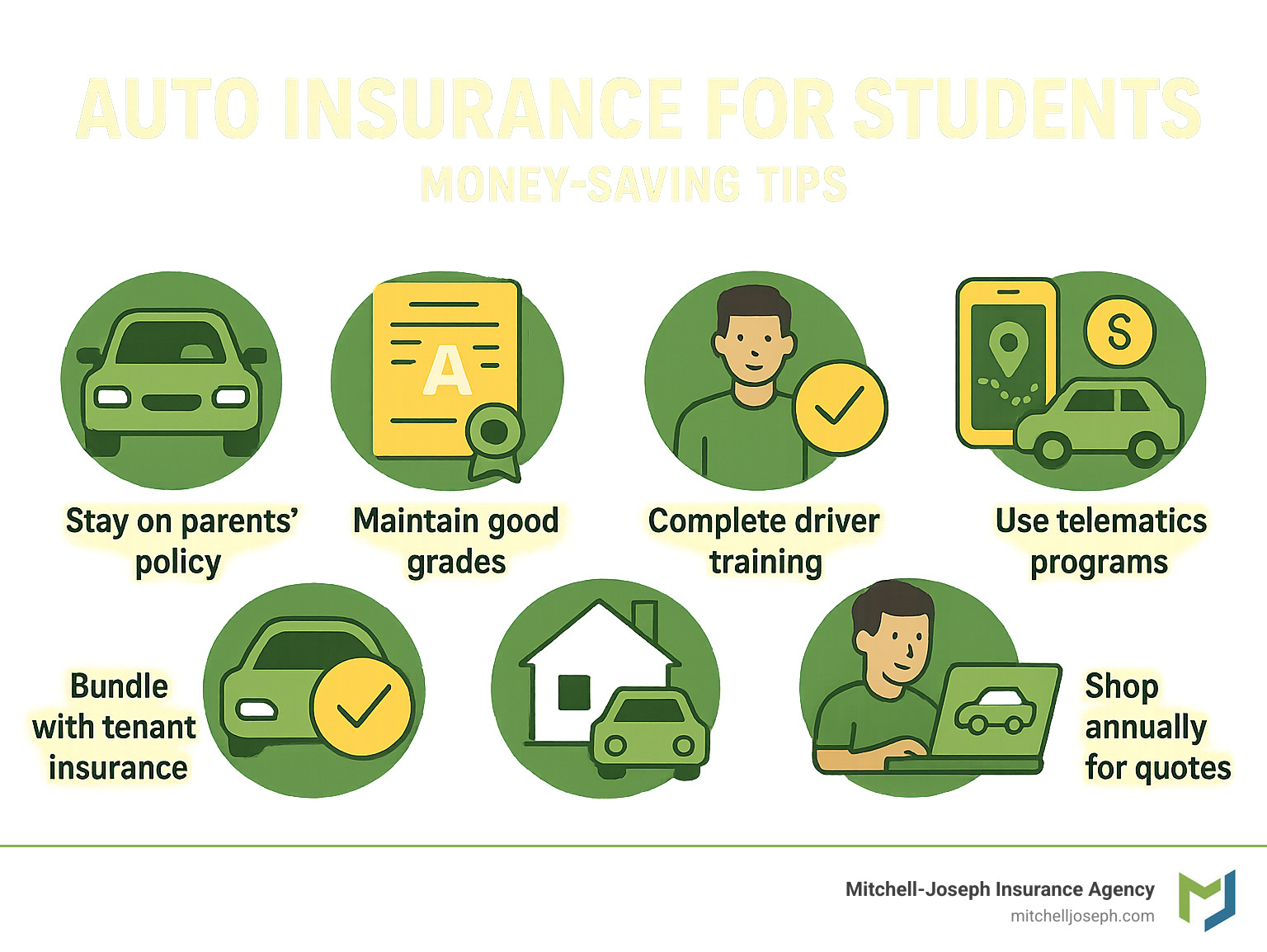
Allstate provides significant auto insurance savings for students through two primary programs: the Smart Student Discount and the Resident Student Discount. Eligibility typically requires being a full-time student under age 25 with a minimum 3.0 GPA. These discounts can reduce premiums by up to 25%, helping offset the higher costs associated with young drivers.
Understanding the Allstate Smart Student Discount
The core of Allstate’s student-focused offerings is the Smart Student Discount. This program is designed to reward young drivers who demonstrate responsibility and discipline in their academic lives. From an actuarial perspective, insurance providers like Allstate have found a statistical correlation between academic performance and safe driving habits. Students who maintain high grades are viewed as lower-risk individuals, which translates into lower premiums.
To qualify for the Smart Student Discount in 2026, a driver must generally meet three specific criteria. First, they must be under the age of 25. Once a driver reaches their 25th birthday, they are typically moved into a different risk pool where student-specific discounts no longer apply, though their overall rates may naturally decrease. Second, the student must be enrolled full-time in high school or a college/university. Part-time students generally do not qualify for this specific incentive. Third, the student must meet one of several academic milestones, the most common being a grade point average (GPA) of 3.0 or higher (a "B" average).
Allstate also extends this discount to students who achieve other notable academic honors. If a student is on the Dean’s List or the Honor Roll, they are eligible. For those in schools that do not use a traditional 4.0 grading scale, Allstate accepts evidence that the student ranks in the upper 20% of their class. Furthermore, homeschooled students or those who have recently taken standardized tests can qualify by providing proof of scoring in the top 20th percentile on the SAT, ACT, or PSAT.
The Resident Student Discount: Savings for Students Away at School
A common scenario for college-aged drivers is leaving for a university located far from home while leaving the family vehicle behind. Allstate addresses this through the Resident Student Discount. This is distinct from the academic performance discount and is based purely on the reduced "exposure" or usage of the vehicle.
To be eligible for the Resident Student Discount, the student must attend a school that is at least 100 miles away from where the vehicle is garaged. The logic is simple: if the student is living on a campus 100 miles away and the car remains in the parents' driveway, the likelihood of that student being involved in an accident with that specific vehicle drops significantly.
This discount allows parents to keep the student listed on the policy—ensuring they have coverage when they return home for holidays or summer break—without paying the full premium required for a daily driver. It is an essential tool for families who want to maintain continuous insurance coverage for their children, which is vital for building a long-term insurance history and avoiding the "uninsured" penalties that can occur if a driver is dropped from a policy and tries to re-apply later.
Enhanced Savings through the teenSMART Program
Beyond direct premium reductions for grades or residency, Allstate encourages participation in the teenSMART program. This is an external, research-based driver safety program that Allstate has partnered with for years. In 2026, this program remains a pillar of their young-driver strategy.
The teenSMART program is not a simple "rules of the road" course. It is a sophisticated behavioral training tool that focuses on the six factors that cause more than 90% of all teen crashes: visual search, hazard recognition, speed management, space management, risk perception, and distracted driving. The program uses driving simulations and interactive exercises to improve a young driver's cognitive skills.
Upon successful completion of the teenSMART program, Allstate often applies an additional discount to the policy. This is particularly valuable because it addresses the root cause of high insurance rates—risk. By proving that the driver has undergone advanced training, the policyholder demonstrates a commitment to safety that goes beyond what a standard high school driver's education course provides.
Comparative Overview of Allstate Student Discounts
The following table outlines the primary ways students can save on their Allstate auto insurance policies in 2026. Note that specific percentage amounts and availability can vary by state due to local regulations.
| Discount Type | Primary Eligibility Criteria | Documentation Required | Target Age Group |
|---|---|---|---|
| Smart Student | 3.0+ GPA, Full-time status, or top 20% class rank. | Latest report card, transcript, or Dean's List letter. | Under 25 |
| Resident Student | School >100 miles from home; car stays at home. | Proof of enrollment and housing location. | Under 25 |
| teenSMART | Completion of the certified teenSMART safety course. | Certificate of completion from the program. | 16–21 (typical) |
| Drivewise® | Usage-based; monitors speed, braking, and time of day. | Allstate mobile app or plug-in device. | All Ages |
| Multiple Policy | Bundling auto with renters or life insurance. | Valid active second policy under the same name. | All Ages |
Documentation and Verification Procedures
Securing a student discount is not an automatic process; it requires proactive documentation. For the Smart Student Discount, Allstate requires fresh evidence of academic standing periodically, usually at the start of each new school year or semester. A certified transcript is the gold standard, but a most recent report card is often sufficient for initial verification.
For the Resident Student Discount, the policyholder may need to provide proof of the student’s enrollment at the distant institution and a statement confirming that the vehicle remains at the primary residence. Allstate agents are trained to assist with these submissions, and in 2026, much of this can be handled via the Allstate mobile app or the online customer portal.
It is important to note that if a student’s GPA falls below the 3.0 threshold, the discount will likely be removed at the next policy renewal. Conversely, if a student who previously didn't qualify improves their grades mid-year, the policyholder should contact their agent immediately to apply the discount for the remainder of the term rather than waiting for the annual renewal.
The Financial Impact: Why Student Discounts Matter
Insuring a driver under the age of 25 is significantly more expensive than insuring an experienced adult. In 2026, the average cost to add a teenager to a family policy can increase premiums by 50% to 100%. This is because drivers in the 16-to-24 age bracket are statistically more likely to be involved in accidents, lead to higher liability claims, and engage in risky behaviors such as speeding or distracted driving.
By stacking multiple discounts—such as the Smart Student Discount (up to 25%) and the teenSMART discount—a family can potentially shave hundreds, if not thousands, of dollars off their annual insurance bill. When these are combined with Allstate’s "Drivewise" program, which monitors actual driving behavior in real-time, the savings become even more substantial. For a student who is academically gifted, stays off their phone while driving, and leaves their car at home while at college, the "student tax" on insurance can be mitigated significantly.
Common Mistakes and How to Avoid Them
One of the most frequent mistakes policyholders make is failing to update their agent when a student's status changes. For example, if a student graduates or moves back home with their vehicle after finishing college, the Resident Student Discount no longer applies. Failing to report this could result in a denied claim if an accident occurs, as the risk profile of the vehicle was misrepresented.
Another mistake is assuming that a "B" average is the only way to qualify. As mentioned, standardized test scores (SAT/ACT) can serve as a substitute for students who might have a lower GPA but perform well on national benchmarks. Families with homeschooled students often overlook this option, assuming the discount is only for traditional brick-and-mortar school attendees.
Finally, many families forget to check if the student qualifies for a "New Car" discount or "Safety Feature" discounts if the student is driving a newer, safer vehicle. While not specific to students, these can be layered on top of the student-specific incentives to reach the maximum possible savings.
Long-Term Benefits of Maintaining Coverage
Beyond immediate savings, keeping a student on an Allstate policy—even with the Resident Student Discount—helps establish a "continuous insurance history." In the insurance industry, gaps in coverage are viewed as a high-risk indicator. When a young person eventually moves off their parents' policy to buy their own insurance, having ten years of continuous history with a reputable carrier like Allstate will result in much lower introductory rates than if they had been uninsured during their college years.
Furthermore, students who start their insurance journey with Allstate can take advantage of the "vanishing deductible" and "accident forgiveness" features as they age. By the time a student reaches 25 and loses their "Smart Student" discount, they may have earned enough "Safe Driving Club" credits to keep their rates stable even as the academic incentives expire.
Frequently Asked Questions
Does the Allstate student discount apply to graduate students?
Yes, the Smart Student Discount can apply to graduate students, provided they meet the core requirements. The student must still be under the age of 25 and enrolled full-time in an accredited graduate program. They must also maintain the required 3.0 GPA or equivalent academic standing. Once the student turns 25, the discount typically expires, regardless of their enrollment status.
Can I combine the Smart Student Discount with Drivewise?
Yes, Allstate allows the stacking of many of its discounts. A student can qualify for the Smart Student Discount based on their grades and simultaneously participate in the Drivewise program to earn additional rewards based on their actual driving behavior. Drivewise tracks things like high-speed events and hard braking, which allows safe student drivers to double-dip on savings by being both a good student and a good driver.
What documents are accepted for a homeschooled student?
For homeschooled students, Allstate typically requires proof of being in the top 20% of national testers. This is usually verified through standardized test results such as the SAT, ACT, or PSAT. Alternatively, if the homeschool program is through an accredited state association that provides formal transcripts and GPAs, those documents may be used just like a traditional high school report card.
Is the Resident Student Discount available in every state?
While Allstate offers the Resident Student Discount nationally, the specific terms, such as the exact mileage requirement (usually 100 miles) and the percentage of the discount, can vary based on state-specific insurance regulations. Some states have different definitions of "resident" or "household member," so it is always best to verify the local rules with a licensed Allstate agent in your specific jurisdiction.
Does Allstate offer a discount for students who move away but take their car?
The Resident Student Discount specifically applies when the student goes to school without the vehicle. If the student takes the car with them to a university 100 miles away, they would not qualify for the Resident Student Discount. However, they would still be eligible for the Smart Student Discount based on their grades. In this case, the insurance premium might actually change based on the "garaging location" (the zip code where the car is parked at school), which could be higher or lower than the home rate.
Practical Recommendation
To maximize savings, students should prioritize maintaining a 3.0 GPA and keep digital copies of their transcripts ready for submission at the start of every academic year. If the student is moving away for college and will not have regular access to a vehicle, ensure the Resident Student Discount is applied to the policy immediately upon their move-in date. Combining these academic and residency discounts with Allstate’s Drivewise app provides the most comprehensive strategy for reducing young-driver insurance costs in 2026.