AARP Medicare Supplement Plan G, insured by UnitedHealthcare, is a standardized insurance policy designed to cover the "gaps" in Original Medicare (Part A and Part B). It provides comprehensive coverage for out-of-pocket costs such as hospital deductibles, coinsurance, and excess charges, making it one of the most popular choices for beneficiaries seeking predictable healthcare expenses.
Navigating the Role of Medicare Supplement Insurance
Medicare Supplement Insurance, commonly referred to as Medigap, is private insurance designed to work alongside Original Medicare. Because Original Medicare—which consists of Part A (hospital insurance) and Part B (medical insurance)—does not cover all healthcare costs, many beneficiaries encounter significant out-of-pocket expenses. These costs typically include deductibles, copayments, and the 20% coinsurance for services covered under Part B.
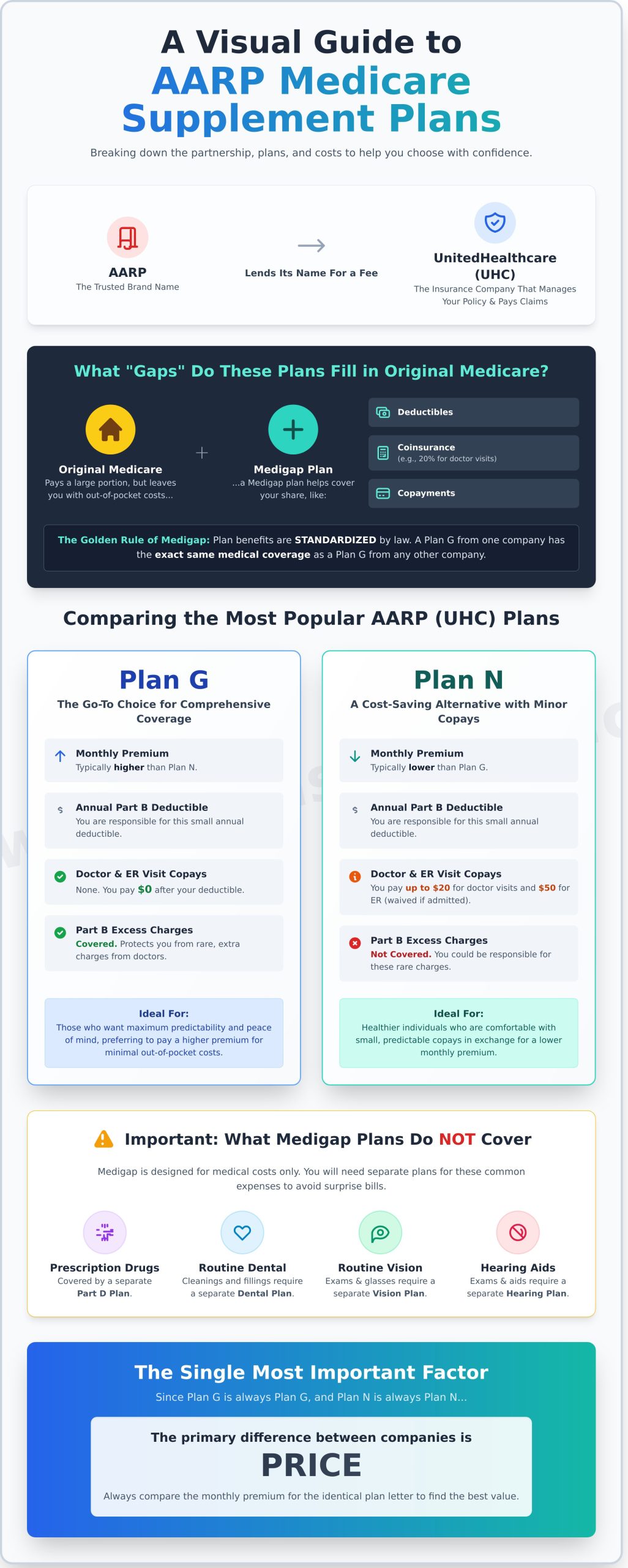
Plan G is a standardized plan. This means that, by federal law, the benefits provided by a Plan G policy are identical regardless of which insurance company issues the policy or in which state you reside (with limited exceptions in Massachusetts, Minnesota, and Wisconsin). When you purchase an AARP-endorsed Medicare Supplement Plan G, you are receiving a policy that covers the same standardized set of benefits as any other insurance carrier’s Plan G. The primary differences between carriers often lie in premiums, the financial stability of the insurer, and the quality of customer service.
What AARP Medicare Supplement Plan G Covers
The primary benefit of Plan G is its robust coverage for "gaps" that Original Medicare leaves behind. Under Plan G, you are responsible for paying the annual Medicare Part B deductible. Once that deductible is satisfied, Plan G covers almost all other Medicare-approved out-of-pocket costs.
The specific benefits included in Plan G are:
- Medicare Part A Coinsurance and Hospital Costs: Coverage for up to an additional 365 days after Medicare benefits are exhausted.
- Medicare Part B Coinsurance or Copayment: Covers the 20% of the Medicare-approved amount that you would otherwise pay for physician services and outpatient care.
- Blood: Coverage for the first three pints of blood each year.
- Part A Hospice Care Coinsurance or Copayment: Covers the costs associated with hospice care as defined by Medicare.
- Skilled Nursing Facility Care Coinsurance: Provides coverage for the coinsurance associated with stays in a skilled nursing facility.
- Medicare Part A Deductible: Pays the full amount of the Part A deductible for each benefit period.
- Medicare Part B Excess Charges: If you see a provider who does not "accept assignment" (meaning they do not accept the Medicare-approved amount as payment in full), they may charge up to 15% more than the Medicare-approved amount. Plan G covers these excess charges.
- Foreign Travel Emergency: Provides 80% coverage for emergency healthcare services received while traveling outside the United States (subject to a lifetime maximum).
It is important to note that Plan G does not cover the Medicare Part B annual deductible. As of 2026, you must pay this amount out of pocket before the plan begins covering your Part B coinsurance and other services.
Understanding the AARP Relationship
A key point of confusion for many beneficiaries is the relationship between AARP and UnitedHealthcare. AARP is a nonprofit, nonpartisan organization that advocates for older adults. They do not act as the insurance company itself. Instead, AARP licenses its brand to UnitedHealthcare.
UnitedHealthcare is the actual issuer and administrator of the AARP Medicare Supplement insurance plans. This means that when you enroll in an AARP Medicare Supplement Plan G, your contract is with UnitedHealthcare. They are responsible for processing claims, managing customer service inquiries, and setting premium rates. AARP receives royalty fees from this arrangement, which are used to help fund their various programs and advocacy efforts.
Comparison of Medicare Supplement Plans
When evaluating Plan G, it is helpful to compare it to other available Medigap options. The following table illustrates how Plan G sits in the landscape of standard supplement options.
| Benefit Category | Plan G | Plan N | Plan F* |
|---|---|---|---|
| Part A Deductible | Yes | Yes | Yes |
| Part B Coinsurance | Yes | Yes (with copay) | Yes |
| Part B Excess Charges | Yes | No | Yes |
| Part B Deductible | No | No | Yes |
| Foreign Travel | Yes (80%) | Yes (80%) | Yes (80%) |
*Plan F is only available to those who were eligible for Medicare prior to January 1, 2020.
As shown in the table, Plan G is often considered the "gold standard" for those who want comprehensive coverage without the complications of managing excess charges. While Plan N often carries a lower premium, it requires the beneficiary to pay copayments for certain office visits and does not cover Part B excess charges. Plan F provides the most comprehensive coverage, but it is no longer available to new Medicare beneficiaries.
Eligibility and Enrollment
To enroll in an AARP Medicare Supplement Plan G, you must meet certain eligibility requirements. You must be enrolled in both Medicare Part A and Part B. While you can apply for a Medigap plan at any time once you are enrolled in Medicare, your "Medigap Open Enrollment Period" is the most advantageous time to do so.
This six-month window begins on the first day of the month in which you are both 65 or older and enrolled in Medicare Part B. During this period, insurance companies cannot deny you coverage or charge you higher premiums due to pre-existing health conditions (this is known as "guaranteed issue"). If you apply for a policy outside of this window, you may be subject to medical underwriting. Underwriting allows the insurer to review your health history and potentially decline your application or increase your premium based on your medical status, depending on your state’s regulations.
Cost Considerations and Premium Factors
The cost of an AARP Medicare Supplement Plan G policy is not fixed. Premiums are influenced by several variables:
- Age and Gender: Premiums are often age-rated, meaning they may increase as you grow older.
- Location: The cost of medical care varies significantly by state and zip code, which affects your monthly premium.
- Tobacco Use: Some carriers apply surcharges for tobacco users.
- Household Discounts: Many UnitedHealthcare-insured AARP plans offer a discount if more than one person in the household is enrolled in the same plan or if another person in the household is also an AARP Medicare Supplement policyholder.
- Annual Increases: Even if your health remains stable, you should anticipate that premiums may rise over time due to inflation, the rising cost of medical services, and the collective claims experience of the policyholder pool.
It is essential to review the "rate history" of an insurance carrier if that information is available in your state. While past performance does not guarantee future results, it can provide insight into how frequently a specific carrier adjusts its premiums.
Potential Drawbacks and Limitations
While Plan G offers extensive coverage, it is not an all-inclusive solution for every healthcare need. Beneficiaries must be aware of what is explicitly excluded from their coverage:
- Prescription Drugs: Medigap policies do not cover outpatient prescription drugs. You will need to enroll in a separate Medicare Part D plan or obtain drug coverage through other creditable means.
- Routine Vision and Dental: Standard Medigap policies, including Plan G, do not cover routine eye exams, eyeglasses, or dental procedures. These are generally considered "non-covered" services under Original Medicare and thus fall outside the scope of Medigap.
- Long-Term Care: Custodial care, such as assistance with activities of daily living (bathing, dressing) in a nursing home or at home, is not covered by Medicare or Medigap.
Steps to Evaluate and Apply
If you are considering an AARP Medicare Supplement Plan G, follow these steps to ensure you are making an informed decision:
- Verify Your Medicare Enrollment: Ensure you have your red, white, and blue Medicare card. You must have both Part A and Part B active to proceed.
- Consult the Medicare Website: Use the official Medicare Plan Finder tool to view the various plans available in your specific service area. This ensures you have a baseline for what standardized plans should cost.
- Request a Quote: Visit the official UnitedHealthcare/AARP Medicare Supplement website or contact a licensed agent. Provide your zip code, age, and gender to receive an accurate premium quote.
- Review the Outline of Coverage: Every insurer is required to provide an "Outline of Coverage." Read this document carefully; it details the specific benefits, exclusions, and renewal provisions of the policy.
- Check for Guaranteed Issue: If you are within your six-month Open Enrollment window, confirm that your application is processed with guaranteed issue rights. If you are applying later, be prepared to answer health history questions accurately.
Frequently Asked Questions
Does AARP Medicare Supplement Plan G cover prescription drugs? No. Plan G is a Medicare Supplement policy and does not include prescription drug coverage. To cover your medications, you must enroll in a separate Medicare Part D prescription drug plan.
What happens if I move to a different state? In most cases, you can keep your AARP Medicare Supplement Plan G if you move, but your premium may change because rates are determined by your location. Contact UnitedHealthcare customer service before you move to understand how your specific policy will be affected.
Can UnitedHealthcare cancel my Plan G policy? No. As long as you pay your premiums on time and provided accurate information on your application, your Medigap policy is "guaranteed renewable." The insurance company cannot cancel your policy simply because you develop health problems or file a high volume of claims.
Is Plan G available for those under 65? Federal law does not mandate that insurers offer Medigap plans to those under 65, though many states have their own laws requiring insurers to offer at least one Medigap plan to people with disabilities. Check your state's Department of Insurance website for local regulations regarding disability eligibility for Plan G.
Does Plan G cover me if I see any doctor in the U.S.? Yes. One of the primary advantages of Plan G is that it works with any doctor or hospital that accepts Medicare. You are not restricted to a provider network (such as an HMO or PPO), which provides significant flexibility for those who travel or want access to specialists nationwide.
Final Recommendation
AARP Medicare Supplement Plan G remains a premier choice for beneficiaries who prioritize predictable healthcare costs and the freedom to choose their own providers. Because it covers nearly all the gaps in Original Medicare, it removes the financial burden of unexpected deductibles and coinsurance.
Before finalizing your decision, use the Medicare Plan Finder to compare the premium rates of Plan G with other available plans in your area. Ensure you account for the cost of a separate Part D prescription drug plan in your total annual healthcare budget. If you are within your initial Open Enrollment period, take advantage of your guaranteed issue rights to secure coverage without medical underwriting.