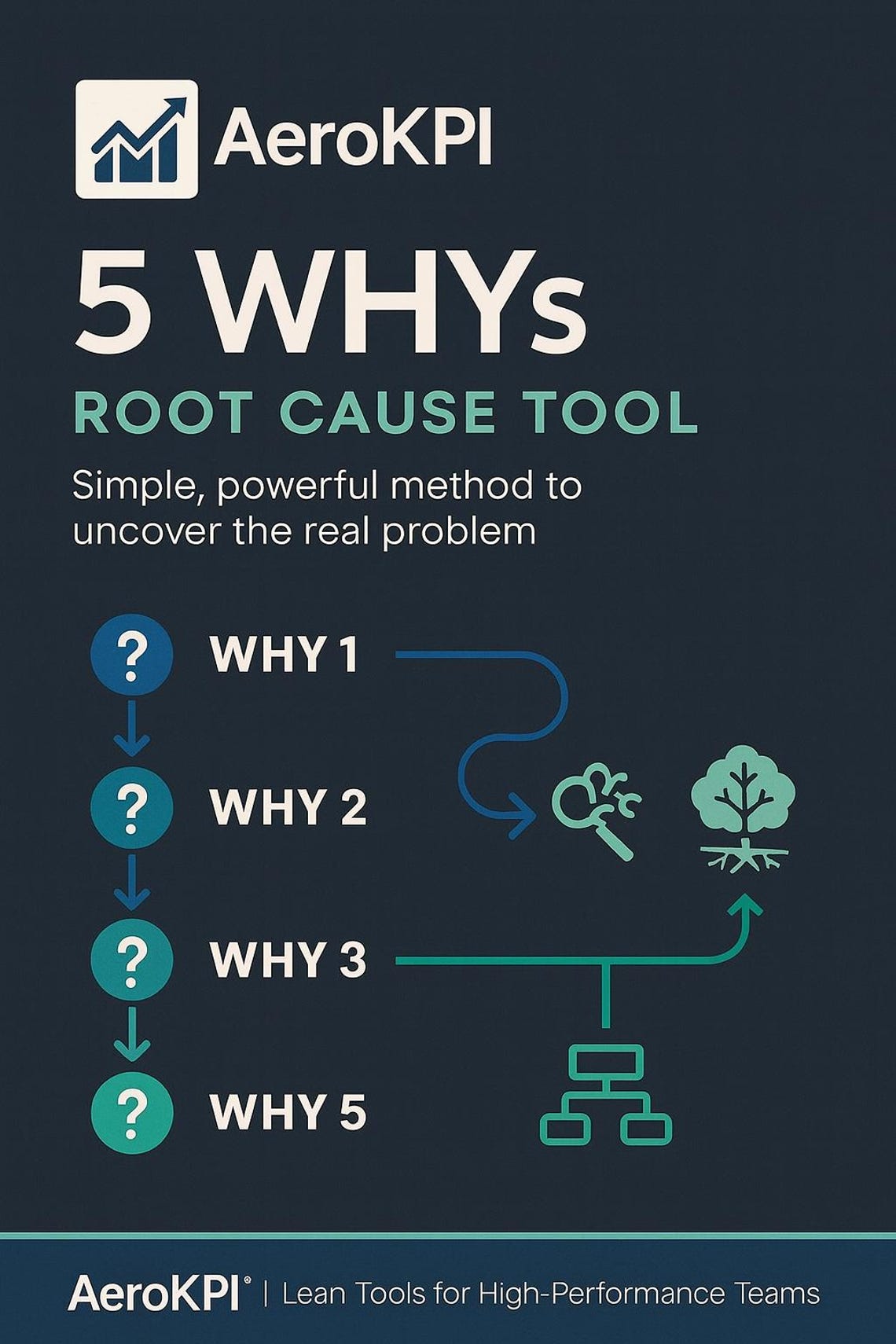
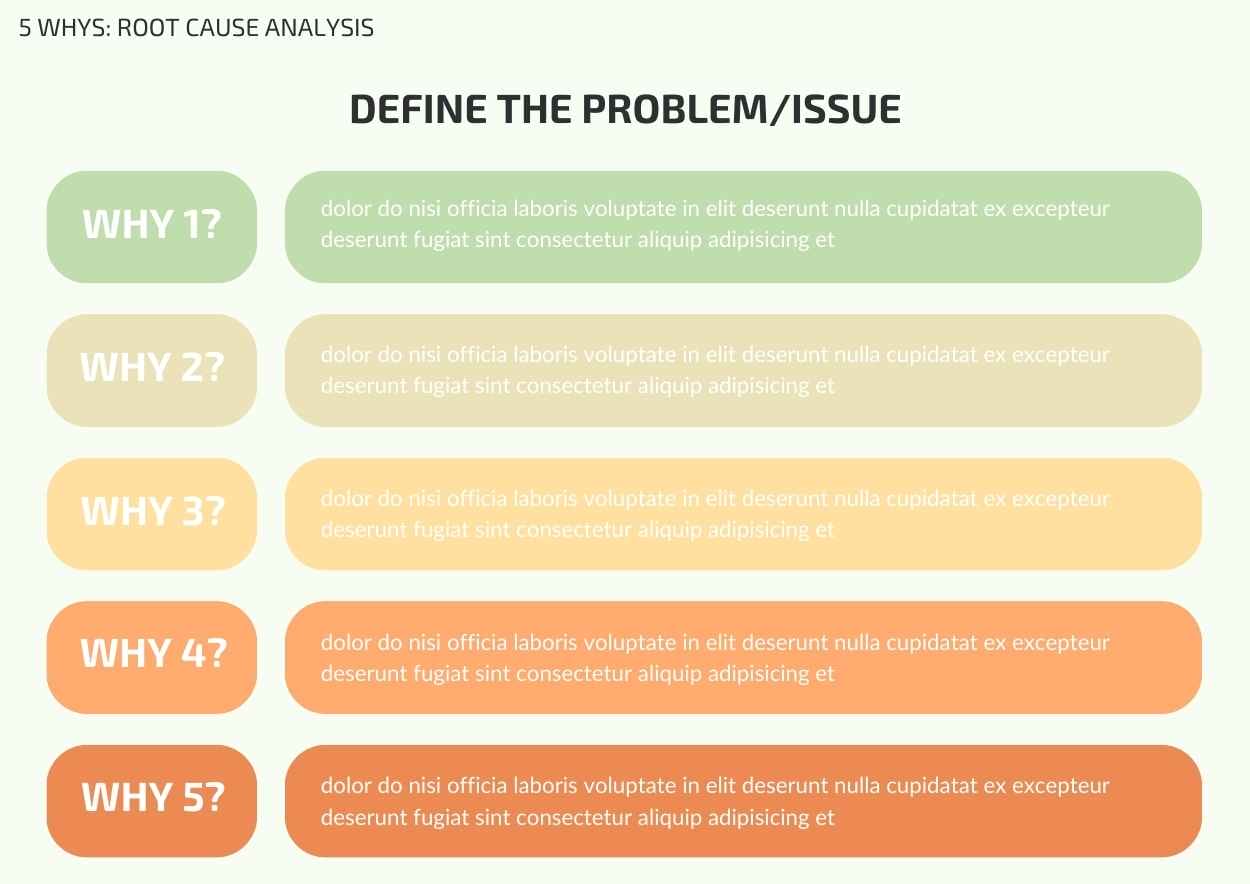
The 5 Whys is a simple root cause analysis tool that helps teams and individuals drill down to the fundamental source of a problem by repeatedly asking "Why?" until the underlying operational or systemic failure is uncovered.
Effective problem-solving in business, engineering, and daily operations often stalls because teams address symptoms rather than underlying causes. When a machine breaks, a software deployment fails, or a customer service metric drops, the immediate instinct is to fix the visible error and move on. However, without identifying why the issue occurred in the first place, organizations find themselves fighting the same fires repeatedly.
The 5 Whys framework offers a direct counter-weight to this reactive cycle. Developed within the Toyota Production System by Sakichi Toyoda, this iterative interrogative technique strips away layers of superficial symptoms to expose systemic vulnerabilities. This guide explores the mechanics of the 5 Whys framework, how to execute it effectively, its structural limitations, and how it compares to alternative root cause analysis tools.
Understanding the Foundation of the 5 Whys
At its core, the 5 Whys technique relies on the premise that every problem is a chain of events. By breaking the chain through targeted inquiry, investigators can isolate the point where a process broke down. The number "5" is not a magic threshold; rather, it represents a general rule of thumb indicating that it typically takes about five iterations of asking "Why?" to transition from a surface-level symptom to a true root cause.
Some problems may require only three iterations, while complex, multi-variable systemic failures might require six or seven. The objective is not to rigidly force an inquiry to reach five questions, but to continue asking until the team identifies a systemic cause that, if corrected, prevents the problem from recurring.
The Philosophy of Blameless Inquiry
A critical requirement for successfully applying the 5 Whys is maintaining a blameless culture. The tool is designed to interrogate processes, systems, and human-system interactions—not to interrogate people.
If an investigator asks "Why did John make a mistake?" and accepts "Because John wasn't paying attention" as the final answer, the analysis fails. A robust 5 Whys investigation treats human error as a symptom of a deeper systemic flaw. It asks why the workflow allowed human error to occur without catching it, whether training was adequate, or if environmental factors like fatigue or poor interface design contributed to the lapse.
Step-by-Step Methodology: How to Conduct a 5 Whys Analysis
Executing a 5 Whys analysis requires discipline, a clear definition of the problem, and the right cross-functional participants in the room. Rushing through the exercise or allowing dominant personalities to steer the narrative compromises the integrity of the findings.
Step 1: Define the Problem Clearly
Before asking the first "Why?", the team must establish a precise, factual statement of the problem. Vague descriptions like "our software is slow" or "production is down" lack the necessary specificity. Instead, define the problem with measurable parameters: "The primary database query response time exceeded 4 seconds during peak traffic hours on Tuesday, violating our SLA."
A well-defined problem statement frames the starting point and prevents investigators from chasing unrelated operational grievances.
Step 2: Form the Right Team
Root cause analysis should rarely be conducted in isolation. Assemble a small team of 3 to 5 individuals who possess direct, firsthand knowledge of the process being investigated. This group should include:
- Process operators or front-line staff who execute the work daily.
- Subject matter experts who understand technical specifications.
- A neutral facilitator to guide the questioning and prevent circular arguments.
Step 3: Ask the First "Why?"
Take the problem statement and ask why it occurred. Ensure the answer is grounded in established facts, data, and direct observation rather than assumptions, guesses, or finger-pointing.
- Problem: The monthly financial report was delivered three days late.
- Why 1: The data reconciliation sheet could not be finalized because the sales figures from the regional office were missing.
Step 4: Iterate and Chain the Questions
Take the answer from the previous step and ask "Why?" again. Each subsequent answer becomes the premise for the next question, forming a causal chain.
- Why 2: Why were the regional sales figures missing? Because the regional manager forgot to upload the end-of-month spreadsheet to the shared drive.
- Why 3: Why did the regional manager forget to upload the spreadsheet? Because they were not notified of the new reporting deadline implemented this quarter.
- Why 4: Why were they not notified? Because the internal communications team did not include regional managers in the policy update email distribution list.
- Why 5: Why were they excluded from the distribution list? Because the HR directory used to populate distribution lists has not been synchronized with the active organizational chart.
In this example, the analysis successfully moves from a late report all the way to an outdated HR directory database synchronization process—a clear systemic fix that prevents future communication failures across all departments.
Common Pitfalls and How to Avoid Them
While the concept of the 5 Whys is deceptively simple, executing it effectively requires avoiding several common traps that undermine its utility.
| Pitfall | Description | Corrective Action |
|---|---|---|
| Stopping at Symptoms | Halting the inquiry too early, resulting in a superficial fix that treats the symptom rather than the disease. | Continue asking "Why?" until the answer points to a controllable process, policy, or system that can be redesigned. |
| Stopping at Human Error | Blaming individuals rather than evaluating the operational environment that allowed the error to happen. | Reframe answers focusing on human error to examine training, tooling, supervision, and workflow design. |
| Single-Path Tunnel Vision | Assuming there is only one causal chain, ignoring the reality that complex problems often stem from multiple interacting factors. | Use branching techniques or transition to a fishbone diagram if multiple root causes emerge during the inquiry. |
| Confirmation Bias | Tailoring the answers to fit a preconceived notion or political preference within the organization. | Anchor every "Why?" in verifiable data, logs, and direct evidence rather than anecdotal opinions. |
Comparing the 5 Whys to Alternative Root Cause Tools
The 5 Whys is valued for its agility and low barrier to entry, but it is not the only tool available for root cause analysis. Understanding when to use the 5 Whys versus more complex methodologies ensures that organizations match the tool to the complexity of the problem.
5 Whys vs. Fishbone (Ishikawa) Diagrams
A Fishbone Diagram categorizes potential causes across broad operational categories—such as Methods, Materials, Machines, Manpower, Measurement, and Milieu (Environment).
- Use 5 Whys when investigating straightforward, linear problems where cause-and-effect relationships are relatively direct.
- Use Fishbone Diagrams when dealing with complex, multi-faceted problems with numerous unknown variables, as the diagram helps brainstorm and organize categories before drilling down.
5 Whys vs. Failure Mode and Effects Analysis (FMEA)
FMEA is a proactive, prospective risk assessment tool used to evaluate potential failures in a process or design before they occur, assigning risk priority numbers based on severity, occurrence, and detection.
- Use 5 Whys reactively, after a failure has already occurred, to understand how it happened.
- Use FMEA proactively during design and planning phases to anticipate vulnerabilities and mitigate them ahead of time.
Integrating 5 Whys Findings into Corrective Action Plans
Identifying the root cause is only half the battle. A root cause analysis provides zero operational value unless its findings translate into concrete corrective and preventive actions (CAPA).
Once the final "Why?" points to a systemic failure, the organization must design a countermeasure that addresses it. Effective countermeasures should be:
- Specific: Clearly outline what changes will be made to the process, software, or policy.
- Measurable: Establish how success will be verified over time.
- Assigned: Designate a single owner responsible for implementation.
- Time-Bound: Set a strict deadline for completion.
Furthermore, teams should implement a verification loop. Return to the problem area 30, 60, and 90 days after implementing the countermeasure to confirm that the issue has not resurfaced. If the problem recurs, it indicates that the 5 Whys analysis stopped too early or targeted the wrong causal chain.
Frequently Asked Questions
Is the 5 Whys only used in manufacturing?
No. While the technique originated in manufacturing as part of lean production systems, it is widely used across software engineering, healthcare, finance, logistics, and administrative workflows. Any operational process subject to failure can benefit from iterative root cause inquiry.
What happens if our team reaches different root causes for the same problem?
Diverging paths are common, especially when complex systemic issues are involved. This indicates that the problem has multiple contributing factors. Rather than forcing a single consensus, document all valid causal chains and develop countermeasures for each identified root cause.
Can one person perform a 5 Whys analysis alone?
Yes, an individual can use the 5 Whys for personal productivity, minor troubleshooting, or preliminary assessments. However, complex organizational problems benefit significantly from collaborative team sessions to avoid blind spots and leverage diverse perspectives.
What should I do if my team keeps answering "I don't know"?
When an investigation stalls because participants do not know the answer to a "Why?", pause the session and assign investigative tasks to gather the necessary data, logs, or operational metrics before resuming the analysis. Never guess or fabricate answers to complete the five steps.
How do I know when to stop asking "Why?"
You have reached an appropriate stopping point when the questioning yields a systemic root cause that is within the organization's control to change, and correcting it will logically prevent the original problem from happening again.
Conclusion
The 5 Whys is an exceptionally versatile framework that strips away complexity to reveal the operational realities hiding behind everyday failures. By fostering a blameless culture of inquiry, grounding every question in verifiable data, and pushing past surface-level symptoms, organizations can transform recurring operational friction into opportunities for lasting systemic improvement. Integrating this simple tool into daily workflows empowers teams to solve problems permanently rather than managing the same symptoms over and over again.