Form 2290 is an essential annual Internal Revenue Service (IRS) filing requirement for owners and operators of heavy motor vehicles traveling on public highways. Navigating this tax form correctly is critical for maintaining commercial vehicle registration, avoiding heavy penalties, and securing the official proof of payment required by state departments of motor vehicles.
Operating a commercial vehicle fleet or even an independent heavy truck requires strict compliance with federal tax obligations, and the Heavy Highway Vehicle Use Tax (HVUT) is one of the most prominent requirements for truck operators. Administered by the Internal Revenue Service, Form 2290 is used to calculate and pay the tax due on heavy vehicles operating on public highways with a taxable gross weight of 55,000 pounds or more. Because this tax directly funds federal highway construction and maintenance, the IRS enforces filing and payment deadlines rigorously.
For motor carriers, owner-operators, and fleet managers, understanding the intricacies of this form prevents costly administrative bottlenecks. Failing to file correctly or missing the registration window can lead to suspended vehicle registrations, steep financial penalties, and audits. This guide breaks down the five most critical points every vehicle owner and tax preparer must understand regarding Form 2290, covering everything from basic filing requirements to exemptions, payment methods, and proof of payment documentation.
1. Who Must File Form 2290 and What Triggers the Tax?
The primary trigger for filing Form 2290 is the registered gross weight of the vehicle combined with its operation on public highways. The tax applies to highway motor vehicles—including trucks, truck tractors, and buses—that have a taxable gross weight of 55,000 pounds or more.
Determining Taxable Gross Weight
The taxable gross weight of a vehicle is not merely its empty weight or its manufacturer’s rated capacity. Instead, it is calculated as the sum of:
- The actual unloaded weight of the vehicle fully equipped for service.
- The actual unloaded weight of any trailers or semi-trailers customarily used in combination with the vehicle.
- The weight of the maximum load customarily carried on the vehicle and its trailers.
If this total calculated weight reaches or exceeds 55,000 pounds, the vehicle is subject to the Heavy Highway Vehicle Use Tax. The tax rate is structured on a sliding scale. For vehicles weighing between 55,000 and 75,000 pounds, the base tax is $100 plus $22 for each 1,000 pounds (or fraction thereof) over 55,000 pounds. For vehicles with a taxable gross weight exceeding 75,000 pounds, the maximum annual tax is capped at $550 per year.
Registered Owner Responsibility
Form 2290 must be filed by the person registered or required to be registered under state law as the owner of the vehicle. If the vehicle is owned by a corporation, LLC, or partnership, the business entity is responsible for the filing. Independent contractors who lease their trucks to motor carriers must still file Form 2290 under their own name and Employer Identification Number (EIN), unless the lease agreement explicitly shifts the legal burden under specific regulatory frameworks, though the registered owner remains ultimately accountable to the IRS.
2. Strict Filing Deadlines and the Tax Period
Unlike standard individual income tax returns that follow the traditional calendar year, the Form 2290 tax period runs from July 1 through June 30 of the following year. Consequently, the standard annual filing deadline for vehicles used during the month of July is August 31.
Understanding the Monthly Pro-Rata Rule
For vehicles placed in service after July, the filing deadline shifts. If a taxable vehicle is first used on public highways in any month other than July, the tax is prorated, and Form 2290 must be filed by the last day of the month following the month the vehicle was first used.
For example, if an operator purchases a new heavy truck and puts it into service on public highways in October, the Form 2290 for that vehicle must be filed, and the tax paid, by November 30. Missing these rolling deadlines triggers failure-to-file penalties and interest charges that accumulate rapidly.
Weekends and Holidays
When a Form 2290 deadline falls on a Saturday, Sunday, or legal holiday, the due date automatically shifts to the next business day. Filers should always verify holiday calendars to avoid accidental defaults.
3. Mandatory Electronic Filing Requirements
Since the implementation of modern IRS regulations, electronic filing (e-filing) has shifted from a convenient option to a strict requirement for many filers, fundamentally changing how proof of payment is obtained.
The 25-Vehicle Threshold
Under IRS guidelines, any taxpayer reporting 25 or more taxable vehicles on a single Form 2290 must file the return electronically through an IRS-approved e-file provider. While taxpayers with fewer than 25 vehicles are legally permitted to file using traditional paper forms (IRS Form 2290), e-filing is strongly encouraged by federal agencies for all filers due to the speed and security it provides.
Advantages of E-Filing
- Immediate Processing: Paper returns can take weeks or months to process through mail queues, whereas e-filed returns are processed almost instantly.
- Rapid Schedule 1 Generation: Once an e-filed return is accepted and paid, the IRS returns a watermarked Schedule 1 within minutes or hours.
- Reduced Error Rates: Tax software and portal interfaces check for missing EINs, incorrect Vehicle Identification Numbers (VINs), and mathematical errors before submission, drastically lowering rejection rates.
4. The Crucial Role of the Schedule 1 and Proof of Payment
Filing Form 2290 is only half the battle; obtaining and maintaining proof of payment is legally mandatory for operating commercial vehicles on public roadways.
What is Schedule 1?
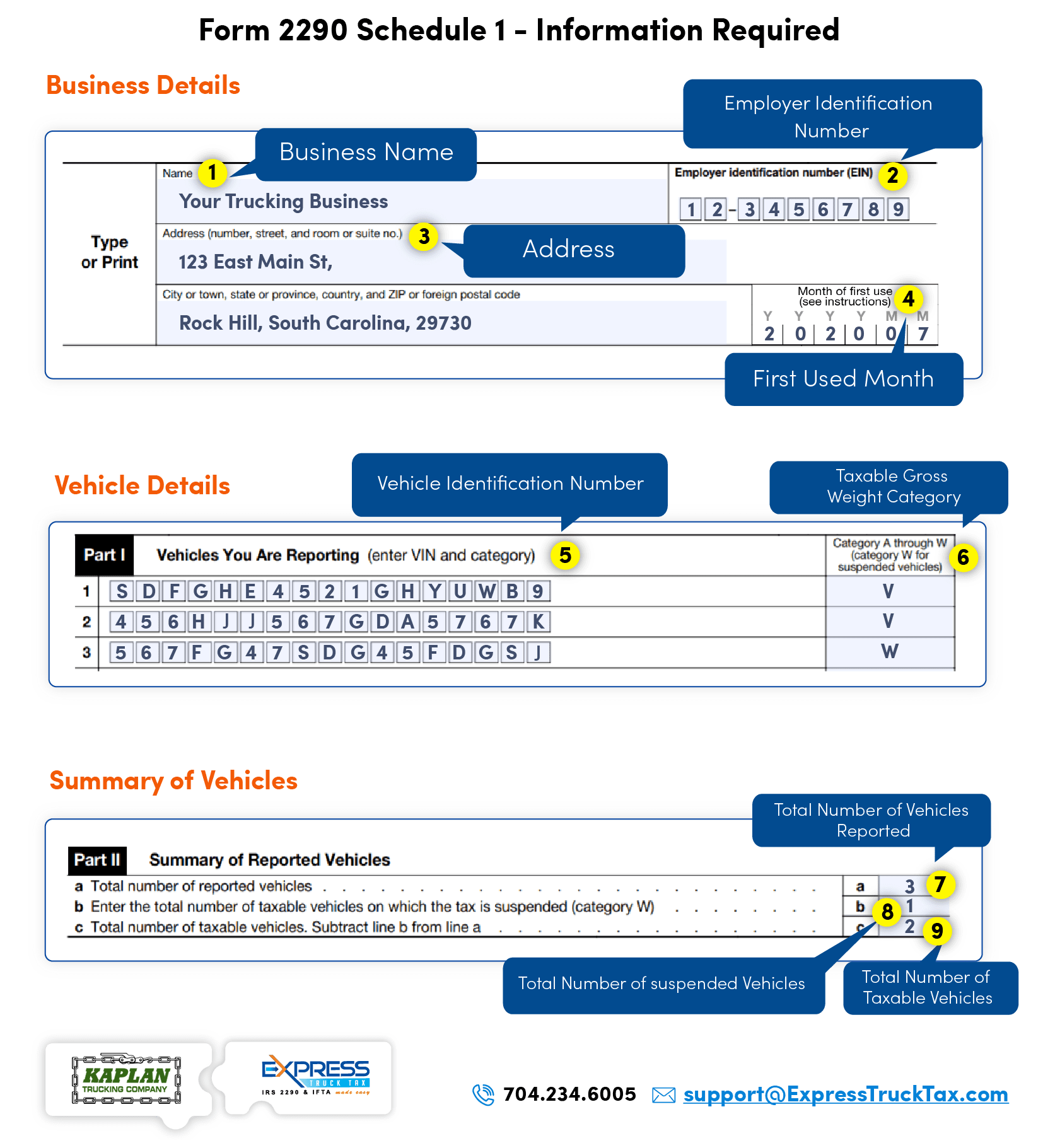
Schedule 1 is the attachment to Form 2290 that lists all vehicles reported on the return by their Vehicle Identification Numbers (VINs). When the IRS processes the return and confirms payment, it stamps or watermarks the Schedule 1.
Why Schedule 1 Matters at the DMV and Scale Houses
State departments of motor vehicles (DMVs) require a stamped or watermarked Schedule 1 before they will renew a vehicle’s registration or issue license plates. Operating without a valid, current Schedule 1 can result in state registration holds, roadside citations from the Department of Transportation (DOT), and substantial fines. Law enforcement officers and state auditors routinely inspect the Schedule 1 during compliance checks to verify that federal highway taxes have been duly paid.
| Filing Method | Processing Time | Schedule 1 Delivery | Best Suited For |
|---|---|---|---|
| IRS-Approved E-File | Minutes to 24 Hours | Electronic PDF (Watermarked) | All filers (Mandatory for 25+ vehicles) |
| Traditional Paper Filing | 4 to 6 Weeks | Mailed Paper Copy (Stamped) | Small fleet owners with low urgency |
5. Suspended Vehicles and Exemptions
Not every heavy vehicle operating on public roads is subject to the full HVUT amount. Taxpayers must understand the nuances of suspended vehicles and specific statutory exemptions to avoid overpaying.
Suspended Vehicles (Mileage Limits)
A vehicle is classified as a "suspended vehicle" if it is expected to be used on public highways for 5,000 miles or less (7,500 miles or less for agricultural vehicles) during the current period (July 1 through June 30).
- Filing Requirement: Even though the tax is suspended (meaning $0 tax is owed), the owner must still file Form 2290 and list the vehicle on the Schedule 1 to claim the suspension.
- Exceeding the Limit: If a suspended vehicle exceeds the mileage threshold during the period, the tax becomes due immediately, and the owner must file an amended Form 2290 reporting the change in status.
Exempt Vehicles
Certain vehicles are entirely exempt from Form 2290 requirements. These include:
- Mobile Machinery: Vehicles designed for nonhighway use, such as mobile cranes, asphalt spreaders, and well-drilling equipment, provided they meet specific structural and operational criteria.
- Government and Transit Vehicles: Vehicles owned and operated by the United States government, state or local governments, and qualified local transit bus companies.
- Blood Collector Vehicles: Trucks used exclusively by nonprofit organizations to collect, store, or transport blood.
Frequently Asked Questions
What happens if I miss the Form 2290 filing deadline?
Missing the deadline results in an IRS penalty for failure to file, which is typically 4.5% of the total tax unpaid, assessed monthly for up to five months. Additionally, a failure-to-pay penalty of 0.5% per month applies, along with mounting interest charges. You may also face state registration suspensions.
Can I pay my Form 2290 tax liability with a credit card?
Yes. When utilizing an IRS-approved e-file provider, taxpayers can typically pay their tax liability via Electronic Funds Withdrawal (EFT), credit card, debit card, or Electronic Federal Tax Payment System (EFTPS). Processing fees may apply for card transactions.
What should I do if my Schedule 1 contains an incorrect VIN?
If you e-filed and noticed an incorrect Vehicle Identification Number on your Schedule 1, you must file an amended Form 2290. You will need to report the corrected VIN, explain the correction, and cross-reference the original submission. Using e-file software significantly minimizes typographical errors on VINs.
Are vehicles used exclusively off-highway subject to Form 2290?
No. Vehicles that are operated exclusively off-highway—such as logging trucks used solely on private timber roads or construction vehicles confined entirely to job sites—are generally exempt from the tax, provided they do not travel on public highways.
How do I transfer Form 2290 tax credit if I sell my truck?
If a taxable vehicle is sold, destroyed, or stolen during the tax period, the owner may be eligible for a tax credit or refund for the unused portion of the tax year. The claim can be filed on Form 2290 (or Form 8849, Claim for Refund of Excise Taxes) once the vehicle is removed from service.
Next Actions and Compliance Checklist
To ensure absolute compliance with federal highway tax laws, motor carriers and independent operators should take the following practical steps:
- Audit Your Fleet: Verify the current taxable gross weight and active status of every vehicle in your fleet ahead of the upcoming tax period.
- Gather Documentation: Ensure all Vehicle Identification Numbers (VINs), business EINs, and registration details are accurate and readily available.
- Select an E-File Provider: Partner with an IRS-authorized e-file provider to streamline submission, secure rapid watermarked Schedule 1 documents, and prevent common data-entry errors.
- Monitor Deadlines: Mark the filing calendar early—remembering the August 31 standard deadline or the rolling monthly deadlines for newly acquired vehicles.