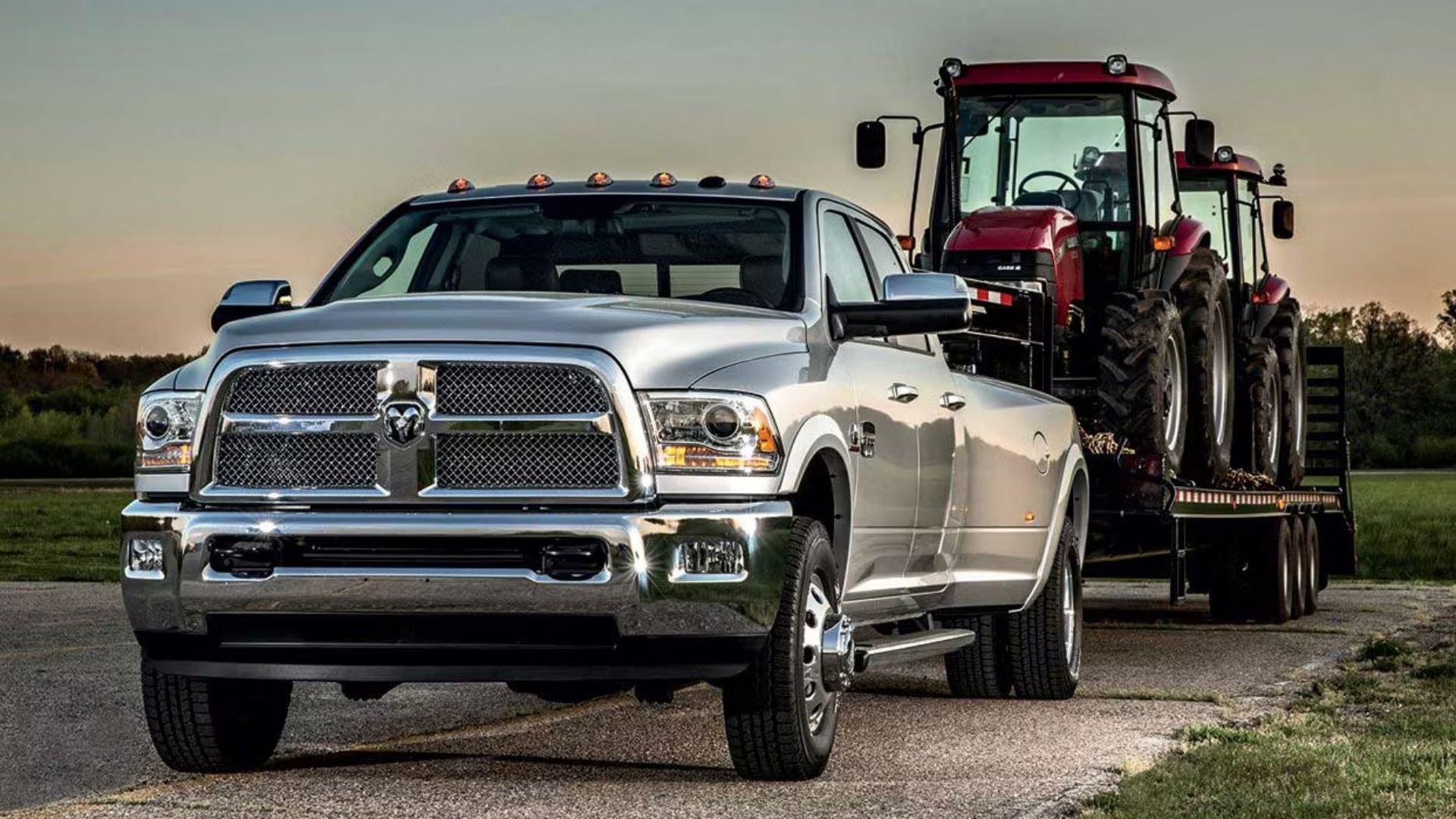
The maximum towing capacity for a Ram 3500 equipped with the 6.7L Cummins High Output Turbo Diesel is 37,090 pounds when properly configured with a regular cab, 4x2 drivetrain, and 4.10 axle ratio. Standard Output models and varied cab configurations typically range between 18,000 and 25,000 pounds.
The Cummins diesel engine has long been the gold standard for heavy-duty pickup trucks, and in 2026, the Ram 3500 continues to leverage this power plant to dominate the towing segment. However, "towing capacity" is not a single, static number. It is a variable figure determined by the engine output, transmission type, axle ratio, and vehicle weight. To safely and legally tow heavy loads, owners must understand how these components interact to produce the Gross Combined Weight Rating (GCWR).
The Heart of the Haul: Cummins 6.7L Engine Variants
The 2026 Ram 3500 offers two distinct versions of the Cummins 6.7L I6 Turbo Diesel. Selecting the right one is the first and most critical step in determining your vehicle's towing potential.
The High Output (HO) Cummins
The High Output variant is specifically engineered for maximum trailering. In the 2026 model year, this engine remains the choice for professional haulers and heavy fifth-wheel enthusiasts. It is characterized by a CGI (Compacted Graphite Iron) block which provides increased strength without excessive weight. The HO version typically produces over 420 horsepower and a staggering 1,075 lb-ft of torque.
Crucially, the HO engine is exclusively paired with the Aisin AS69RC six-speed automatic transmission. This transmission is a medium-duty component designed to handle the massive torque loads that occur when pulling 30,000+ pounds up a steep grade. Without the Aisin transmission and the HO engine, the truck cannot reach the 37,000-pound maximum towing threshold.
The Standard Output (SO) Cummins
The Standard Output Cummins is no slouch, but it is tuned for a balance of efficiency and capability. It generally produces around 370 horsepower and 850 lb-ft of torque. This version is paired with the Ram-built 68RFE six-speed automatic transmission.
While the SO engine is more than capable for most horse trailers and medium-sized campers, its towing capacity is significantly lower than the HO version, usually topping out around 22,670 pounds depending on the configuration. The 68RFE transmission is not rated for the extreme GCWR of the HO/Aisin combination, which is why the towing gap between the two engines is so wide.
Configuration Variables: How the Truck Setup Changes Capacity
Even with the High Output Cummins, you will only reach the maximum towing capacity if the rest of the truck is configured correctly. Every pound added to the truck’s own weight (curb weight) is a pound subtracted from what it can legally tow.
Single Rear Wheel (SRW) vs. Dual Rear Wheel (DRW)
For anyone looking to maximize 3500 Cummins towing capacity, the "Dually" (DRW) setup is mandatory. The additional two wheels on the rear axle provide the lateral stability necessary to manage heavy trailers and increase the Gross Axle Weight Rating (GAWR).
An SRW Ram 3500 is generally limited by its tires and rear springs, typically maxing out at a towing capacity of around 18,210 pounds. If your goal is to pull a massive gooseneck trailer, the stability and weight distribution of the DRW configuration are essential.
Axle Ratios: The Force Multiplier
The axle ratio (or gear ratio) determines how many times the driveshaft rotates for every single rotation of the wheel.
- 3.73 Axle Ratio: This is the standard ratio. It offers a good balance between towing capability and fuel economy when the truck is empty.
- 4.10 Axle Ratio: This is the "tow-boss" gear. It provides more mechanical advantage, allowing the engine to stay in its power band more easily when moving heavy loads from a dead stop. To reach the 37,090-pound maximum, the 4.10 gear set is a requirement.
Cab and Bed Size
The Regular Cab, Long Bed, 4x2 configuration is the lightest version of the truck. Because it has the lowest curb weight, it has the highest towing capacity. As you move to a Crew Cab or the massive Mega Cab, and add 4WD systems, the truck becomes heavier. A fully loaded Mega Cab 4x4 Limited will have a significantly lower maximum towing capacity than a base Tradesman Regular Cab 4x2, simply because the truck itself weighs 1,000 to 1,500 pounds more.
Understanding the "Big Four" Weight Ratings
To safely operate a Cummins-powered 3500, you must look beyond the "max towing" marketing number and understand the actual legal limits of the vehicle.
- GVWR (Gross Vehicle Weight Rating): The maximum total weight of the truck alone, including passengers, fuel, and the "tongue weight" or "kingpin weight" of the trailer. For most 2026 Ram 3500 DRW models, this is 14,000 pounds.
- GCWR (Gross Combined Weight Rating): The maximum allowable weight of the truck and the loaded trailer combined. For the HO Cummins with 4.10 gears, this is approximately 43,000 pounds.
- Payload Capacity: This is GVWR minus the Curb Weight. This is often the actual limiting factor for 5th-wheel towing. If your trailer's kingpin weight exceeds the payload capacity, you are overloaded, even if you are under the "max towing" limit.
- GAWR (Gross Axle Weight Rating): The maximum weight that can be placed on the front or rear axles specifically.
| Configuration | Engine | Max Towing (lbs) | Max Payload (lbs) | GCWR (lbs) |
|---|---|---|---|---|
| Regular Cab 4x2 DRW | 6.7L HO Cummins | 37,090 | 6,570 | 43,000 |
| Crew Cab 4x4 DRW | 6.7L HO Cummins | 34,110 | 6,140 | 43,000 |
| Mega Cab 4x4 DRW | 6.7L HO Cummins | 32,750 | 5,590 | 43,000 |
| Crew Cab 4x4 SRW | 6.7L SO Cummins | 18,210 | 4,120 | 27,000 |
Note: Figures are estimates based on 2026 SAE J2807 standards for the Ram 3500 series.
Towing Equipment and Technology in 2026
The Cummins engine provides the power, but the 2026 Ram 3500 chassis provides the control. Several technical features are necessary to manage the extreme loads these trucks are rated for.
Fifth-Wheel/Gooseneck Prep Group
To reach the 30,000-pound+ range, you cannot use a traditional bumper hitch. The truck must be equipped with the factory-installed gooseneck prep package. This includes a structural cross-member in the frame and integrated mounting holes in the bed. High-capacity towing requires a 30K or 40K rated hitch, which is significantly more robust than standard consumer fifth-wheel hitches.
Smart Exhaust Braking
One of the most praised features of the Cummins engine is the Integrated Variable Geometry Turbo (VGT) Exhaust Brake. When descending a grade with a heavy load, the exhaust brake uses the engine's compression to slow the vehicle, reducing the heat and wear on the truck's service brakes. In the 2026 models, "Smart Mode" allows the driver to set a specific speed, and the truck will automatically modulate the exhaust braking to maintain that speed without driver intervention.
Rear Auto-Level Air Suspension
For the 3500, the optional air suspension is highly recommended for heavy towing. It replaces the traditional rear leaf springs with air bags that can automatically level the truck when a heavy trailer is attached. This ensures that the truck’s headlights stay pointed at the road and that the suspension geometry remains optimal for handling and braking performance.
Practical Considerations for Heavy Hauling
Towing at the limit of a 3500 Cummins requires more than just a powerful truck; it requires meticulous maintenance and operational awareness.
Tires and Pressures
When towing near the 37,000-pound limit, tire pressure becomes a safety-critical variable. The rear tires on a DRW truck must be inflated to the "Cold Max" pressure listed on the tire sidewall or the vehicle door jamb to support the massive payload of a gooseneck trailer. Heat is the enemy of tires, and under-inflation is the leading cause of blowouts under load.
Cooling and Lubrication
The 2026 Cummins 6.7L utilizes a high-capacity cooling system, but extreme towing still generates massive heat in the transmission and differential. Owners who frequently tow near the maximum capacity should follow the "Severe Duty" maintenance schedule, which involves more frequent changes of the transmission fluid, differential gear oil, and engine coolant.
Licensing and Regulations
In many jurisdictions, driving a truck and trailer combination with a GCWR over 26,000 pounds requires a Commercial Driver’s License (CDL) or a non-commercial Class A license. Even if you are towing for personal use, such as a large RV, you must check local regulations. Furthermore, any vehicle used for commerce (like hotshot hauling) with a GCWR over 10,000 pounds is subject to Department of Transportation (DOT) regulations.
Frequently Asked Questions
Can a Ram 3500 Cummins tow 40,000 lbs?
As of 2026, the factory-rated maximum towing capacity for the Ram 3500 remains just under 38,000 pounds (specifically 37,090 lbs). While the engine might physically move 40,000 pounds, doing so exceeds the manufacturer's GCWR, which can lead to legal liability, denied insurance claims, and premature mechanical failure. For loads consistently over 37,000 pounds, a Class 4 or 5 truck (Ram 4500/5500) is required.
What is the difference between the 68RFE and Aisin transmissions for towing?
The 68RFE is a standard-duty transmission found on the SO Cummins; it is smoother for daily driving but has a lower torque rating. The Aisin AS69RC is a commercial-grade transmission found on the HO Cummins; it is larger, heavier, and designed with higher-strength internals specifically to handle the stresses of maximum-capacity towing.
Does the Mega Cab tow less than the Regular Cab?
Yes. The Mega Cab is significantly heavier than a Regular Cab because of the extra steel and interior components. Since the Gross Combined Weight Rating (the total weight of truck + trailer) is fixed for a specific engine/axle combo, the extra weight of the Mega Cab "eats into" the remaining weight available for the trailer.
Why is the 4.10 axle ratio better for towing?
The 4.10 ratio provides more torque at the wheels. Think of it like using a longer wrench to loosen a tight bolt. It makes it easier for the engine to start a heavy load moving from a stop and helps maintain speed on steep mountain grades, though it may slightly reduce fuel economy when the truck is empty.
Is the Cummins engine better for towing than the HEMI gas engine?
For the 3500 series, the Cummins diesel is vastly superior for heavy towing. While a gas engine (like the 6.4L HEMI) is lighter and cheaper to purchase, it lacks the low-end torque of the Cummins. For trailers over 15,000 pounds, the diesel's ability to maintain speed and its integrated exhaust brake make it the only logical choice for safety and longevity.
Final Recommendation
If you are planning to utilize the full 3500 Cummins towing capacity, your build must prioritize functional specs over luxury trim. To achieve the highest possible capacity, select a Ram 3500 Tradesman Regular Cab 4x2 with the 6.7L High Output Cummins, Aisin Transmission, and 4.10 Rear Axle Ratio. If you require a Crew Cab for family use, expect your real-world towing capacity to sit between 32,000 and 34,000 pounds—still a class-leading figure that can handle almost any recreational or commercial trailer on the market in 2026. Always verify your specific VIN's ratings on the official Ram Trucks Towing Guide before hitting the road.