Navigating the complexities of clinical documentation and medical classification requires a precise understanding of the International Classification of Diseases, Tenth Revision, and its specialized applications, such as Trauma Care Protocol (TCP) coding. Mastering these systems ensures accurate reimbursement, seamless clinical communication, and compliance with modern healthcare standards.
Understanding the Foundation of ICD-10 Medical Coding
Medical classification systems form the backbone of modern healthcare data collection, epidemiological tracking, and revenue cycle management. Transitioning from legacy coding structures to the International Classification of Diseases, Tenth Revision, brought unprecedented specificity to clinical documentation. For healthcare administrators, health information management (HIM) professionals, and clinical documentation improvement (CDI) specialists, understanding the foundational architecture of this system is the first step toward achieving operational accuracy.
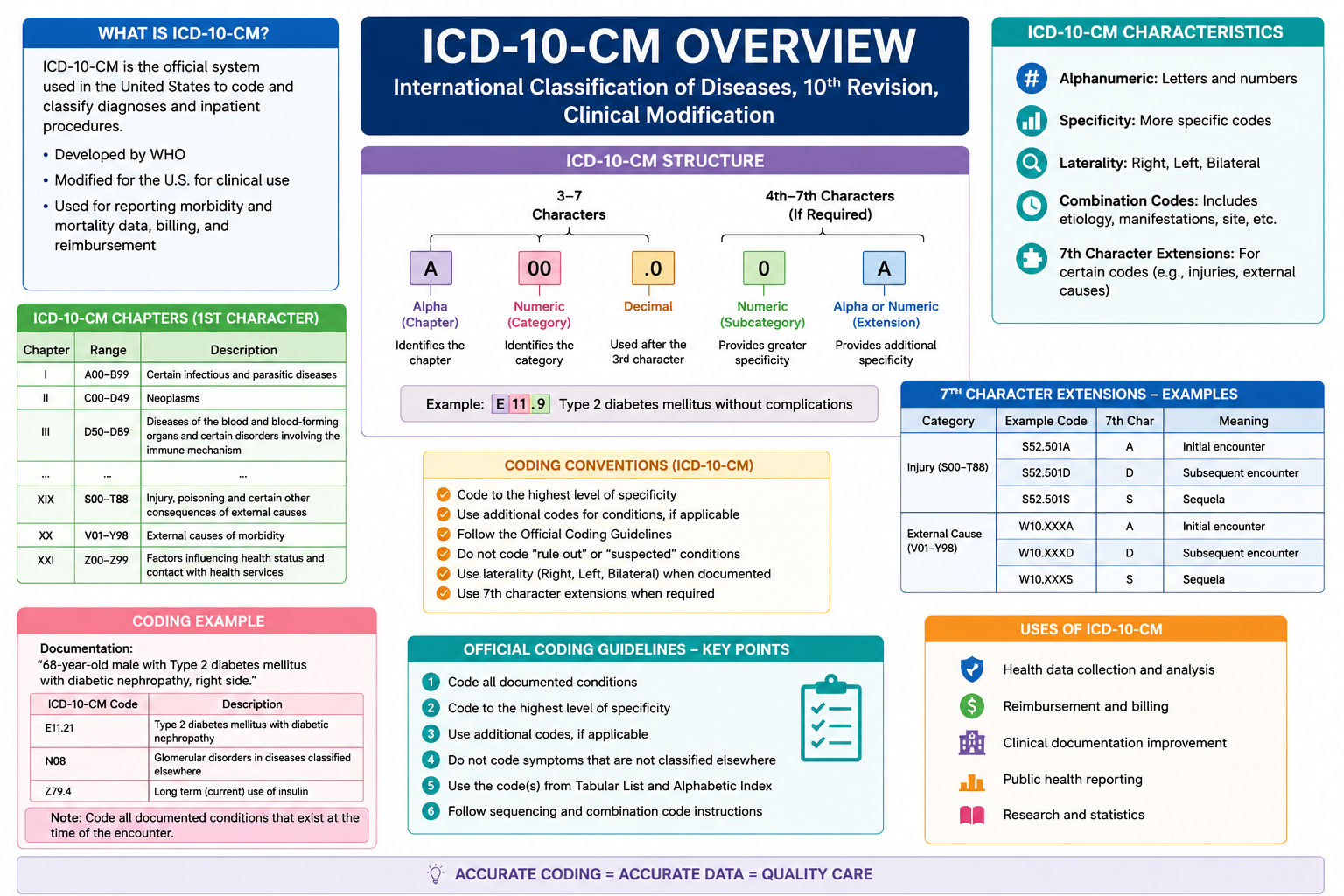
The structure of a standard code within this classification framework is alphanumeric, typically ranging from three to seven characters. The first character designates the category of the condition, while subsequent characters provide details regarding etiology, anatomical site, severity, and episode of care. When specialized protocols—such as trauma care pathways—intersect with standard diagnostic guidelines, the demand for clinical precision multiplies. Recognizing how these structural elements interact prevents claim rejections and supports comprehensive patient histories.
1. The Critical Intersection of Trauma Care Protocols and ICD-10
Trauma care environments operate under extreme time constraints, where rapid assessment and life-saving interventions take precedence over administrative documentation. However, the downstream financial and clinical outcomes depend heavily on how these acute events are translated into standardized alphanumeric values. Trauma Care Protocols (TCP) provide structured pathways for managing severely injured patients, and aligning these pathways with specific classification guidelines ensures that every resource utilized is accurately captured.
Integrating TCP workflows with standardized coding requires clinical staff to document specific physiological parameters, injury mechanisms, and anatomical locations immediately upon admission. When clinicians and coders share a unified understanding of how trauma-specific guidelines dictate code selection, institutions reduce query rates and accelerate billing cycles. This intersection bridges the gap between emergency medicine and health informatics, safeguarding both patient safety metrics and institutional revenue integrity.
2. Granularity and Specificity in Injury Classification
One of the most significant advancements in modern medical classification is the level of granularity available for injury documentation. Vague descriptions of trauma no longer suffice under contemporary coding standards. Healthcare providers must capture precise details, including laterality, exact anatomical sub-sites, and the specific nature of the injury, such as open versus closed fractures or superficial versus deep lacerations.
Achieving this required level of specificity demands active collaboration between attending physicians and coding professionals. For instance, documenting a fracture requires noting whether it is displaced or non-displaced, the specific segment of the bone affected, and whether the encounter represents initial care, subsequent care, or a sequela. Omitting these details forces coders to default to unspecified codes, which frequently triggers payer audits or claim denials.
Common Injury Documentation Variables and Coding Impact
| Documentation Variable | Specificity Required | Potential Impact of Omission |
|---|---|---|
| Laterality | Left, right, or bilateral | Claim rejection or downcoding |
| Encounter Type | Initial, subsequent, or sequela | Compliance risk and inaccurate tracking |
| Injury Severity | Superficial, open, closed, displaced | Reduced case-mix index and loss of revenue |
| External Cause | Mechanism and place of occurrence | Incomplete public health data reporting |
3. The Role of External Cause Codes in Trauma Assessment
Capturing the medical diagnosis alone tells only part of the story in trauma cases. External cause codes provide crucial context regarding how an injury occurred, the intent (accidental, intentional, self-inflicted, or assault), and the place of occurrence. While not always mandated by every third-party payer, these codes are indispensable for public health research, injury prevention program development, and trauma registry compliance.
In the context of specialized trauma protocols, external cause data helps hospital systems track environmental hazards, occupational injuries, and vehicular accident trends. Coding professionals must extract this information from emergency department triage notes, paramedic reports, and physician narratives. Thorough capture of these details supports broader epidemiological studies and assists regulatory bodies in evaluating community health risks.
4. Overcoming Documentation Deficiencies Through CDI Programs
Clinical Documentation Improvement (CDI) programs serve as the vital link between treating clinicians and coding specialists. In high-acuity departments utilizing specialized care protocols, documentation gaps often occur due to the chaotic nature of resuscitation and acute stabilization. CDI specialists review patient records concurrently to identify missing, conflicting, or ambiguous documentation before the final bill is dropped.
Effective CDI integration ensures that the severity of illness (SOI) and risk of mortality (ROM) are accurately reflected in the assigned codes. When physicians receive real-time education on how their phrasing affects classification outcomes, documentation quality improves organically. This proactive approach reduces the administrative burden of retrospective chart reviews and minimizes compliance vulnerabilities associated with unverified assumptions.
5. Impact on Reimbursement and Case-Mix Index (CMI)
The financial health of a healthcare institution is closely tied to the accuracy of its clinical classification practices. The Case-Mix Index (CMI) measures the diversity, clinical complexity, and resource consumption of all patients treated at a given facility. Precise trauma coding directly influences the CMI by ensuring that high-complexity cases are adequately reimbursed under prospective payment systems.
When coders fail to capture secondary diagnoses, complications, or specific manifestations associated with a trauma protocol, the institution suffers from under-coding. This undervalues the severity of the care provided and results in lost revenue. Conversely, over-coding or unsupported code assignment introduces severe compliance risks, including federal audits, financial penalties, and legal scrutiny. Maintaining a balanced, evidence-based approach is essential for fiscal sustainability.
6. Navigating Seventh Characters and Encounter Timing
A unique feature of injury-related classification within the system is the mandatory use of a seventh character to designate the encounter type. Understanding the nuances of initial encounters, subsequent encounters, and sequelae is critical for maintaining chronological integrity in patient records.
- Initial Encounters (Character A, D, or S equivalents): Used while the patient is receiving active treatment for the injury, including surgical interventions, emergency evaluation, and initial evaluation by new providers.
- Subsequent Encounters: Used for routine care during the healing or recovery phase, such as cast changes, medication adjustments, and suture removals.
- Sequelae: Used for complications or conditions that arise as a direct result of a previous injury, such as chronic pain or scar contractures resulting from past trauma.
Misapplying these seventh characters distorts clinical timelines and can lead to immediate automated rejections from insurance clearinghouses.
7. Managing Complications and Comorbidities (CC/MCC)
In trauma care, patients frequently present with pre-existing chronic conditions—such as diabetes, hypertension, or chronic obstructive pulmonary disease—that complicate acute management. These pre-existing conditions, known as Comorbidities, as well as complications that arise during hospitalization (CCs and Major Comorbidities / MCCs), heavily influence reimbursement calculations and quality metrics.
Coders must meticulously review inpatient charts to identify conditions that meet the Uniform Hospital Discharge Data Set (UHDDS) definition for reporting. This means the condition must clinically affect patient management, require therapeutic treatment, necessitate diagnostic evaluation, extend the length of stay, or increase nursing care. Capturing CCs and MCCs accurately ensures that the hospital is fairly compensated for managing medically complex trauma patients.
8. Compliance, Auditing, and Regulatory Standards
Regulatory compliance is a non-negotiable priority in health information management. Government agencies and private insurers routinely audit coding practices to detect fraudulent billing, upcoding, or systematic documentation errors. Healthcare organizations must establish robust internal auditing schedules to review a random sample of trauma charts regularly.
Compliance officers look for strict adherence to official coding guidelines, physician query compliance, and appropriate modifier usage. If discrepancies are found, corrective action plans and targeted staff education must be implemented immediately. Proactive auditing protects the organization from steep financial liabilities and preserves its reputation within the healthcare community.
9. The Influence of Electronic Health Records (EHR) on Coding Efficiency
Modern Electronic Health Record (EHR) systems have revolutionized how clinical data flows from the bedside to the billing department. Integrated EHR platforms often feature computer-assisted coding (CAC) tools and template-driven clinical documentation modules designed to capture required data elements at the point of care.
However, reliance on automated systems introduces specific risks, such as template cloning and the uncritical propagation of outdated clinical information. HIM professionals and lead coders must ensure that EHR templates are regularly updated to reflect current coding guidelines. Furthermore, human oversight remains essential; CAC tools should assist, rather than replace, human expertise in interpreting complex trauma documentation.
10. Future-Proofing Coding Operations Through Continuous Education
The landscape of medical classification is dynamic, with annual updates, guideline revisions, and new technology additions taking effect regularly. Healthcare institutions that fail to invest in continuous professional education for their coding and clinical staff quickly fall behind, experiencing rising error rates and delayed cash flows.
Investing in ongoing training involves securing credentials from recognized organizations, attending regulatory update seminars, and fostering a culture of cross-departmental communication. When physicians, nurses, CDI specialists, and coders operate as a cohesive, well-informed unit, the organization achieves optimal clinical documentation integrity, ensuring accurate data for both patient care and operational success.
Frequently Asked Questions
What is the primary purpose of specialized trauma coding guidelines?
Specialized trauma coding guidelines ensure that acute injuries, mechanisms of trauma, and subsequent care phases are captured with high precision. This standardization supports accurate reimbursement, facilitates trauma registry reporting, and improves public health tracking for injury prevention.
Why is the seventh character mandatory for injury codes?
The seventh character identifies the stage of the encounter—such as initial treatment, routine subsequent care, or late effects (sequelae). This distinction is vital for establishing clinical timelines, ensuring proper payer reimbursement, and maintaining accurate medical histories.
How do Clinical Documentation Improvement (CDI) programs affect reimbursement?
CDI programs review patient records concurrently to ensure that physicians document specific details regarding severity, laterality, and underlying comorbidities. By clarifying these elements before billing, CDI programs prevent under-coding and reduce claim rejections, securing appropriate reimbursement.
What is the difference between a Comorbidity (CC) and a Major Comorbidity (MCC)?
A Comorbidity (CC) is a secondary condition that moderately increases patient complexity and resource utilization during a hospital stay. A Major Comorbidity (MCC) represents a significantly higher level of clinical severity, substantially increasing resource use and expected costs.
How often do medical coding guidelines change?
Official coding guidelines and classification updates are revised annually, typically taking effect on October 1st of each year. Healthcare organizations must update their internal systems and provide ongoing staff training to maintain compliance with these changes.