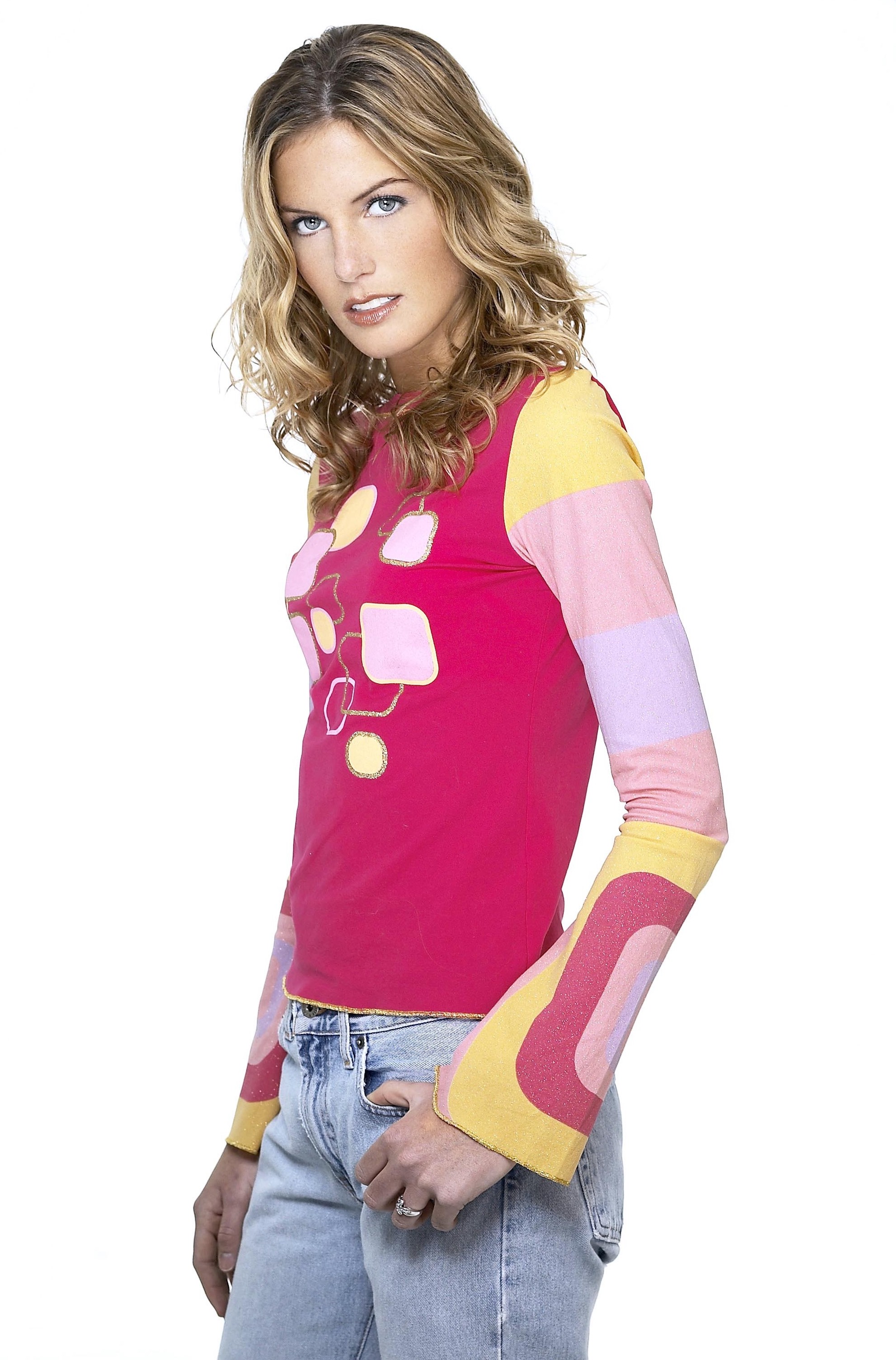
Shannon Stewart’s participation in the inaugural cycle of America’s Next Top Model remains one of the most discussed arcs in reality television history. Her decision to refuse a nude photoshoot during the competition—a choice grounded in her personal and religious convictions—served as a pivotal moment that challenged the industry’s standard expectations for models and sparked a lasting debate about autonomy, integrity, and professional boundaries in fashion.
The Context of the Decision: ANTM Cycle 1
In 2003, America’s Next Top Model debuted as a cultural phenomenon, introducing viewers to the high-pressure environment of the fashion industry. The contestants were thrust into various challenges designed to test their versatility, confidence, and willingness to conform to the demands of professional modeling. During the show’s first cycle, the contestants were presented with an assignment that required them to pose in the nude to demonstrate their comfort level with their bodies and their professional malleability.
For many, this was simply a standard industry test. However, for Shannon Stewart, the request presented a direct conflict with her personal values. Her decision to decline the photoshoot was not just an act of defiance against a production mandate; it was a firm declaration of the boundaries she set for her career before it had even truly begun. This moment created immediate tension between the contestant, the production team, and the judging panel, led by Tyra Banks.
The Professional Repercussions and Industry Standards
In the fashion industry, the "nude" or "implied nude" shot is often used as a litmus test for a model's willingness to be "commercially viable." Photographers and agencies frequently argue that a model who refuses to show skin may be difficult to work with in high-fashion editorial settings. When Shannon made her choice, the show’s narrative framed it as a potential liability.
However, the "verdict" on her choice is far more nuanced when viewed through the lens of long-term career viability. By standing by her principles, Shannon established a professional brand that was fundamentally tied to her identity. While the judges initially expressed concern that her refusal would hinder her chances of succeeding in the industry, Shannon ultimately proved that a model could maintain strict personal boundaries and still reach the finale. She finished as the runner-up of the cycle, demonstrating that talent, presence, and photographic ability can, in some instances, supersede the conventional demand for total physical exposure.
Analyzing the Impact of Personal Boundaries in Reality TV
The intersection of personal belief systems and reality television requirements often creates a spectacle. In the case of Shannon Stewart, the audience was effectively asked to judge whether her decision was "brave" or "short-sighted."
The Argument for Professional Compliance
Those who argue that Shannon’s decision was a mistake often cite the nature of the modeling business. The industry is notoriously demanding, and the ability to adapt to a photographer's vision is a core competency. From this perspective, the competition was a simulation of the real world, and by declining a common professional requirement, the contestant risked being seen as a "difficult" hire.
The Argument for Personal Autonomy
Conversely, supporters of her decision point to the importance of agency. In an industry where models are often treated as canvases or products, taking a stance against a specific type of work is a rare assertion of power. Shannon’s ability to remain in the competition while holding firm to her convictions provided a template for future contestants who might find themselves in similar moral dilemmas.
Comparison of Modeling Expectations and Reality TV Mandates
The following table breaks down the friction between industry standards and the specific circumstances of the 2003 competition.
| Aspect | Industry Standard (Editorial) | ANTM Reality TV Requirement |
|---|---|---|
| Professionalism | Defined by flexibility and output | Often defined by compliance to production drama |
| Nudity | Negotiated via contracts and comfort | Often treated as a "test" of submission |
| Agency | Varies by agency and individual model | Often restricted by production control |
| Long-term Value | Built on portfolio, brand, and client relationships | Built on exposure and public narrative |
The Legacy of Shannon Stewart’s Choice
By 2026, the fashion industry has undergone significant shifts regarding the treatment of models and the expectations placed upon them. The conversation around "the gaze" and the rights of the model has evolved, with more focus now placed on consent and professional boundaries. Shannon Stewart’s choice in 2003, while controversial at the time, aligns more closely with modern sensibilities regarding body autonomy and professional consent.
Her trajectory post-ANTM confirms that the choice did not result in a career dead-end. Shannon continued to work in the modeling industry for years, appearing in various campaigns and runway shows. Her ability to navigate a professional path that respected her personal limits stands as a case study for new models entering the industry. It proves that while specific choices may limit the scope of one's work, they do not necessarily negate the talent of the individual or the viability of their career.
Frequently Asked Questions (FAQ)
Did Shannon Stewart win America’s Next Top Model?
No, Shannon Stewart did not win the first cycle of America’s Next Top Model. She was the runner-up, with Adrienne Curry being declared the winner of the competition.
Why exactly did Shannon Stewart refuse the nude photoshoot?
Shannon Stewart stated that her refusal was based on her personal values and religious beliefs. She did not feel comfortable participating in a nude photoshoot and maintained that position despite pressure from the production staff and the judges.
Did her decision affect her professional reputation in the long run?
While the refusal was a major point of contention during the show, it did not end her career. Shannon continued to work as a professional model following her time on the show, proving that artists can set personal boundaries and still maintain a presence in the competitive world of fashion.
How has the modeling industry changed regarding this issue since 2003?
Since 2003, the industry has placed a much higher premium on the agency and consent of models. While high-fashion photography still involves varying levels of exposure, the expectation that a model must be willing to do anything asked of them has been challenged by increased advocacy and better contractual protections.
What is the primary lesson for aspiring models from this situation?
The lesson is that establishing personal and professional boundaries early in a career is possible. While such decisions may create short-term friction or require navigating difficult conversations with clients or producers, they allow a model to build a career that is sustainable and aligned with their own standards of integrity.
Conclusion and Next Actions
The verdict on Shannon Stewart’s choice is that it was a formative moment in her career that asserted her personal values over the pressure to conform. For those currently working in creative industries or participating in reality television, the takeaway is clear: understanding your own boundaries before entering a high-pressure environment is essential.
If you find yourself in a situation where your professional obligations conflict with your personal values, the best course of action is to communicate these boundaries clearly and early. Do not wait for a high-stakes moment to clarify your position. Review your contracts, understand the scope of the work you are signing up for, and ensure that your representation—whether it be an agent, manager, or legal counsel—is aligned with your personal expectations. Integrity does not have to be a barrier to success; it is, for many, the very foundation of a long and reputable career.