An overview of auto insurance coverage options and the provider landscape examines essential policy components—such as liability, collision, comprehensive, and uninsured motorist protection—alongside major national and regional insurance carriers. Understanding these coverage structures and carrier capabilities helps policyholders balance regulatory compliance, asset protection, and premium affordability in 2026.
Core Architecture of Auto Insurance Coverage Options
An auto insurance policy is a legally binding contract between a vehicle owner and an insurance carrier. In exchange for premium payments, the insurer agrees to pay for specified financial losses resulting from auto accidents, vehicle theft, or other physical damage. Understanding the structure of auto insurance requires examining the underlying contractual components, statutory obligations, and risk transfer mechanisms.
Every standard auto insurance policy consists of five key structural sections:
- Declarations Page: Summarizes the policyholder's identity, insured vehicles, covered drivers, policy term dates, chosen coverage limits, deductibles, and total premium charges.
- Insuring Agreement: Outlines the legal promises made by the insurer, detailing the scope of perils and risks covered under the policy contract.
- Exclusions: Explicitly lists scenarios, losses, or uses of the vehicle that are not covered, such as intentional acts, commercial ridesharing without a commercial endorsement, or racing.
- Conditions: Establishes the responsibilities of both parties, including prompt accident reporting, premium payment schedules, cooperation during claims investigations, and policy cancellation procedures.
- Endorsements (Riders): Written amendments that add, remove, or alter standard policy terms to tailor coverage to specific individual needs.
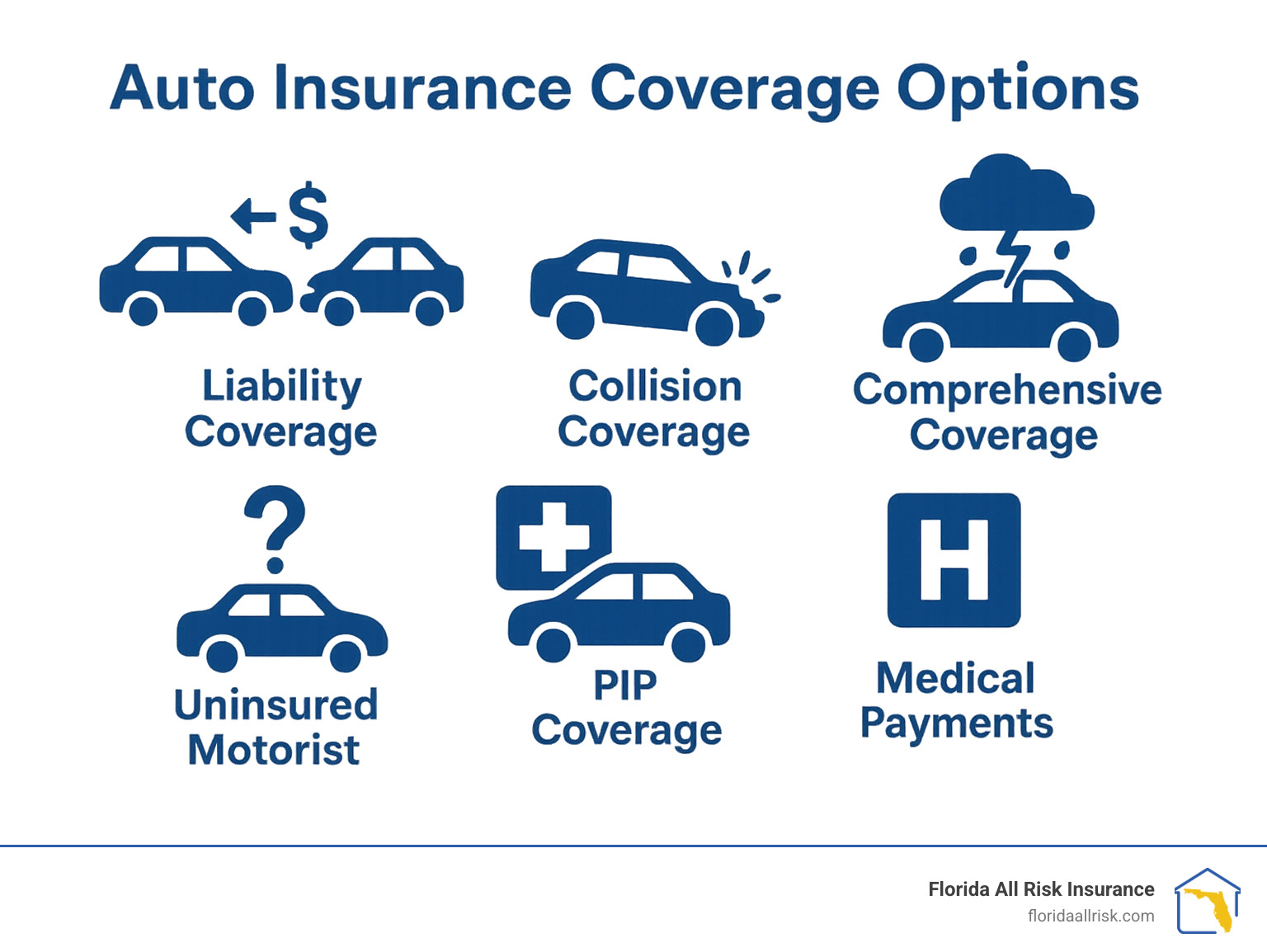
Insurance coverages are divided into third-party liability protections (which defend and indemnify the policyholder when responsible for damage or injury to others) and first-party protections (which pay for damages to the policyholder’s own vehicle, medical expenses, or income losses).
| Third-Party Coverage (Protection for Other Parties) | First-Party Coverage (Protection for Policyholder) |
|---|---|
| • Bodily Injury Liability• Property Damage Liability | • Collision Coverage• Comprehensive (OTC) Coverage• Personal Injury Protection (PIP)• Medical Payments (MedPay)• Uninsured/Underinsured Motorist |
Breakdown of Standard Auto Insurance Coverage Types
1. Mandatory Third-Party Liability Coverages
Liability insurance protects policyholders against financial ruin if they cause an accident that harms another person or damages another party's property. Most jurisdictions mandate minimum liability limits, though mandatory minimums rarely provide sufficient protection for vehicle owners with significant personal assets.
- Bodily Injury Liability (BI): Covers medical bills, rehabilitation expenses, lost wages, legal defense costs, and pain and suffering damages for third parties injured in an accident caused by the policyholder. BI limits are typically structured as split limits—for example, $100,000/$300,000—where the first number represents the maximum payout per injured individual and the second number represents the total maximum payout per accident, regardless of how many people are injured.
- Property Damage Liability (PD): Pays to repair or replace third-party property damaged in an accident where the policyholder is at fault. This includes other motor vehicles, guardrails, utility poles, buildings, and personal property inside another vehicle. PD is usually written as the third number in split-limit shorthand (e.g., $100,000/$300,000/$100,000).
2. First-Party Physical Damage Coverages
Physical damage coverages protect the insured vehicle itself against sudden and accidental loss. Unlike liability coverages, physical damage protections are subject to an out-of-pocket deductible selected by the policyholder.
- Collision Coverage: Indemnifies the vehicle owner for structural damage to their own vehicle resulting from an impact with another vehicle or object (such as a tree, guardrail, or telephone pole), as well as rollover accidents. Collision coverage pays regardless of fault, minus the chosen deductible.
- Comprehensive (Other-Than-Collision) Coverage: Covers physical damage to the insured vehicle caused by non-collision events beyond the driver's control. Covered perils include theft, vandalism, weather damage (hail, windstorms, flood), falling objects, fire, glass breakage, and striking an animal (such as a deer).
Physical damage coverage payouts are capped at the vehicle's Actual Cash Value (ACV) at the time of loss. ACV equals the original purchase price or market value minus cumulative depreciation. If the estimated cost of repairs exceeds a specified threshold of the vehicle's ACV (commonly 70% to 80%, depending on state regulation), the insurer declares the vehicle a total loss.
3. First-Party Injury and Medical Coverages
Medical coverages ensure that drivers and their passengers receive immediate healthcare funding following an accident, regardless of who caused the collision.
- Personal Injury Protection (PIP): Required in no-fault auto insurance jurisdictions, PIP covers medical costs, wage replacement, essential household service support, and funeral expenses for the driver and passengers. PIP claims are filed directly with the policyholder’s own insurer, bypassing the need to establish legal fault before receiving payment.
- Medical Payments Coverage (MedPay): Common in tort jurisdictions, MedPay pays necessary medical and funeral costs for the insured driver and passengers resulting from an auto accident. MedPay does not cover wage replacement or indirect non-medical losses.
4. Supplemental and Endorsement Coverages
Drivers can append specialized endorsements to broaden financial protection and address specific operational or financial exposures:
- Uninsured/Underinsured Motorist (UM/UIM): Pays for bodily injuries (and in some states, property damage) sustained by the policyholder when hit by a driver who lacks liability insurance (uninsured) or carries liability limits insufficient to cover total damages (underinsured). UM coverage also protects against hit-and-run accidents.
- Guaranteed Auto Protection (Gap) Insurance: Fills the financial gap between the Actual Cash Value of a total-loss vehicle and the remaining unpaid balance on an auto loan or lease agreement.
- Rental Reimbursement: Covers the daily rental car cost while the primary insured vehicle is undergoing repairs for a covered collision or comprehensive claim.
- Roadside Assistance / Towing: Provides emergency towing, battery jump-starts, flat tire changes, lockout assistance, and fuel delivery.
Comparative Matrix of Auto Insurance Coverage Types
The following table summarizes the structural attributes of standard auto insurance coverages, highlighting statutory rules, primary loss triggers, and risk management recommendations.
| Coverage Type | Statutory Requirement | Primary Perils / Losses Covered | Deductible Applicable | Standard / Recommended Limits |
|---|---|---|---|---|
| Bodily Injury Liability | Mandatory in nearly all states | Third-party bodily injuries, lost wages, legal defense | No | Recommended: $100k per person / $300k per accident minimum |
| Property Damage Liability | Mandatory in nearly all states | Third-party vehicles, utility structures, static property | No | Recommended: $100,000 minimum |
| Collision Coverage | Optional (Mandatory for financed/leased vehicles) | Vehicle impact with other cars, objects, or rollovers | Yes ($250–$2,000) | Actual Cash Value (ACV) of vehicle |
| Comprehensive Coverage | Optional (Mandatory for financed/leased vehicles) | Theft, weather, vandalism, animal strikes, glass | Yes ($100–$1,000) | Actual Cash Value (ACV) of vehicle |
| Personal Injury Protection (PIP) | Mandatory in no-fault states | First-party medical expenses, lost earnings, funeral fees | Varies by state | State mandatory minimums ($10k–$50k+) |
| Uninsured Motorist (UM/UIM) | Mandatory in some states, optional in others | Injuries/damage caused by uninsured or hit-and-run drivers | Optional for property damage | Match chosen Bodily Injury Liability limits |
| Gap Insurance | Optional (Required by some lease lenders) | Out-of-pocket variance between ACV payout and remaining loan balance | No | 100% of outstanding loan/lease balance delta |
Analyzing the Auto Insurance Provider Landscape in 2026
The auto insurance market features a mix of national carriers, regional mutual insurers, specialized military/affinity groups, and tech-driven insurtech companies. Insurers differ in market capitalization, distribution methods, financial strength, technology integration, and underwriting focus.
| Tier 1 Nationals | Regional Mutuals | Insurtechs & Digital-First |
|---|---|---|
| • State Farm• GEICO• Progressive• Allstate | • Erie Insurance• Auto-Owners• Amica• NJM Insurance | • Root Insurance• Lemonade• Clearcover• Mile Auto |
| Market Strengths:Scaled capital, direct platforms, telematics pools | Market Strengths:Localized agents, high customer satisfaction scores | Market Strengths:Algorithmic pricing, app-native interfaces, dynamic pay-per-mile options |
1. Tier 1 National Insurance Carriers
National carriers control the majority of auto insurance market share. Their scale allows them to invest heavily in brand marketing, direct-to-consumer digital tools, mobile app policy management, and large telematics datasets.
- State Farm: Maintains the largest total market share in U.S. auto insurance. Operating primarily through a widespread network of exclusive captive agents, State Farm balances physical branch availability with mobile app services and multi-policy bundling discounts.
- GEICO (Berkshire Hathaway): Built on a direct-to-consumer model, GEICO emphasizes digital underwriting, rapid phone and online quoting, and competitive rates for standard drivers.
- Progressive: Known for rate transparency tools, commercial auto underwriting, and advanced risk segmentation. Progressive utilizes telematics data through its Snapshot program to price policies based on real-time driving behaviors.
- Allstate: Operates a dual model combining captive local agencies with modern digital channels. Allstate targets higher-tier coverage packages, drivewise telematics integration, and extensive optional endorsement programs.
2. Specialized and Affinity Carriers
Affinity-based insurers focus on specific customer demographics, allowing them to optimize underwriting for defined risk pools.
- USAA: Restricted to active-duty military service members, veterans, and their eligible families. USAA consistently earns top customer satisfaction and claims handling ratings due to low distribution overhead, member-focused operational models, and high customer retention.
3. Regional Mutual Carriers
Regional mutual insurance companies operate on customer-owned business models rather than publicly traded shareholder frameworks.
- Erie Insurance, Auto-Owners Insurance, Amica Mutual, and NJM: These regional carriers often outperform national competitors in customer service satisfaction, claim handling accuracy, and rate stability. They rely primarily on independent agent networks to provide personalized coverage advice tailored to local regional markets.
4. Insurtechs and Usage-Based Underwriters
Insurtech carriers leverage smartphone sensors, artificial intelligence, and real-time telematics to re-engineer pricing and policy delivery.
- Root Insurance & Lemonade: Emphasize smartphone-native policy management, instantaneous automated claims processing, and continuous telematics monitoring.
- Pay-Per-Mile Models (e.g., Mile Auto): Target low-mileage drivers by splitting premiums into a low base rate plus a variable per-mile charge, offering savings to remote workers and urban dwellers.
Underwriting Factors and Premium Calculation Variables
Auto insurance premiums are determined using complex actuarial algorithms that assess the statistical likelihood of a driver filing a claim. Insurers analyze key risk metrics to establish personal premium rates.
- Driver Risk Profile: Driving History, Age, Credit Score (CBIS)
- Vehicle Risk Metrics: ACV, Safety Features, Repair Cost Indices
- Geographic Exposure: Zip Code Density, Weather, Litigation
- Usage Metrics: Annual Mileage, Telematics (UBI Data)
1. Driver Profile Factors
- Motor Vehicle Record (MVR): Prior moving violations, at-fault collisions, and major infractions (such as DUI convictions) significantly increase premium rates due to higher statistical risk.
- Credit-Based Insurance Scores (CBIS): In jurisdictions where legally permitted, insurers use credit-derived metrics to forecast claim frequency. Actuarial data shows a strong correlation between credit stability and lower claim risk. (States such as California, Massachusetts, and Washington restrict or prohibit the use of credit scores in auto insurance rating).
- Age and Driving Experience: Drivers under 25 pay higher base premiums due to elevated accident rates according to national transportation statistics gathered by the National Highway Traffic Safety Administration (NHTSA).
- Continuous Coverage History: Maintaining uninterrupted auto insurance coverage indicates financial responsibility. Lapses in coverage often trigger higher premium tiers upon re-entry into the market.
2. Vehicle Characteristics
- Vehicle Identification Number (VIN) Loss History: Insurers track aggregate claim statistics by make, model, and trim level. Cars with higher rates of theft, expensive structural components, or low crashworthiness earn higher risk ratings.
- Advanced Driver Assistance Systems (ADAS): Technologies like automatic emergency braking, lane-departure warnings, and blind-spot sensors reduce collision frequency. However, expensive sensors integrated into bumpers and windshields can raise body shop repair costs.
3. Geographic and Usage Variables
- ZIP Code Location: Urban areas with dense traffic, high auto theft rates, elevated uninsured motorist counts, and frequent litigation generally carry higher liability and comprehensive rates than rural areas.
- Annual Mileage and Telematics (Usage-Based Insurance): Higher annual mileage increases road exposure and collision risk. Telematics tools track hard braking, rapid acceleration, cornering speeds, late-night driving, and phone distraction to provide custom premium discounts or surcharges.
Step-by-Step Guide to Policy Evaluation and Carrier Selection
Optimizing auto insurance protection requires evaluating policy limits, setting appropriate deductibles, and comparing carrier quotes systematically.
- Step 1: Audit Net Worth & Define Required Liability Protection Limits
- Step 2: Determine Asset Value & Physical Damage Deductible Capacity
- Step 3: Collect Quotes Using Identical Limits, Endorsements & Terms
- Step 4: Verify Carrier Financial Ratings (A.M. Best) & Complaint Rates
- Step 5: Bind New Policy First, Then Cancel Existing Policy Cleanly
Step 1: Conduct a Financial Protection Audit
Calculate total personal net worth, including home equity, cash savings, investment portfolios, and future income potential. Select Bodily Injury and Property Damage liability limits high enough to protect these personal assets against lawsuit judgments that exceed standard policy caps. If personal net worth exceeds standard maximum auto policy limits ($500,000 combined single limit), purchase a supplemental Personal Umbrella Liability Policy.
Step 2: Structure Deductibles Based on Emergency Reserve Funds
Assess liquid cash reserves when choosing physical damage deductibles for Collision and Comprehensive coverage. Raising a deductible from $250 to $1,000 can lower annual physical damage premiums by 15% to 30%. Ensure the emergency savings fund can comfortably absorb the out-of-pocket deductible in the event of a sudden loss.
Step 3: Normalize Quote Comparison Variables
When requesting quotes from national, regional, and insurtech carriers, standardize coverage parameters across every bid:
- Use identical split liability limits (e.g., $250,000/$500,000/$100,000).
- Use identical deductibles for Collision and Comprehensive coverages.
- Ensure identical inclusion of Uninsured Motorist protection and roadside assistance.
- Disclose all household drivers transparently to prevent underwriting rescission during future claims.
Step 4: Assess Carrier Stability and Customer Service Metrics
Prioritize insurers with strong financial solvency and reliable claims handling histories:
- Financial Solvency Ratings: Check credit rating agencies such as A.M. Best to confirm the insurer holds an Financial Strength Rating of "A-" (Excellent) or higher.
- Regulatory Complaint Indices: Check the National Association of Insurance Commissioners (NAIC) Consumer Insurance Search tool to review an insurer’s official closed-complaint ratio relative to its market share size.
Step 5: Transition Policies Without Coverage Gaps
Coordinate effective dates precisely when switching auto insurance providers. Ensure the new policy active start date matches the cancellation date of the outgoing policy to prevent coverage gaps. A single day without active insurance can lead to state license verification fines, registration suspensions, and higher insurance rating tiers.
Frequently Asked Questions (FAQs)
What is the difference between split limits and combined single limits (CSL)?
Split limits divide liability coverage into three distinct caps: maximum bodily injury per person, maximum bodily injury per accident, and maximum property damage per accident (e.g., $100k/$300k/$100k). A Combined Single Limit (CSL) provides one total dollar cap (e.g., $300,000) that can be allocated across any combination of bodily injuries and property damage resulting from a single accident. CSL policies offer greater flexibility but usually cost slightly more than split-limit coverage.
How does telematics or usage-based insurance (UBI) affect insurance rates?
Telematics programs monitor driving behavior using mobile apps or plugged-in OBD-II vehicle devices. Drivers who avoid hard braking, rapid acceleration, late-night driving, and active mobile device usage can earn premium discounts ranging from 5% to 40%. However, depending on state regulations and the carrier's terms, drivers with risky driving habits may face rate surcharges.
Why are state minimum liability limits considered insufficient for most drivers?
State minimum liability limits were established decades ago and have not kept pace with modern vehicle replacement costs, rising medical expenses, or court judgment awards. For example, a state minimum property damage limit of $15,000 will not cover the total loss of a standard modern vehicle. If claim damages exceed state policy limits, the at-fault driver remains personally liable for the remaining balance, putting their personal savings, home equity, and future wages at risk.
What is the difference between Actual Cash Value (ACV) and Replacement Cost?
Actual Cash Value (ACV) equals the market value of the vehicle immediately prior to the loss, taking into account age, mileage, wear-and-tear, and structural depreciation. Standard physical damage auto policies pay claims based on ACV. Replacement cost coverage, which pays to replace the damaged vehicle with a brand-new model of the same make without deducting depreciation, is typically limited to new vehicles within their first 1 to 2 model years via specialized policy riders.
How do insurance credit scores affect premium pricing?
Insurance companies use Credit-Based Insurance Scores (CBIS) to assess potential loss risk. Actuarial studies indicate that credit stability correlates directly with claim management consistency and lower overall loss frequency. Drivers with strong credit profiles generally pay lower premiums, while lower credit scores can lead to higher baseline rates. However, states like California, Massachusetts, and Washington prohibit insurers from using credit scores in auto insurance rating algorithms.
Final Guidance: Optimizing Your Auto Insurance Strategy
Achieving balance between cost efficiency and asset protection requires ongoing policy management. Automobile values change over time, personal net worth evolves, and living circumstances change.
Review your auto insurance coverage annually or whenever major life events occur, such as moving to a new ZIP code, adding drivers to the household, purchasing a new car, or clearing a home mortgage. To keep premiums manageable without compromising protection:
- Bundle personal auto insurance with home, condo, or renters policies to secure multi-line discounts.
- Audit physical damage coverages on older vehicles; if a car's market value drops below $3,000, dropping Collision and Comprehensive coverage can save more in premiums than the maximum potential insurance payout.
- Re-evaluate deductibles regularly to keep policy premiums affordable while keeping out-of-pocket costs within manageable limits.
Disclaimer: This article is for informational purposes only and does not constitute formal legal or financial advice. Insurance regulations, policy rules, and coverage structures vary by jurisdiction; consult a licensed insurance agent or legal professional for guidance tailored to your specific circumstances.