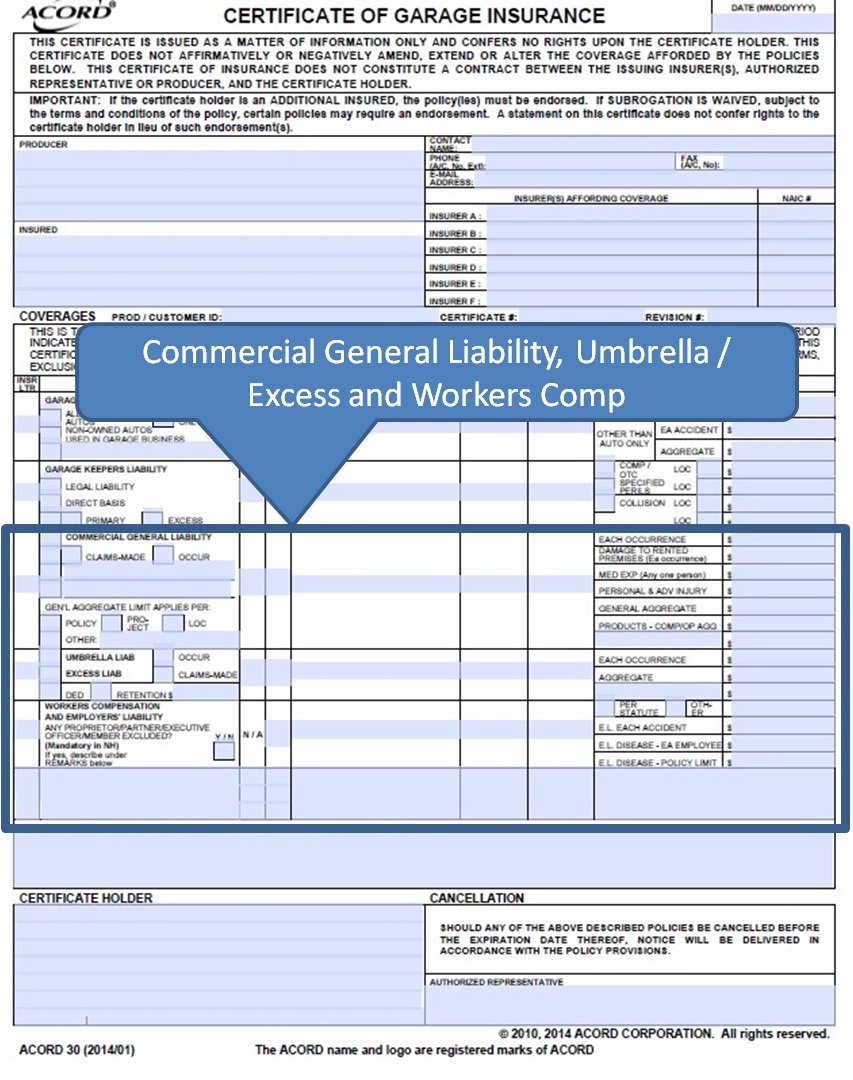
An ACORD form for workers' compensation is a standardized insurance industry document used to apply for coverage or prove existing policy compliance. ACORD 130 serves as the standard Workers' Compensation Application for underwriting, while ACORD 25 (Certificate of Liability Insurance) acts as formal evidence that a business maintains active statutory workers' compensation coverage for clients, general contractors, or regulatory entities.
What Is an ACORD Form and Why Is It Essential for Workers' Compensation?
The Association for Cooperative Operations Research and Development (ACORD) is an international non-profit organization that creates standardized forms, data definitions, and electronic specs for the commercial and personal lines insurance industry. Before ACORD standardizations were universally adopted across North America, every insurance carrier utilized unique application forms, loss history questionnaires, and policy documentation layouts. This lack of standardization created massive administrative friction for independent insurance agents, underwriters, and corporate risk managers.
In commercial workers' compensation, ACORD forms establish a uniform framework for gathering operational data, classifying payroll, evaluating occupational risk, and verifying financial liability protection. Whether a business applies for a new workers' compensation policy, modifies an existing policy across multiple state jurisdictions, or provides evidence of coverage to secure a commercial contract, standard ACORD documents streamline data exchange between policyholders, independent agencies, insurance carriers, and rating bureaus such as the National Council on Compensation Insurance (NCCI).
Using standardized ACORD forms provides three essential structural advantages:
- Regulatory and Underwriting Consistency: Underwriters receive risk profile details—such as National Council on Compensation Insurance (NCCI) or independent state classification codes, annual payroll projections, and claims histories—formatted in a predictable layout.
- Third-Party Coverage Verification: General contractors, project owners, and commercial landlords rely on standard certificate formats to confirm that subcontractors carry compulsory statutory workers' compensation coverage, protecting project leaders from vicarious liability and costly premium audit penalties.
- Legal Clarity in Dispute Resolution: Standard language and structured fields establish explicit legal boundaries regarding who is insured, which officer exclusions apply, and what limits are provided under Employers' Liability (Part Two) coverage.
Disclaimer: Workers' compensation regulations, state statutory benefits, and officer inclusion/exclusion laws vary significantly by state jurisdiction. Business owners and risk professionals should consult a licensed insurance agent or legal counsel regarding state-specific compliance requirements.
Primary Workers' Compensation ACORD Forms Explained
While dozens of ACORD documents exist across property, casualty, and marine insurance lines, four primary forms dictate the lifecycle of a workers' compensation policy application, underwriting rating, and ongoing compliance.
ACORD Form Architecture:
- ACORD 125 : Commercial Insurance Application (Applicant Core)
- ACORD 130 : Workers' Compensation Application (Policy Data)
- ACORD 133 : State Schedule (Multi-State Allocations)
- ACORD 25 : Certificate of Insurance (Proof to 3rd Parties)
- ACORD 130 : Workers' Compensation Application (Policy Data)
ACORD 130: Workers' Compensation Application
ACORD 130 is the cornerstone document for acquiring a workers' compensation insurance policy. It captures operational data required by carrier underwriters to evaluate workplace safety, assign appropriate class codes, and calculate estimated annual premiums.
The form requires comprehensive details regarding business ownership structures, physical jobsite locations, estimated annual payroll split across operational roles, past loss runs, and specific working conditions (such as height exposure, sub-contractor utilization, or hazardous material handling).
ACORD 25: Certificate of Liability Insurance
While ACORD 130 is used to apply for coverage, ACORD 25 is the document most frequently requested by third parties. ACORD 25 is a summary document generated by an insurance producer (agent or broker) to demonstrate that an entity holds active commercial insurance policies, including General Liability, Commercial Auto, Umbrella/Excess Liability, and Workers' Compensation and Employers' Liability.
On an ACORD 25 certificate, the Workers' Compensation section specifically states whether statutory limits apply, details the monetary caps for Employers' Liability coverage, lists active policy numbers and effective/expiration dates, and notes whether corporate officers or business owners are included or excluded from coverage.
ACORD 125: Commercial Insurance Application (Applicant Information Section)
ACORD 125 acts as the primary master application header for commercial insurance submissions. When an agent submits ACORD 130 to an insurance carrier, it is almost always accompanied by ACORD 125.
While ACORD 130 focuses strictly on workers' compensation exposures, ACORD 125 gathers general corporate details: named insured legal entities, Tax Identification Numbers (FEIN), contact details, primary business locations, premises schedules, and broad prior loss records.
ACORD 133: Workers' Compensation State Schedule
For enterprises operating in multiple states or businesses with staff performing out-of-state work, ACORD 133 serves as a supplemental attachment to ACORD 130. It provides extended room to detail operational addresses, state-specific payroll allocations, separate unemployment account numbers, and local governing class codes for every jurisdiction where operations occur.
Step-by-Step Guide: How to Complete ACORD Form 130
Completing ACORD 130 accurately is vital. Incorrect payroll estimates, omitted locations, or inaccurate job classifications can lead to delayed policy issuance, unexpected premium adjustments during mandatory annual audits, or denied claims.
ACORD 130 Submission Workflow:
- Step 1: Complete Corporate & FEIN Identification
- Step 2: Map NCCI/State Class Codes & Estimated Payroll
- Step 3: Document 3-to-5 Year Prior Loss History & Experience Mod
- Step 4: Answer Underwriting Questions & Safety Protocols
- Step 5: Sign & Submit to Carrier with ACORD 125
Section 1: Applicant and Named Insured Information
The header section of ACORD 130 requires the exact legal entity name as filed with state authorities (e.g., LLC, Corporation, Sole Proprietorship, or Partnership), alongside any Doing Business As (DBA) designations.
- Federal Employer Identification Number (FEIN): Must be accurately reported for every entity listed. Group policies covering parent companies and subsidiaries require listing all individual FEINs.
- Legal Structure: Check the exact entity type. Rating bureaus track experience modification ratings (E-Mods) by entity structure, and structural shifts (e.g., transitioning from a Sole Proprietorship to an S-Corp) can alter historical loss ratings.
- Locations: Provide physical street addresses for all operational premises, branch offices, warehouses, and remote work hubs.
Section 2: Rating Information (Class Codes, Payroll, and State Locations)
This section forms the financial calculation engine of the application. Misrepresenting data here directly skews initial premium quotes and results in audit penalties.
- State & Rating Bureau: Specify the state of exposure and whether the state follows NCCI guidelines or operates an independent rating bureau (such as the Workers' Compensation Insurance Rating Bureau of California - WCIRB, or the New York Compensation Insurance Rating Board - NYCIRB).
- Class Codes: Input the four-digit classification codes corresponding to specific job roles (e.g., Code 8810 for Clerical Office Employees vs. Code 5645 for Main Building Construction).
- Estimated Annual Payroll (Remuneration): Enter projected gross wages for the 12-month policy term per class code. Remuneration generally includes gross wages, bonuses, overtime pay, and vacation pay, subject to state-specific payroll inclusion/exclusion rules.
- Number of Employees: List full-time and part-time employee counts associated with each class code and location.
Section 3: Prior Carrier and Loss History
Underwriters analyze historic claims frequency and severity to assess workplace safety and determine pricing adjustments (schedule rating credits or debits).
- Prior Insurance Information: Provide policy numbers, insurance carriers, annual premiums, and effective dates for the preceding 3 to 5 years.
- Experience Modification Factor (E-Mod / EMR): Enter the applicant's current Experience Modification Factor provided by NCCI or state bureaus. An E-Mod above 1.00 indicates higher-than-average historical loss ratios, while an E-Mod below 1.00 reflects superior safety performance.
- Loss History Attachments: For accounts exceeding standard premium thresholds, official carrier-issued loss runs (typically covering 3 to 5 policy years) must be attached to substantiate the entry on the ACORD form.
Section 4: General Underwriting Questions and Safety Practices
ACORD 130 includes a series of mandatory Yes/No underwriting questions designed to uncover operational risk factors:
- Subcontractor Usage: Questions clarify whether independent contractors are engaged, whether certificates of insurance (ACORD 25) are collected from all subcontractors, and whether subcontractors maintain equal or higher coverage limits.
- Work at Heights or Underground: Underwriters require specifics on scaffolding usage, excavation depths, and ladder work.
- Travel or Out-of-State Exposure: Identifies interstate commercial travel, temporary out-of-state job assignments, or international exposures.
- Safety & Return-to-Work Programs: Details formalized written safety protocols, regular safety meetings, personal protective equipment (PPE) requirements, and light-duty return-to-work initiatives. Demonstrating proactive safety management often yields carrier underwriting discounts.
How to Verify Workers' Compensation Coverage on an ACORD 25 Form
When hiring contractors, leasing commercial real estate, or forming business partnerships, receiving an ACORD 25 certificate provides visual evidence that an organization has active insurance policies. However, reading an ACORD 25 certificate requires attention to specific boxes and numbers to ensure compliance.
ACORD 25 Certificate Verification Checklist:
- [✓] WORKERS COMPENSATION BOX CHECKED (Y)
- [✓] STATUTORY LIMITS BOX CHECKED (OR PER-STATE MANDATED CAP)
- [✓] EMPLOYERS' LIABILITY LIMITS VERIFIED:
- E.L. EACH ACCIDENT : $100k / $500k / $1M
- E.L. DISEASE - POLICY LIMIT : $100k / $500k / $1M
- E.L. DISEASE - EACH EMP : $100k / $500k / $1M
- [✓] EXECUTIVE OFFICERS INCLUDED / EXCLUDED STATUS NOTED
- [✓] POLICY DATES CURRENT (NOT EXPIRED)
Examining Box Section: Workers Compensation and Employers' Liability
On the ACORD 25 (Certificate of Liability Insurance) form, locate the middle section labeled WORKERS COMPENSATION AND EMPLOYERS' LIABILITY.
- Insured Letter Code: Confirm which carrier listed in the "INSR LTR" column corresponds to the Workers' Compensation line item. Cross-reference this letter with the "INSURERS AFFORDING COVERAGE" list at the top of the form to verify carrier identity and financial strength rating (such as an A.M. Best rating).
- Statutory Limits vs. Policy Limits: Ensure the checkbox marked PER STATUTE is selected. Statutory limits mean the policy pays all medical benefits and indemnity payments required under state workers' compensation laws without an aggregate dollar cap.
- Employers' Liability (Part Two) Coverage Limits: Unlike statutory benefits (Part One), Employers' Liability (Part Two) covers employer liability for workplace injuries not governed by statutory compensation laws (e.g., third-party action-over claims). Standard baseline policy limits are expressed in three distinct dollar caps:
- E.L. Each Accident: Maximum payout per individual accident (e.g., $100,000 or $500,000 or $1,000,000).
- E.L. Disease - Policy Limit: Maximum aggregate payout for disease claims during the policy term.
- E.L. Disease - Each Employee: Maximum payout for a single employee suffering an occupational disease.
Identifying Excluded Officers, Partners, or Members
A critical check on the ACORD 25 form is the ANY PROPRIETOR/PARTNER/EXECUTIVE OFFICER/MEMBER EXCLUDED? box.
- If YES is checked, the Description of Operations section at the bottom of the form must explicitly name the excluded individuals (e.g., corporate officers, managing members, or sole proprietors).
- Risk Warning: If a contractor’s sole owner excludes themselves from their workers' compensation policy and has no non-owner employees, the policy may provide zero active coverage on jobsites. If that owner suffers an injury on your premises, state workers' compensation boards or audit rules may classify that individual as an uninsured statutory employee of your business, triggering audit penalties or legal claims.
Additional Insured Limitations on Workers' Compensation
A frequent point of confusion involves requests to add a client or general contractor as an Additional Insured on a workers' compensation policy.
- Standard commercial insurance practice and statutory guidelines across the U.S. generally prohibit adding third parties as Additional Insureds under Workers' Compensation policies. Workers' compensation covers statutory benefits for direct employees of the named insured.
- Third-party protection is instead handled through General Liability endorsements or a Waiver of Subrogation endorsement on the Workers' Compensation policy (where the insurer waives its legal right to recover benefit payments from a negligent third party). Look at the "INSR SUBR WVD" column on the ACORD 25 form to verify if a Waiver of Subrogation is marked.
Key ACORD Forms for Workers' Compensation Compared
The following comparative reference outlines the primary forms, their administrative purpose, target users, and key operational details.
| ACORD Form Number & Name | Primary Purpose | Key Audience / Users | Critical Information Captured |
|---|---|---|---|
| ACORD 130(Workers Compensation Application) | Detailed application form for obtaining policy underwriting and premium quotes. | Insurance Brokers, Underwriters, Business Owners | Class codes, estimated annual payroll, officer inclusions/exclusions, 3-5 year loss history, safety program specifics. |
| ACORD 25(Certificate of Liability Insurance) | Publicly verifiable proof of active insurance policies issued to third parties. | General Contractors, Clients, Commercial Landlords, Vendors | Policy active dates, Statutory Limits checkbox, Employers' Liability monetary limits, officer exclusion notices. |
| ACORD 125(Commercial Insurance Application) | General master cover application establishing corporate profile and entity details. | Insurance Agents, Risk Managers, Commercial Underwriters | Legal entity legal name, FEIN list, primary headquarters, contact data, comprehensive premises schedule. |
| ACORD 133(Workers Compensation State Schedule) | Multi-state supplemental form for extending coverage across several jurisdictions. | Multi-state Employers, Regional Enterprises, Insurance Producers | Out-of-state physical locations, state-specific payroll breakdowns, state UI account numbers, local class codes. |
Common Pitfalls and Avoidable Errors in Workers' Compensation ACORD Submissions
Data inconsistencies within ACORD submissions can trigger premium audit disputes, policy cancellations, or coverage gaps.
Common ACORD Submission Errors:
- Error 1: Class Code Mismatches (e.g., Code 8810 vs Code 5645)
- Error 2: Gross Payroll Underestimation (Triggers Audit Penalties)
- Error 3: Improper Sole Proprietor Exclusions
- Error 4: Incomplete Out-of-State Endorsements (Item 3.C.)
1. Mismatched NCCI or State Class Codes
Assigning incorrect four-digit class codes is a frequent mistake in ACORD 130 applications. For example, placing field supervisors who perform hands-on labor under code 8810 (Clerical Office Employees) rather than code 5606 (Contractor Executive Supervisor) or field construction codes results in an immediate rating mismatch. Insurance auditors will reclassify these employees during mandatory annual audits, generating large retro-active premium adjustments.
2. Miscalculating Estimated Annual Payroll
Payroll projections on ACORD 130 should reflect realistic anticipated remuneration for the upcoming 12 months. Business owners sometimes deliberately underreport projected payroll to obtain a lower initial deposit quote.
However, because workers' compensation is an audited policy line, the insurance carrier compares actual payroll (via IRS Form 941s, state unemployment filings, and payroll reports) against estimated payroll at policy expiration. Underreporting results in substantial audit billing at year-end and can lead to non-renewal by the carrier.
3. Misinterpreting Waiver of Subrogation and Endorsements
Checking the "SUBR WVD" (Subrogation Waived) column on an ACORD 25 form without securing an actual, paid policy endorsement from the insurance carrier creates legal exposure. A certificate holder reading an ACORD 25 form may assume rights have been waived, but if the insurance contract lacks an official NCCI or state-approved Waiver of Subrogation endorsement (such as Form WC 00 03 13), the insurer retains its right to recover benefit payments from negligent third parties.
4. Omission of Out-of-State Operations (Item 3.C. Coverage)
If a business headquartered in Texas sends employees to perform temporary work in Louisiana or Oklahoma, those state jurisdictions must be properly disclosed on ACORD 130 and listed in Item 3.C. of the workers' compensation policy declarations page.
Failing to list active operational states on ACORD applications can leave an employer without proper statutory benefits coverage in the event an employee is injured in an unlisted state, exposing the enterprise to state administrative fines and direct injury lawsuits.
Impact of ACORD Forms on Annual Workers' Compensation Audits
At the conclusion of every policy term, workers' compensation carriers conduct a mandatory financial and operational audit to adjust estimated premiums to actual risk exposure. ACORD documentation serves as the historical baseline for these evaluations.
Annual Audit Verification Cycle:
- Initial ACORD 130 Submission: Est. Payroll & Initial Premium
- Continuous Certificate Collection: ACORD 25 Forms from Subcontractors
- Final Annual Audit Review: Audit Compares Actual Payroll + Subcontractor ACORD 25 Proof vs. Initial ACORD 130 Projections
Subcontractor Certificate Tracking
If a company utilizes 1099 independent contractors or subcontractors, the insurance carrier's auditor will examine those relationships. Unless the policyholder produces valid ACORD 25 certificates proving that every subcontractor carried active workers' compensation coverage during the period they performed work, the auditor will treat those subcontractor payments as unrated payroll for the hiring employer.
This results in the primary policyholder being charged full workers' compensation premium rates on every dollar paid to uninsured subcontractors. Maintaining a system of ACORD 25 collection is essential for risk control.
Ghost Policies vs. Full Statutory Coverage
In industries like residential construction, sole proprietors frequently purchase what is colloquially known as a "Ghost Policy"—a minimum-premium workers' compensation policy where all corporate officers or owners legally exclude themselves from coverage, and the business maintains zero non-owner employees.
When a contractor presents an ACORD 25 reflecting a Ghost Policy, the certificate will show active coverage, but the officer exclusion box will be marked YES. If that sole proprietor performs physical labor on a project, their exclusion means they carry no injury protection under that policy. General contractors must verify whether their contractual agreements allow sole proprietors with officer exclusions onto work sites.
Frequently Asked Questions (FAQ)
Is ACORD Form 130 mandatory for buying workers' compensation insurance?
ACORD Form 130 is the universally accepted standard commercial application across the insurance industry, though it is not a direct statutory requirement set by federal law. Most independent agencies, insurance brokerages, and insurance carriers mandate an ACORD 130 submission to initiate underwriting. Some direct-writing insurance carriers may collect the exact same application data through proprietary online digital portals, but the underlying data structures map directly to ACORD 130 fields.
Can ACORD 25 be used as an official insurance policy or binder?
No. An ACORD 25 (Certificate of Liability Insurance) is strictly an informational document that confirms the existence of insurance policies at the specific moment of form issuance. It confers no rights upon the certificate holder, does not amend or alter coverage terms, and does not constitute a legal binder or policy contract. Official proof of coverage modifications requires carrier-issued policy declarations and official policy endorsements.
How do class codes on ACORD 130 affect premiums?
Class codes directly dictate the base rate charged per $100 of payroll. Rating bureaus like NCCI establish class codes based on the hazards of specific job functions. For instance, low-risk clerical office work (Code 8810) carries a baseline rate of a few cents per $100 of payroll, whereas high-risk roofing work (Code 5551) can carry base rates of tens of dollars per $100 of payroll. Accurately matching operational roles to their true class code on ACORD 130 ensures equitable pricing and prevents audit adjustments.
What is the difference between Statutory Limits and Employers' Liability on ACORD 25?
Statutory Limits (Part One of a Workers' Compensation policy) pay all medical treatments, disability payments, and rehabilitation benefits dictated by state workers' compensation statutes, without any fixed dollar cap on the policy. Employers' Liability (Part Two) covers an employer's legal liability if an employee sues the business for bodily injury outside the statutory compensation system (e.g., claims of dual capacity or third-party indemnification claims). Employers' Liability carries specific policy caps, typically starting at $100,000 / $500,000 / $100,000.
How long is an ACORD 25 certificate valid for proving workers' comp coverage?
An ACORD 25 certificate is valid only for the policy term specified in its "POLICY EFF" (Effective) and "POLICY EXP" (Expiration) date fields. Once the policy expiration date passes, the certificate is invalid, and a renewed ACORD 25 certificate must be issued. Furthermore, if a policy is canceled mid-term due to non-payment or administrative changes, the certificate becomes invalid, though certificate holders receive cancellation notices only if required by policy endorsements or state-specific regulations.
Strategic Next Actions for Business Owners and Risk Managers
To maintain regulatory compliance and optimize workers' compensation costs using ACORD standardized forms, implement the following operational steps:
- Audit Your NCCI / State Class Codes Annually: Review the class codes listed on your primary ACORD 130 application prior to every policy renewal. Ensure that modified job duties, new operational divisions, or automated clerical workflows are correctly reflected to prevent paying elevated manual rates.
- Establish a Continuous ACORD 25 Subcontractor Tracking System: Before issuing payments to third-party vendors or subcontractors, collect a fully executed ACORD 25 certificate. Verify that the WORKERS COMPENSATION box is checked, Statutory Limits apply, policy dates cover the job duration, and executive officer exclusion boxes are reviewed.
- Align Estimated Payroll with IRS Form 941 Records: Cross-reference estimated annual remuneration on ACORD applications with actual payroll trends. Adjust payroll estimates mid-term via policy endorsements if operations expand or downsize to avoid sudden year-end audit bills.
- Maintain Official Carrier Loss Runs: Keep official 3- to 5-year loss runs alongside historical ACORD applications. Demonstrating an improving claims history allows your agent to market your ACORD 130 application to competitive carrier markets, securing lower experience modification adjustments and schedule rating credits.