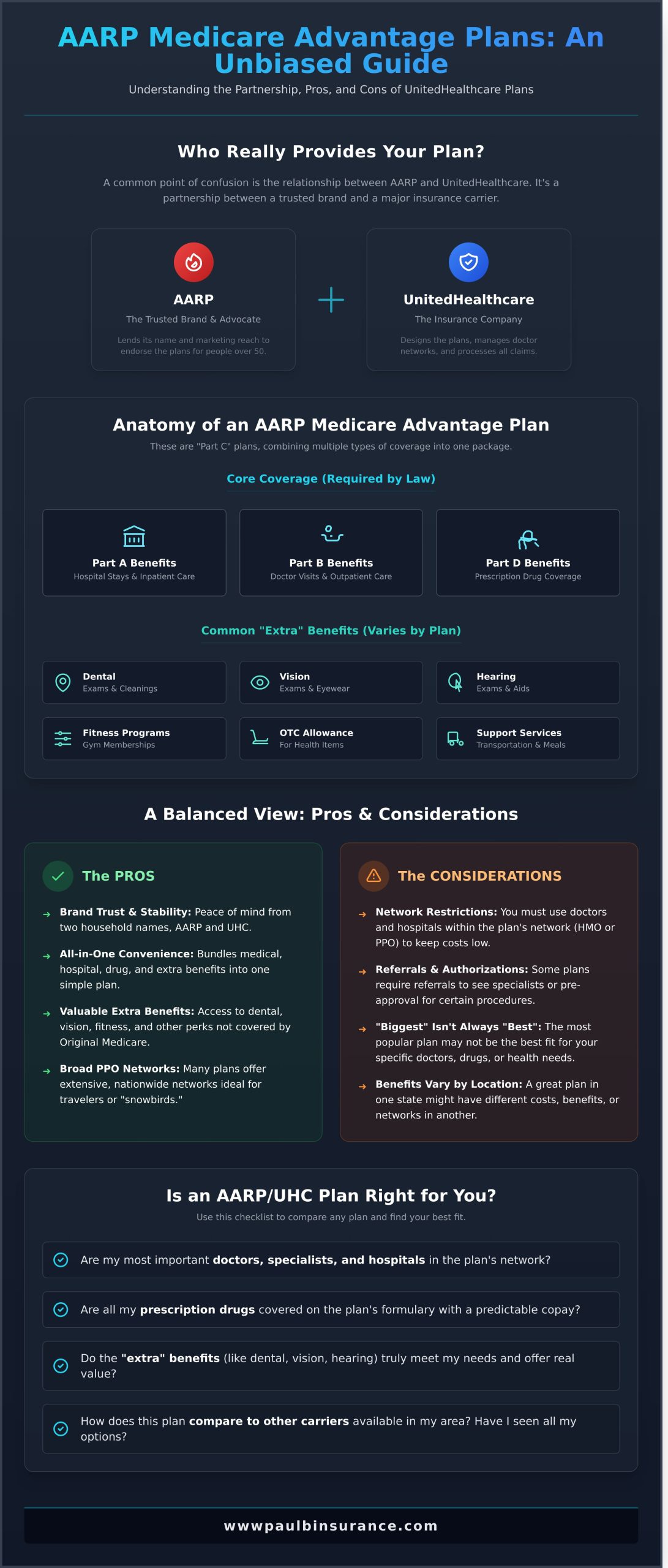
AARP health care insurance refers to a suite of health insurance products endorsed by AARP and primarily underwritten by UnitedHealthcare. These plans include Medicare Supplement (Medigap), Medicare Advantage (Part C), and Medicare Part D prescription drug coverage. To enroll, individuals generally must be AARP members and meet specific Medicare eligibility requirements, such as being age 65 or older or having certain disabilities.
As we navigate the 2026 insurance landscape, understanding the relationship between AARP and its insurance partners is vital for retirees and those approaching 65. AARP is not an insurance company; it is a membership organization that lends its brand and marketing reach to carriers—most notably UnitedHealthcare—to offer tailored health solutions to its members. This guide provides an in-depth analysis of the current offerings, costs, and selection strategies for 2026.
The Relationship Between AARP and UnitedHealthcare
The cornerstone of AARP-branded health insurance is the long-standing strategic alliance with UnitedHealthcare (UHC). For decades, UHC has been the exclusive insurer for AARP’s Medicare-related products. This partnership is unique because while AARP advocates for senior health and provides the platform, UHC handles the underwriting, claims processing, and provider networks.
For the consumer, this means that while the plan carries the "AARP" name, the actual "health care insurance" is provided by UnitedHealthcare. A portion of the member premiums is paid to AARP as a royalty fee for the use of its intellectual property. This arrangement has resulted in one of the largest private health insurance portfolios in the United States, offering members standardized benefits often paired with additional "AARP Member Only" perks.
AARP Medicare Supplement Insurance (Medigap)
In 2026, Medicare Supplement plans—commonly known as Medigap—remain a top choice for AARP members who prefer predictable out-of-pocket costs and the freedom to choose any doctor. Because original Medicare (Parts A and B) does not cover all expenses, Medigap fills the "gaps," such as copayments, coinsurance, and deductibles.
Popular Medigap Plan Types
Under the AARP/UnitedHealthcare umbrella, several standardized plans are offered, with Plans G and N being the most prominent in 2026.
- Plan G: This remains the most comprehensive plan available to new Medicare beneficiaries. It covers almost all out-of-pocket costs, including the Part A deductible and Part B excess charges. The only cost the member must pay is the annual Medicare Part B deductible.
- Plan N: This is a popular "middle-ground" option. It offers lower monthly premiums than Plan G but requires small copayments for some office visits and emergency room trips. It also does not cover Part B excess charges, making it ideal for those who live in states where excess charges are prohibited or who see providers that accept "Medicare Assignment."
- Plan F: While highly comprehensive, Plan F is only available to individuals who were eligible for Medicare prior to January 1, 2020. For those grandfathered in, AARP continues to offer and support these plans in 2026.
The Benefit of National Portability
A key advantage of AARP Medigap plans is that they are not network-based. As long as a healthcare provider accepts Medicare, they must accept an AARP Medicare Supplement plan, regardless of which state you are in. This makes these plans exceptionally well-suited for "snowbirds" or retirees who travel frequently within the United States.
AARP Medicare Advantage Plans (Part C)
Unlike Medigap, which works alongside Original Medicare, AARP Medicare Advantage plans replace Original Medicare with a private insurance alternative. These plans are managed care systems, typically structured as Health Maintenance Organizations (HMOs) or Preferred Provider Organizations (PPOs).
Integrated Benefits in 2026
By 2026, the competitive nature of the Medicare Advantage market has led AARP-branded plans to include significant ancillary benefits that Original Medicare does not offer:
- Prescription Drug Coverage (MAPD): Most AARP Medicare Advantage plans include Part D coverage, eliminating the need for a separate drug plan.
- Dental, Vision, and Hearing: These plans often provide allowances or specific coverage for routine exams, dentures, contacts, and hearing aids.
- Fitness Programs: Access to programs like "Renew Active" (UnitedHealthcare’s successor to SilverSneakers) is a standard feature, providing gym memberships and brain health exercises.
- Over-the-Counter (OTC) Credits: Many plans provide a quarterly credit for members to purchase health-related items like aspirin, vitamins, and bandages.
Network Constraints and Considerations
The primary trade-off with Medicare Advantage is the network. Members generally must use providers within the UnitedHealthcare network to receive the lowest cost-sharing rates. In an HMO, out-of-network care is often not covered except in emergencies. In a PPO, you can see out-of-network providers, but your out-of-pocket costs will be significantly higher.
AARP Medicare Part D: Prescription Drug Coverage
For those who choose Original Medicare plus a Medigap plan, a standalone AARP Medicare Part D plan is necessary to cover prescription medications. In 2026, these plans operate under the full implementation of the Inflation Reduction Act, which has drastically altered the cost structure for seniors.
The $2,000 Out-of-Pocket Cap
Starting in 2025 and continuing through 2026, there is a hard $2,000 annual limit on out-of-pocket spending for prescription drugs covered under Part D. Once a member reaches this threshold, they pay $0 for their covered drugs for the remainder of the year. This has eliminated the "donut hole" or coverage gap that previously plagued Medicare beneficiaries.
Medicare Prescription Payment Plan (M3P)
AARP Part D plans in 2026 offer the "Medicare Prescription Payment Plan." This allows members to spread their out-of-pocket drug costs over the course of the calendar year rather than paying a large sum all at once at the pharmacy counter. This is a crucial financial tool for members taking high-cost specialty medications.
Supplemental Health Insurance: Dental and Vision
While Medicare Advantage plans often include basic dental and vision, AARP also offers standalone plans for those on Original Medicare or those who need more robust coverage.
- AARP Dental Insurance Plan: Administered by Delta Dental, these plans offer a range of options from basic PPO plans to more comprehensive coverage that includes implants and major restorative work. Coverage is available to AARP members of all ages, though it is specifically designed for the needs of those 50 and older.
- AARP Vision Insurance: Provided through VSP Vision Care, these plans help cover the cost of annual eye exams and provide significant discounts or allowances for frames, lenses, and contact lenses.
AARP Health Care Insurance Comparison Table
The following table compares the primary characteristics of the three main types of AARP-branded Medicare insurance available in 2026.
| Feature | Medicare Supplement (Medigap) | Medicare Advantage (Part C) | Part D (Prescription Drug) |
|---|---|---|---|
| Primary Goal | Covers the "gaps" in Parts A & B. | Provides an all-in-one private alternative. | Covers outpatient prescription drugs. |
| Monthly Premium | Generally higher (e.g., $150–$300+). | Often $0 or very low premium. | Varies by formulary and tier. |
| Provider Network | Any provider that accepts Medicare. | Restricted to UHC network (HMO/PPO). | Network pharmacies for best pricing. |
| Drug Coverage | Not included; must buy Part D. | Usually included. | Primary focus of the plan. |
| Extra Benefits | None (standardized by law). | Dental, Vision, Gym, OTC. | None. |
| Out-of-Pocket Limit | High predictability; low per-visit cost. | Annual Max Out-of-Pocket (MOOP) cap. | $2,000 annual cap on drugs. |
Eligibility and Enrollment Requirements
To access AARP health care insurance, there are two layers of eligibility you must satisfy: AARP membership and Medicare status.
1. AARP Membership
You must be a current member of AARP to enroll in any AARP-branded UnitedHealthcare plan. Membership is open to anyone age 50 or older. The annual membership fee is relatively low (typically under $20), and it grants access not just to insurance, but to a wide array of travel, retail, and financial discounts.
2. Medicare Enrollment
For Medigap, Advantage, and Part D plans, you must be enrolled in Medicare Part A and Part B. Most people become eligible at age 65. If you are still working and have employer-sponsored insurance, you may delay Part B, but you generally cannot purchase an AARP Medicare plan until you have both parts active.
3. Enrollment Windows
- Initial Enrollment Period (IEP): The seven-month window around your 65th birthday.
- General Enrollment Period: January 1 through March 31 each year.
- Annual Enrollment Period (AEP): October 15 through December 7. This is the primary time to switch between AARP Medicare Advantage and Part D plans for the following year (2026).
- Medigap Open Enrollment: A one-time six-month window starting the month you turn 65 and are enrolled in Part B. During this time, you have "guaranteed issue" rights, meaning UnitedHealthcare cannot deny you coverage or charge you more for pre-existing conditions.
Strategic Selection: How to Choose Your Plan
Choosing between these options depends on your health status, budget, and lifestyle.
When to Choose Medigap (Plan G or N)
If you prefer total freedom to choose your specialists and want to know exactly what your medical bills will be each month, Medigap is the superior choice. It is particularly beneficial for those with chronic conditions who require frequent specialist visits, as there are no "prior authorization" hurdles that are common in Advantage plans.
When to Choose Medicare Advantage
If you are looking for a "one-stop shop" and want to save on monthly premiums, Medicare Advantage is compelling. It is a good fit for individuals who are comfortable staying within a specific network of doctors and who value the extra perks like dental coverage and fitness memberships. However, you should always verify that your must-have doctors and preferred hospitals are in the UnitedHealthcare network before signing up.
Frequently Asked Questions
Is AARP health insurance the same as UnitedHealthcare?
Not exactly. AARP is the sponsoring organization that endorses the plans, while UnitedHealthcare is the insurance company that provides the actual coverage, pays the claims, and manages the provider networks. You must be an AARP member to buy these specific UHC plans.
Can I keep my AARP insurance if I move to a different state?
If you have an AARP Medigap plan, your coverage is portable across the U.S. because it is not tied to a local network. However, if you have an AARP Medicare Advantage plan, you will likely need to switch to a new plan offered by UHC in your new service area, as Advantage plans are zip-code specific.
Does AARP health insurance cover long-term care?
No. AARP-branded Medicare Supplement and Medicare Advantage plans do not cover long-term custodial care (such as nursing homes or assisted living). They only cover "skilled" care for recovery following a hospital stay. AARP does offer separate information and access to long-term care insurance providers, but this is distinct from their health insurance products.
How has the $2,000 drug cap affected AARP Part D premiums in 2026?
The $2,000 out-of-pocket cap mandated by the Inflation Reduction Act has led to shifts in the Part D market. While it provides immense relief for those with high drug costs, some plans have adjusted by increasing monthly premiums or changing their "formularies" (the list of covered drugs). It is more important than ever in 2026 to perform an annual review of your drug plan during the Open Enrollment period.
Do AARP plans cover pre-existing conditions?
If you enroll in an AARP Medicare Advantage plan or a Part D plan, you cannot be denied coverage based on pre-existing conditions. For Medigap plans, you are guaranteed coverage if you apply during your Initial Enrollment Period. If you apply for a Medigap plan later, you may be subject to medical underwriting depending on your state's laws.
Practical Recommendation for 2026
For the 2026 plan year, the most critical action for AARP members is to utilize the Medicare Plan Finder tool on the official Medicare.gov website or the AARP/UnitedHealthcare member portal. Due to significant legislative changes regarding drug costs and the expansion of Medicare Advantage benefits, a plan that worked for you in 2024 or 2025 may no longer be the most cost-effective option.
If you value doctor choice and have a stable budget, AARP Medicare Supplement Plan G remains the gold standard. If you are healthy and want to minimize monthly fixed costs while gaining dental and vision benefits, explore the AARP Medicare Advantage PPO options, which offer a balance of network flexibility and integrated perks.