For a standard 2012 Ford Escape, the manufacturer-recommended cold tire pressure is typically 30 psi for both front and rear tires, though specific trims, aftermarket wheel sizes, and towing configurations may require adjustments ranging up to 35 psi. Determining the exact inflation level requires checking the safety compliance certification label located on the driver's door jamb rather than relying solely on the maximum pressure stamped on the tire sidewall.
Maintaining correct tire pressure is one of the most critical yet frequently overlooked aspects of vehicle maintenance. For owners of the 2012 Ford Escape, navigating conflicting recommendations between door-jamb stickers, tire sidewalls, and general automotive advice can be confusing. Drivers often debate whether to stick with a lower baseline of 30 psi or increase inflation to 32, 33, or 35 psi for better fuel economy or handling. Understanding the engineering rationale behind these figures ensures optimal safety, predictable handling, extended tire life, and maximum fuel efficiency.
The Manufacturer Specification: Decoding the Door-Jamb Sticker
The single most accurate source of tire pressure information for any vehicle is the Tire and Loading Information placard. On the 2012 Ford Escape, this sticker is affixed to the B-pillar on the driver’s side, visible when the door is open.
Ford engineered the second-generation Escape (covering model years 2008 through 2012) with a baseline cold inflation pressure of 30 psi for the standard original equipment tires. This figure was calculated by Ford's vehicle dynamics engineers to balance ride comfort, braking performance, load capacity, and tire footprint.
When engineers select 30 psi for a crossover utility vehicle of this weight class, they account for the vehicle’s center of gravity, suspension geometry, and gross vehicle weight rating (GVWR). Inflating the tires to this specific level ensures that the tire tread makes full, flat contact with the road surface. This maximizes traction in wet and dry conditions while preventing premature center-tread wear caused by over-inflation.
Why Do People Recommend 32, 33, or 35 PSI?
Despite the factory recommendation of 30 psi, many experienced mechanics, tire technicians, and long-time Escape owners advocate for running 32 to 35 psi. This divergence in opinion stems from several practical factors regarding real-world driving conditions, seasonal temperature fluctuations, and personal preference.
1. Temperature Fluctuations and Seasonal Pressure Loss
Air is a gas that expands when heated and contracts when cooled. For every 10-degree Fahrenheit drop in ambient temperature, tire pressure typically decreases by about 1 to 2 psi. A 2012 Ford Escape set to 30 psi during a warm autumn afternoon might drop to 26 or 27 psi during a freezing winter morning.
By starting at a slightly higher baseline, such as 32 or 35 psi, drivers provide a buffer against cold-weather pressure drops. This helps prevent the Tire Pressure Monitoring System (TPMS) warning light from illuminating unexpectedly on chilly mornings.
2. Fuel Economy and Rolling Resistance
Higher tire pressure results in a stiffer tire carcass and a smaller contact patch with the road, which reduces rolling resistance. Less rolling resistance means the engine requires less energy to propel the vehicle forward, resulting in a marginal improvement in fuel economy. Drivers looking to maximize miles per gallon often lean toward the upper end of safe inflation limits, commonly choosing 35 psi.
However, running pressures significantly higher than recommended can compromise ride quality, making the suspension feel harsh and jarring over road imperfections.
3. Load and Passenger Weight
The 30 psi recommendation assumes standard driving conditions with light to moderate passenger loads. When loading a 2012 Ford Escape with heavy cargo, luggage, or multiple adult passengers, the load on the tires increases. Higher loads require higher internal air pressure to support the weight without excessive sidewall flexing, which generates heat and increases the risk of tire failure.
While the factory door sticker provides baseline numbers for maximum vehicle capacity, adjusting pressures closer to 35 psi under heavy loads helps maintain vehicle stability.
Examining Trim Levels and Tire Size Variations
The 2012 Ford Escape was manufactured in multiple trim levels—including the XLS, XLT, and Limited—along with a Hybrid variant. Furthermore, buyers could choose between front-wheel drive (FWD) and four-wheel drive (4WD) configurations. Factory wheel sizes also varied, ranging from 16-inch alloy and steel wheels to 17-inch premium wheels.
| Trim Level & Drivetrain | Factory Wheel Size | Original Equipment Tire Size | Recommended Cold Tire Pressure |
|---|---|---|---|
| 2012 Escape XLS / XLT (FWD/4WD) | 16-inch | P215/70R16 | 30 PSI (Front and Rear) |
| 2012 Escape Limited (FWD/4WD) | 17-inch | P235/65R17 | 30 PSI (Front and Rear) |
| 2012 Escape Hybrid (FWD/4WD) | 16-inch | P215/70R16 | 30 PSI (Front and Rear) |
| Loaded Cargo / Towing Configuration | Any Standard Size | Any Standard Size | 32–35 PSI (Check Load Limits) |
When vehicle owners replace original tires with aftermarket alternatives—such as switching from passenger-car (P-metric) tires to light-truck (LT-metric) tires or changing wheel diameters—the standard 30 psi guideline may no longer apply. LT tires feature stiffer sidewalls and often require significantly higher pressures to carry the same load as P-metric tires. Always consult a professional tire installer or the tire manufacturer’s load inflation tables if running non-standard tire sizes.
The Risks of Incorrect Tire Pressure
Operating a 2012 Ford Escape with improper tire inflation introduces mechanical risks, safety hazards, and financial costs over time. Both under-inflation and over-inflation degrade the driving experience and shorten component lifespans.
Under-Inflation (Below 30 PSI)
When a tire is under-inflated, the sidewalls flex excessively as the wheel rotates. This continuous flexing generates internal heat, which can lead to tread separation, structural tire failure, or a blowout at highway speeds.
- Increased Wear: The outer edges of the tread bear the burden of the vehicle's weight, causing rapid shoulder wear and shortening tire life.
- Reduced Fuel Economy: Higher rolling resistance forces the engine to burn more fuel.
- Sluggish Handling: Steering response becomes mushy, and cornering stability diminishes.
Over-Inflation (Above 35 PSI)
While some drivers prefer the stiffer feel of high pressure, exceeding safe limits creates its own set of problems.
- Center Tread Wear: The middle section of the tire balloons outward and bears the majority of the vehicle's weight, wearing out prematurely while the shoulders remain intact.
- Harsh Ride: Suspension components absorb less shock, transferring road impacts directly into the vehicle frame and cabin.
- Reduced Traction: A smaller contact patch reduces available grip, particularly on wet, icy, or loose gravel surfaces, leading to longer braking distances.
How to Properly Check and Adjust Tire Pressure
Measuring tire pressure requires a methodical approach to ensure accuracy. Ambient temperatures and recent driving activity significantly alter internal tire pressure readings.
- Check Tires When Cold: A "cold" tire is defined as a vehicle that has been parked for at least three hours or driven less than one mile at low speeds. Driving heats up the air inside the tire, increasing pressure by 3 to 5 psi. Never bleed air out of a hot tire to reach 30 psi, as the tire will become severely under-inflated once it cools down.
- Use a Reliable Gauge: Digital gauges or quality dial gauges provide more consistent readings than standard pencil-type spring gauges. Keep a dedicated gauge in the glove compartment or center console.
- Remove Valve Caps: Unscrew the plastic dust caps from the valve stems on all four tires, plus the spare tire if equipped.
- Measure and Record: Press the tire gauge firmly onto the valve stem until the hissing sound stops and the gauge registers a reading. Note the pressure for each tire.
- Inflate or Deflate as Needed: If pressure is below the target (30 to 35 psi depending on preference and load), use a portable air compressor or service station inflator to add air. If pressure is too high, use the small pin on the back of the gauge to depress the valve core and release air.
- Reinstall Caps: Replace the valve caps securely to keep moisture and dirt out of the valve mechanisms.
Understanding the 2012 Ford Escape TPMS System
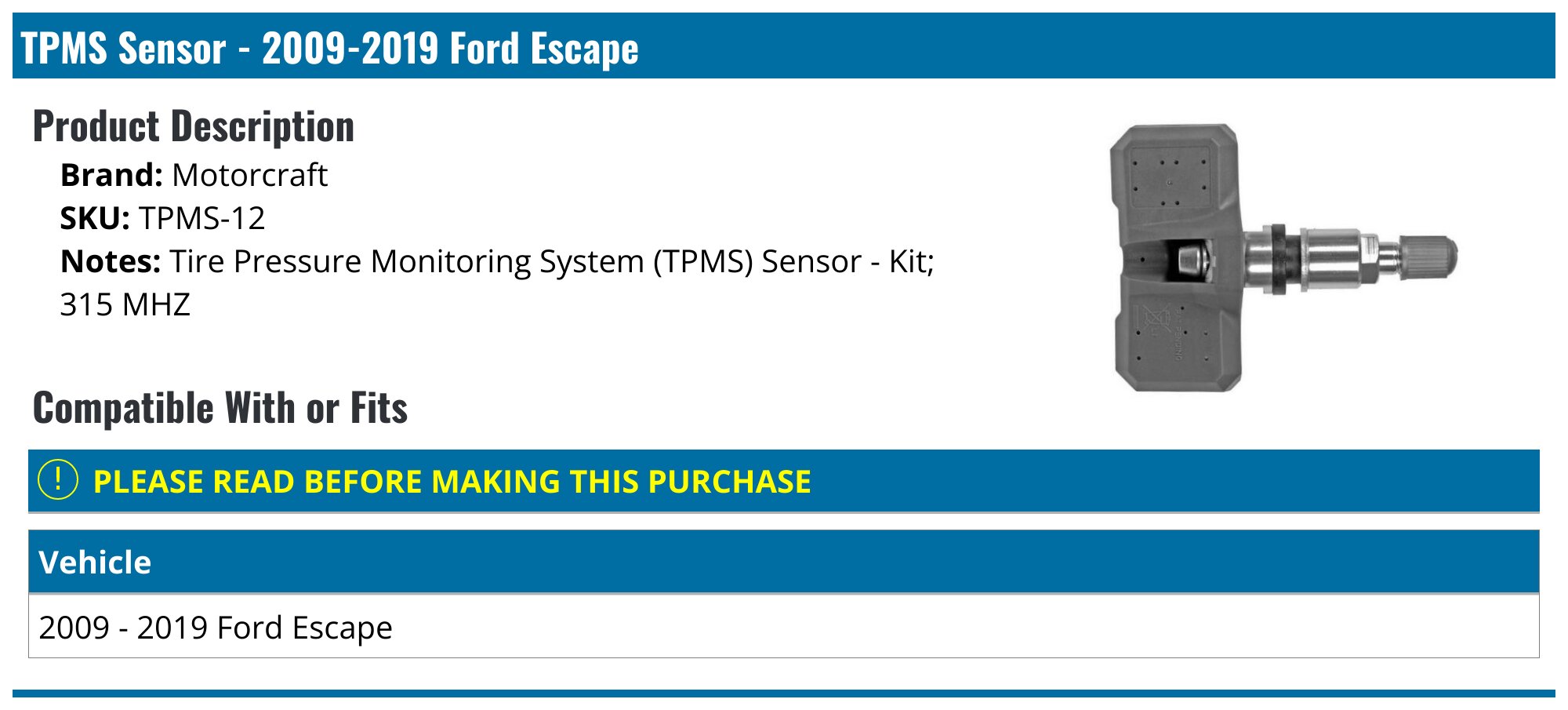
The 2012 Ford Escape is equipped with an indirect or direct Tire Pressure Monitoring System designed to alert the driver when pressure drops significantly below the recommended level—usually around 25% under the factory specification (roughly 22 to 23 psi).
It is important to understand that the TPMS dashboard light is a safety warning, not a maintenance tool. Relying on the TPMS light to illuminate before checking tire pressure means running on dangerously low tires. Furthermore, seasonal temperature drops can trigger the TPMS light even if tires are mechanically sound, simply because cold air contracts. Always verify actual pressure with a physical gauge when the TPMS light appears.
Frequently Asked Questions
Is 35 psi safe to use on a 2012 Ford Escape?
Yes, running 35 psi is generally safe and will not cause immediate tire failure, but it will result in a firmer ride and slightly faster center-tread wear over the long term. Many drivers choose 32 to 35 psi to improve fuel economy or compensate for cold weather pressure drops.
Should front and rear tire pressures be different on a 2012 Ford Escape?
For the factory setup, Ford recommends the same pressure (30 psi) for both front and rear tires. Unlike rear-wheel-drive trucks or sports cars with staggered wheel setups, the front-wheel-drive and four-wheel-drive configurations of the Escape utilize equal pressure across all four corners.
Why does my tire pressure drop every time the weather gets cold?
As ambient temperatures drop, the gas molecules inside the tire slow down and move closer together, reducing internal pressure. As a general rule of thumb, tire pressure drops by 1 to 2 psi for every 10-degree Fahrenheit drop in temperature. Checking and adjusting pressures at the change of each season prevents under-inflation.
Can I trust the maximum psi printed on the tire sidewall?
No. The number printed on the tire sidewall (often 44 psi or 51 psi) represents the maximum pressure the tire can safely hold, not the recommended operating pressure for your vehicle. Always inflate your tires based on the vehicle manufacturer's specification found on the door-jamb placard.
How often should I check my tire pressure?
Tire pressure should be checked at least once a month and before taking any long road trips. Additionally, always check pressures whenever there is a dramatic shift in local outdoor temperatures, such as the transition from autumn to winter.
Conclusion and Recommended Next Action
For optimal balance between ride comfort, safety, and tire longevity, set your 2012 Ford Escape tire pressure to the factory-recommended 30 psi for normal daily commuting. If you frequently carry heavy cargo, drive at sustained high highway speeds, or want a buffer against cold-weather pressure loss, adjusting to 32 or 35 psi remains within a safe operational window.
Your immediate next action should be to walk out to your vehicle, open the driver's door to verify your specific placard specifications, grab a reliable pressure gauge, and check your cold tire pressures before your next drive.