A closely held business with multiple owners where the majority of each owner’s net worth is tied to the company benefits most from a life insurance funded buy-sell agreement. This specific scenario ensures immediate liquidity to compensate a deceased owner’s heirs while preventing business liquidation or the forced entry of unqualified family members into active management.
The stability of a business is often its most fragile attribute. When a co-owner of a private company passes away, the legal and financial ripples can quickly destabilize operations, credit lines, and employee morale. Without a pre-funded exit strategy, the surviving owners may find themselves in a precarious position: sharing the boardroom with the deceased partner’s spouse or children, or being forced to sell company assets at a discount to pay out the estate. A buy-sell agreement funded by life insurance is the primary tool used in 2026 to mitigate these risks, providing a clear roadmap and the necessary capital to execute a clean transition.
Understanding the "Most Benefited" Scenario: The Closely Held Business
While many business structures can utilize buy-sell agreements, the closely held corporation or multi-member LLC represents the scenario with the highest stakes. In these businesses, the owners are typically the primary drivers of revenue and strategy. The loss of one owner is not just a loss of capital, but a loss of vital institutional knowledge and leadership.
In this scenario, the owners usually lack the "excess" cash on the balance sheet required to buy out a multi-million dollar stake in the event of a sudden death. Furthermore, the heirs of the deceased owner often need immediate cash to settle estate taxes or maintain their lifestyle, but they may have no interest or expertise in running the company. The life insurance policy acts as a "liquidity event" that satisfies both parties: the heirs get cash, and the surviving partners get 100% control of the company.
The Liquidity Crisis in Private Equity
Most small-to-medium enterprise (SME) owners are "asset rich and cash poor." Their wealth is locked in the valuation of their company. If an owner dies, their shares pass to their estate. According to the Internal Revenue Service (IRS), estate taxes may be due, and the heirs may look to the business to provide that liquidity. If the business cannot afford a buyout, it may be forced into a fire sale or bankruptcy. A life insurance funded agreement provides a "pennies on the dollar" solution, where the death benefit—purchased via annual premiums—covers the full purchase price of the shares.
How Life Insurance Funded Buy-Sell Agreements Function
At its core, a buy-sell agreement is a legally binding contract between business owners. It stipulates that if a "triggering event" (usually death or disability) occurs, the remaining owners or the business itself is obligated to purchase the departing owner’s interest, and the departing owner’s estate is obligated to sell it.
Life insurance is the preferred funding vehicle because it guarantees the availability of funds at the exact moment they are needed. Unlike a sinking fund or a bank loan, the death benefit is usually income-tax-free and provides the full amount regardless of how many premiums have been paid.
1. The Cross-Purchase Agreement
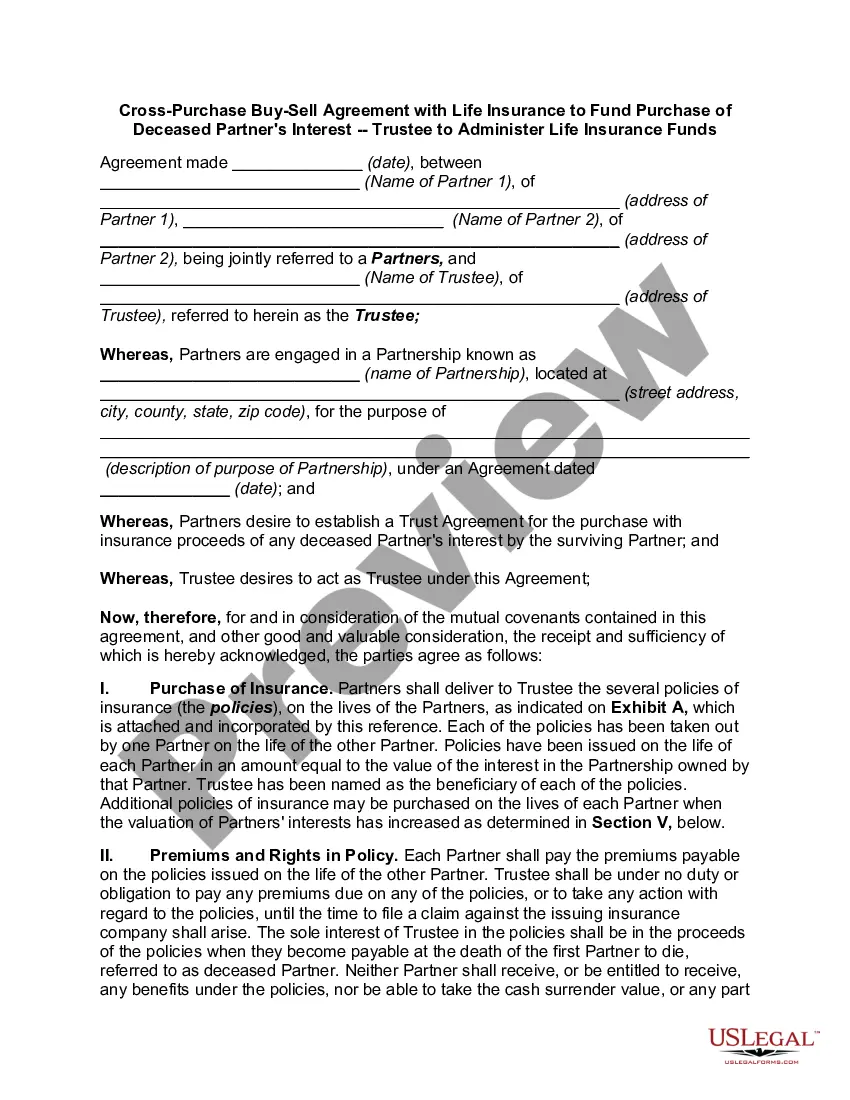
In a cross-purchase plan, each owner purchases a life insurance policy on every other owner.
- Mechanism: If Owner A and Owner B each own 50% of a company worth $2 million, Owner A buys a $1 million policy on Owner B, and vice versa.
- Benefit: If Owner B dies, Owner A receives the $1 million tax-free and uses it to buy Owner B's shares from their estate.
- Tax Advantage: Owner A gets a "step-up in basis." Their original basis in the company increases by the $1 million they just paid, which significantly reduces capital gains taxes if Owner A sells the business later.
2. The Entity-Purchase (Redemption) Agreement
In an entity-purchase plan, the business itself owns the policies on each owner.
- Mechanism: The company pays the premiums and is the beneficiary. Upon an owner’s death, the company receives the death benefit and uses the funds to "redeem" (buy back) the deceased owner’s shares.
- Benefit: This is much simpler to administer if there are many owners. If a company has 10 owners, a cross-purchase would require 90 separate policies. An entity-purchase only requires 10.
- Drawback: There is no step-up in basis for the surviving owners, and the cash value of the policies can be subject to the company's creditors.
Comparison of Funding Methods for Buy-Sell Agreements
When determining the best strategy for 2026, business owners must compare life insurance against other traditional funding methods.
| Funding Method | Immediate Availability | Cost Efficiency | Tax Implications | Impact on Cash Flow |
|---|---|---|---|---|
| Life Insurance | High (Immediate) | High (Premiums are low relative to benefit) | Death benefit is generally tax-free | Predictable annual premiums |
| Cash Reserves | Low (Takes years to build) | Low (Tied up capital) | Interest earned is taxable | Diverts cash from growth |
| Installment Note | Medium (Requires future cash flow) | Low (Interest costs) | Payments are made with after-tax dollars | Burdens business for years |
| Bank Loan | Low (Death of an owner may hurt credit) | Low (Interest and principal) | Interest may be deductible but debt is high | High impact on debt-to-equity |
Key Triggers Beyond Death
While the primary question focuses on the "life insurance" aspect (which implies death), a comprehensive buy-sell agreement in 2026 often includes other triggers that benefit from similar insurance-based funding:
- Total Disability: Many agreements are funded with "Disability Buy-Out" (DBO) insurance. If an owner becomes permanently disabled and can no longer contribute to the firm, the DBO policy provides the funds to buy them out.
- Retirement: While life insurance death benefits don't cover retirement, permanent life insurance (like Whole Life or Universal Life) accumulates cash value. This cash value can be harvested or borrowed against to provide a partial down payment for an owner’s retirement buyout.
- Critical Illness: Some modern policies include "accelerated death benefit" riders, allowing the business to access funds if an owner is diagnosed with a terminal or chronic illness.
Valuation: The Foundation of the Agreement
A buy-sell agreement is only as good as the valuation formula it contains. If the life insurance coverage is $5 million, but the business is actually worth $10 million at the time of death, the agreement is underfunded, leading to potential litigation between the survivors and the heirs.
Common valuation methods used in 2026 include:
- Fixed Price: Owners agree on a set value annually. This is risky if they forget to update it.
- Formula-Based: Usually a multiple of EBITDA (Earnings Before Interest, Taxes, Depreciation, and Amortization) or book value. This adjusts automatically with the company's performance.
- Independent Appraisal: The agreement mandates that an external valuation expert be hired upon the triggering event. This is the most accurate but also the most time-consuming and expensive method.
For the scenario that benefits most—the high-growth closely held firm—a formula-based approach is often best, as it ensures the insurance coverage can be adjusted periodically to match the rising value of the firm.
Legal and Tax Considerations (Section 101(j))
Business owners must be aware of Internal Revenue Code Section 101(j). This rule stipulates that for a business-owned life insurance policy to remain tax-free, the business must provide notice to the insured employee and receive their written consent before the policy is issued. Failure to comply with these "Notice and Consent" requirements can result in the death benefit being treated as taxable income, which would gut the funding of the buyout.
Furthermore, in a 2026 environment, the Corporate Transparency Act (CTA) and other reporting requirements mean that the ownership of these policies and the underlying agreements must be clearly documented in the company’s corporate minutes. Legal counsel should always review the agreement to ensure it coordinates correctly with the owners' individual estate plans and the company's operating agreement or bylaws.
Common Pitfalls to Avoid
Even the most well-intentioned buy-sell agreements can fail if not maintained properly.
- Underfunding: As the business grows, the original life insurance policies may no longer cover the full value of the shares. Owners should conduct a "triennial review" to adjust coverage.
- Unfair Pricing: If the valuation is too low, the heirs may sue the surviving partners for breach of fiduciary duty.
- Policy Ownership Mismatches: In a cross-purchase, if Owner A stops paying the premium on Owner B’s policy, the whole system collapses. This is why many firms use a "Trusteed Cross-Purchase" where a third-party trustee ensures premiums are paid and policies are kept in force.
- Ignoring the "Wait and See" Approach: Sometimes, owners aren't sure if a cross-purchase or entity-purchase is better. A "Wait and See" agreement allows the business a first option to buy, followed by the individual owners. This provides maximum flexibility for tax planning at the time of the event.
Frequently Asked Questions
Is the premium for buy-sell life insurance tax-deductible?
No. Under current tax law, premiums paid for life insurance where the business or its owners are the beneficiaries are generally not tax-deductible. However, the death benefit is typically received income-tax-free, provided the requirements of Section 101(j) are met.
What happens if an owner becomes "uninsurable"?
This is a common hurdle. If an owner cannot qualify for life insurance due to health issues, the agreement often substitutes an installment sale. The company might use a "sinking fund" or set aside a portion of profits annually to build the necessary capital over time. Some owners also use existing personal policies or "rated" policies with higher premiums.
How often should we update our buy-sell agreement?
Most experts recommend a formal review every two to three years, or whenever a significant "material event" occurs, such as a major acquisition, a large spike in revenue, or the addition of a new partner. Regular updates ensure the valuation and the insurance funding remain aligned.
Can we use term insurance instead of permanent insurance?
Yes, term insurance is often used because it is much cheaper in the short term. However, term insurance eventually expires or becomes prohibitively expensive as owners age. For a long-term business succession plan, permanent insurance (like Universal Life) is often preferred because it stays in force as long as premiums are paid and builds cash value.
What if there are more than three owners?
As the number of owners increases, a cross-purchase agreement becomes administratively difficult. In this scenario, a Business Continuity Trust or an Entity-Purchase Agreement is usually the most beneficial structure, as it centralizes policy management and reduces the total number of policies required.
Next Steps for Business Owners
If your business fits the "most benefited" profile—a closely held company with significant value and limited liquidity—your next action should be a tripartite meeting between your legal counsel, tax advisor, and insurance professional.
- Draft or Update the Agreement: Ensure your buy-sell agreement is legally binding and reflects current valuations.
- Conduct a Valuation: Determine the "Fair Market Value" of the company using an agreed-upon formula.
- Audit Existing Policies: Ensure all policies are in compliance with Section 101(j) and that the death benefits are sufficient to cover the current valuation.
- Establish a Review Schedule: Commit to a recurring meeting every 24–36 months to adjust for company growth or changes in the ownership structure.
By securing a life insurance funded buy-sell agreement, you are not just buying an insurance policy; you are purchasing the "peace of mind" that your business will survive your absence and that your family will be financially protected for the value you've spent a lifetime building.