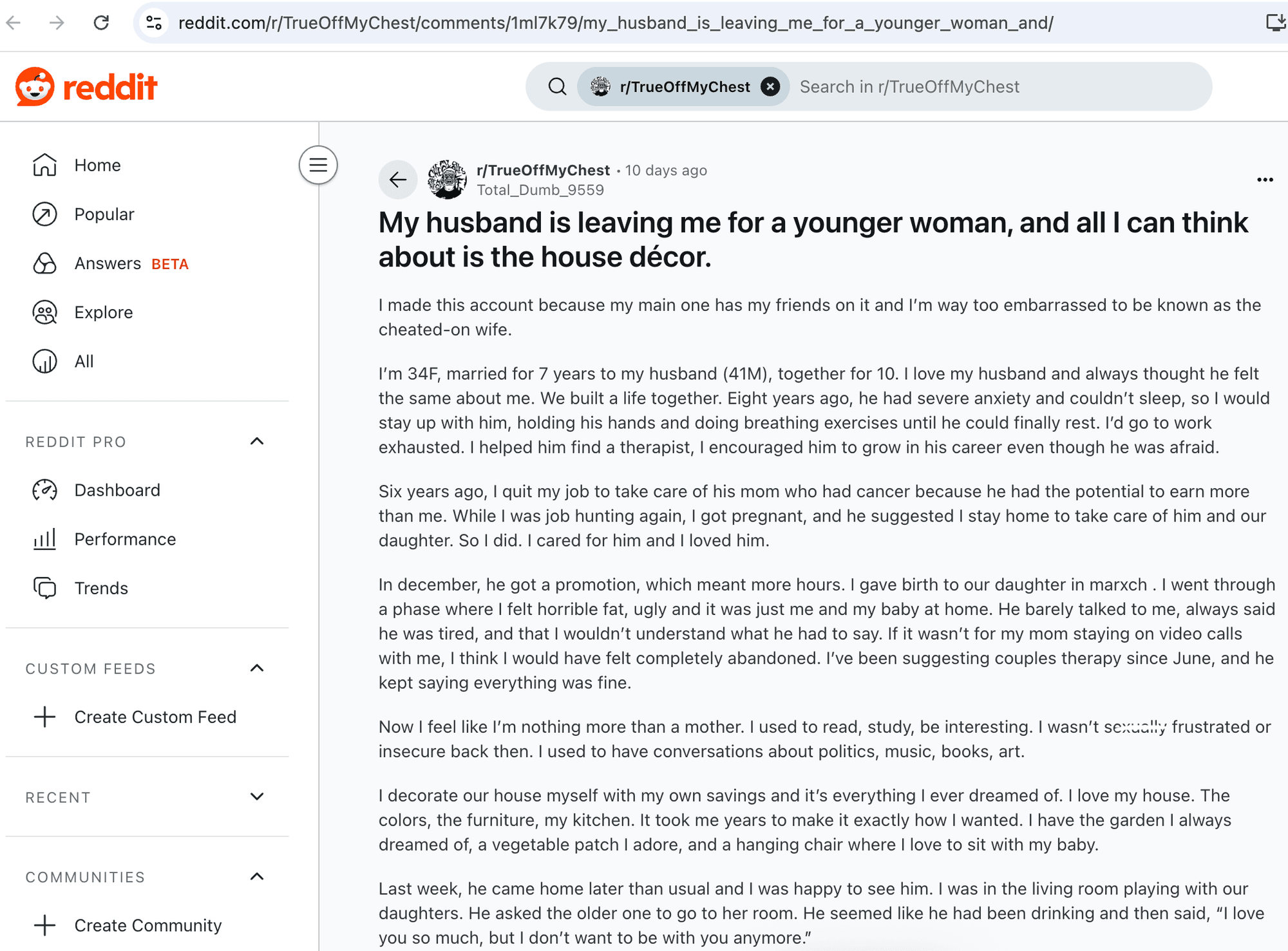
Navigating the aftermath of a husband leaving for a younger woman requires a dual focus on emotional stabilization and strategic practical planning. Recovery involves processing the trauma of betrayal, securing your financial and legal rights through professional counsel, and eventually shifting your focus from the loss of the relationship to your own independent growth and long-term well-being.
The experience of a husband exiting a long-term marriage to pursue a relationship with a significantly younger woman is a profound life crisis that touches on themes of identity, worth, and security. While this cliché is often dismissed as a "midlife crisis," for the spouse left behind, it is a destabilizing event that requires a comprehensive approach to navigate. Understanding the psychological drivers, the legal realities of 2026, and the roadmap for emotional recovery is essential for moving from a state of victimhood to one of agency.
The Psychological Underpinnings of the Departure
When a husband leaves for a younger partner, it is rarely a sudden whim, even if it feels that way to the spouse. Psychologically, this transition often stems from a complex intersection of internal dissatisfaction and external validation seeking. In many cases, the younger woman represents a "blank slate"—someone who does not know his flaws, his past failures, or the mundane realities of his daily life.
The Pursuit of Youthful Validation
For many men, aging brings about a sense of mortality and a fear of fading relevance. A younger partner often acts as a mirror that reflects a more youthful, vibrant version of himself back to him. This is frequently referred to in clinical psychology as "narcissistic supply." The younger woman’s admiration provides a temporary ego boost that masks underlying insecurities about his own aging process or professional stagnation.
The Phenomenon of "Affair Fog"
"Affair fog" is a state of limerence—an intense, obsessive infatuation—where the person leaving becomes emotionally cognitively impaired. In this state, the husband often rewrites the history of the marriage to justify his departure. He may claim he was "never happy" or that the marriage was "dead for years," even if there is evidence to the contrary. This cognitive dissonance allows him to pursue the new relationship without the crushing weight of guilt, as he has effectively vilified his spouse to make himself the "hero" of his new narrative.
Midlife Transition vs. Midlife Crisis
It is important to distinguish between a healthy midlife transition and a destructive midlife crisis. A transition involves reflecting on one's life and making constructive changes. A crisis, however, is often characterized by impulsive, high-stakes decisions that prioritize immediate gratification over long-term commitments and family stability. When a husband leaves for a younger woman, it is typically a hallmark of the latter, driven by an inability to cope with the psychological demands of aging.
Immediate Steps After the Discovery
The first 90 days after a spouse leaves are often the most volatile. Your primary goal during this period is not "winning him back" or seeking closure—it is protection.
Securing Legal Counsel
In 2026, divorce laws continue to evolve, particularly regarding "no-fault" jurisdictions and the division of digital assets. Even if you hope for a reconciliation, you must consult with a family law attorney immediately. An attorney can help you understand your rights regarding temporary alimony, child support, and the freezing of marital assets to prevent them from being spent on the new partner.
Financial Forensics and Asset Protection
It is common for a spouse who is planning a departure to begin "sequestering" funds or hiding assets. Review all joint bank accounts, credit card statements, and investment portfolios. Look for unusual withdrawals or transfers. In high-net-worth cases, hiring a forensic accountant may be necessary to ensure that the marital estate is divided equitably. Pay close attention to shared digital assets, including cryptocurrency and shared subscription services, which are often overlooked in traditional settlements.
Establishing Emotional Boundaries
If your husband has moved out to be with a younger woman, implement a "Modified No-Contact" rule. Communications should be limited strictly to logistics, finances, and parenting. Engaging in emotional pleas, "pick-me" behavior, or arguments about the younger woman only serves to reinforce his narrative that you are "difficult" or "unstable," while further damaging your own self-esteem.
Navigating the Legal Landscape in 2026
The legal implications of a husband leaving for another person vary significantly depending on your jurisdiction. While most regions follow no-fault divorce laws, the presence of an affair can still influence certain aspects of the settlement.
| Feature | Impact in No-Fault Jurisdictions | Impact in At-Fault Jurisdictions |
|---|---|---|
| Grounds for Divorce | Irreconcilable differences; infidelity is legally irrelevant for the "right" to divorce. | Adultery can be cited as the specific reason for the marriage's end. |
| Alimony/Spousal Support | Generally based on need and duration of marriage; rarely affected by infidelity. | Infidelity may increase the award or disqualify the unfaithful spouse from receiving support. |
| Asset Division | Assets are split equitably or equally; infidelity only matters if "dissipation" occurred. | Potential for a larger share of assets if the affair caused significant emotional or financial harm. |
| Child Custody | Focused on the "best interests of the child"; infidelity rarely impacts custody unless the new partner is a risk. | Similar to no-fault, but the "moral fitness" of the parent might be scrutinized more closely. |
| Dissipation of Assets | Marital funds spent on the "other woman" (gifts, travel, rent) can be recouped. | Stronger emphasis on reclaiming funds spent on the extramarital relationship. |
The Concept of Marital Dissipation
One of the most critical legal tools for a spouse left for a younger partner is the claim of "dissipation of marital assets." If your husband used joint funds to buy jewelry, pay for vacations, or fund the lifestyle of his new partner, the court can "add back" those funds to your side of the ledger during the final division of property. It is vital to keep meticulous records of any such spending.
The Impact on Children and Family Dynamics
When a father leaves for a younger woman, the impact on children—even adult children—is profound. It shatters their perception of family stability and can lead to a phenomenon known as "parental alienation" or "alignment."
Explaining the Departure
Children should be told the truth in an age-appropriate manner, but without "over-sharing" the sordid details. The focus should be on the fact that the marriage is ending and that both parents still love them. However, it is inevitable that children will notice the age gap of the new partner, which can lead to feelings of embarrassment, anger, or confusion.
Managing Introductions
A common mistake made by the departing husband is introducing the younger woman to the children too soon. This is often viewed as an attempt to "force" a new family unit, which usually backfires, causing the children to resent both the father and the new partner. Experts generally recommend waiting at least six months to a year after the divorce is finalized—and ensuring the relationship is stable—before any introductions occur.
Dealing with Adult Children
Adult children often experience a unique form of grief. They may feel they have to "parent" their grieving mother while simultaneously feeling disgusted by their father’s behavior. The father’s departure can also trigger concerns about their own future inheritance or the stability of their parents' retirement.
Strategies for Long-Term Healing
Recovery from this specific type of betrayal is not a linear process. It involves deconstructing the "younger woman" myth and rebuilding your own sense of identity.
Deconstructing the "Younger Woman" Myth
It is easy to fall into the trap of comparing yourself to the younger partner. However, it is essential to realize that his choice is not a reflection of your lack of value, but rather a reflection of his own internal vacuum. Younger age does not equate to a better partner; it often equates to a partner with less shared history, fewer complications, and a different stage of life development. Most "rebound" relationships built on the ashes of a long-term marriage face significant statistical hurdles to long-term success.
The Role of Therapy
Traditional talk therapy is helpful, but trauma-informed therapy (such as EMDR or Somatic Experiencing) is often more effective for dealing with the "betrayal trauma" associated with being replaced. A therapist can help you process the "discard" and prevent you from internalizing the rejection.
Reclaiming Your Identity
In long-term marriages, identities often become enmeshed. Part of the healing process involves "untangling" who you are from who you were as a wife. This is the time to pursue interests, career goals, or social circles that may have been sidelined during the marriage. Rebuilding your life isn't about "showing him what he lost," but about "discovering what you have gained" in terms of freedom and self-determination.
Common Obstacles to Recovery
There are several psychological traps that can keep a person "stuck" in the pain of being left for a younger woman.
- Pain-Shopping: Constantly checking the husband’s or the new partner’s social media. This only serves to reset the "grief clock" and provides a distorted, "highlight reel" view of their new life.
- The Closure Trap: Waiting for the husband to apologize or explain "why" in a way that makes sense. True closure comes from within, as the departing spouse is often unable or unwilling to provide a truthful accounting of their actions.
- Comparing Timelines: Feeling like a failure because he has "moved on" quickly while you are still struggling. Remember that he "moved on" while still in the marriage; you are starting your healing process from scratch.
Frequently Asked Questions
Why do men choose women who are so much younger?
The choice is often less about the specific woman and more about what she symbolizes: a return to a time before the responsibilities of mortgage, children, and aging. A younger woman typically has fewer demands and offers a fresh ego-boost that makes the man feel powerful and "reborn." It is a psychological defense mechanism against the reality of midlife.
Do these relationships usually last?
Statistically, relationships that begin as affairs or involve a significant age gap during a midlife crisis have a lower success rate than peer-to-peer relationships. Once the "limerence" or "affair fog" wears off—usually between 18 months and 3 years—the reality of the age gap (different life stages, health issues, and social circles) begins to create significant friction.
How do I handle the "social death" of my friend group?
Often, friends feel they have to "choose sides," or they become uncomfortable around the discarded spouse because it reminds them of their own marital vulnerability. It is common to lose some friends during a divorce. Focus on cultivating "new" friends who only know you as an individual, while leaning on the core group that remains loyal.
Should I tell people that he left for a younger woman?
While you shouldn't feel the need to protect his reputation, "blasting" the details on social media often backfires, making you look vengeful. State the facts calmly to those who need to know: "We are divorcing; he has chosen to pursue a relationship with someone else." This maintains your dignity while acknowledging the reality of the situation.
Is it possible to forgive him and the other woman?
Forgiveness is a tool for your own peace, not a gift for them. It does not mean condoning their behavior or allowing them back into your life. Forgiveness is simply the process of letting go of the hope that the past could have been different. Most people find that true forgiveness only becomes possible once they have built a new, fulfilling life that is independent of the old one.
What if he wants to come back after the new relationship fails?
This is a common occurrence known as the "boomerang" effect. Before considering a reconciliation, ask yourself if he has done the deep psychological work to understand why he left, or if he is simply looking for a "soft landing" now that the fantasy has ended. Most experts advise extreme caution, as the trust has been fundamentally broken.
Final Recommendation: Prioritize Your Future Self
If you find yourself in the position of being left for a younger woman, the most effective path forward is a strategic "pivot." Stop looking backward at the marriage that was and start looking forward to the life you want to create. Engage a high-quality legal team to secure your financial future, commit to rigorous self-care and therapy, and strictly limit your engagement with your former spouse. Your value is not defined by his inability to appreciate it, and your "second act" has the potential to be more authentic and fulfilling than the first.