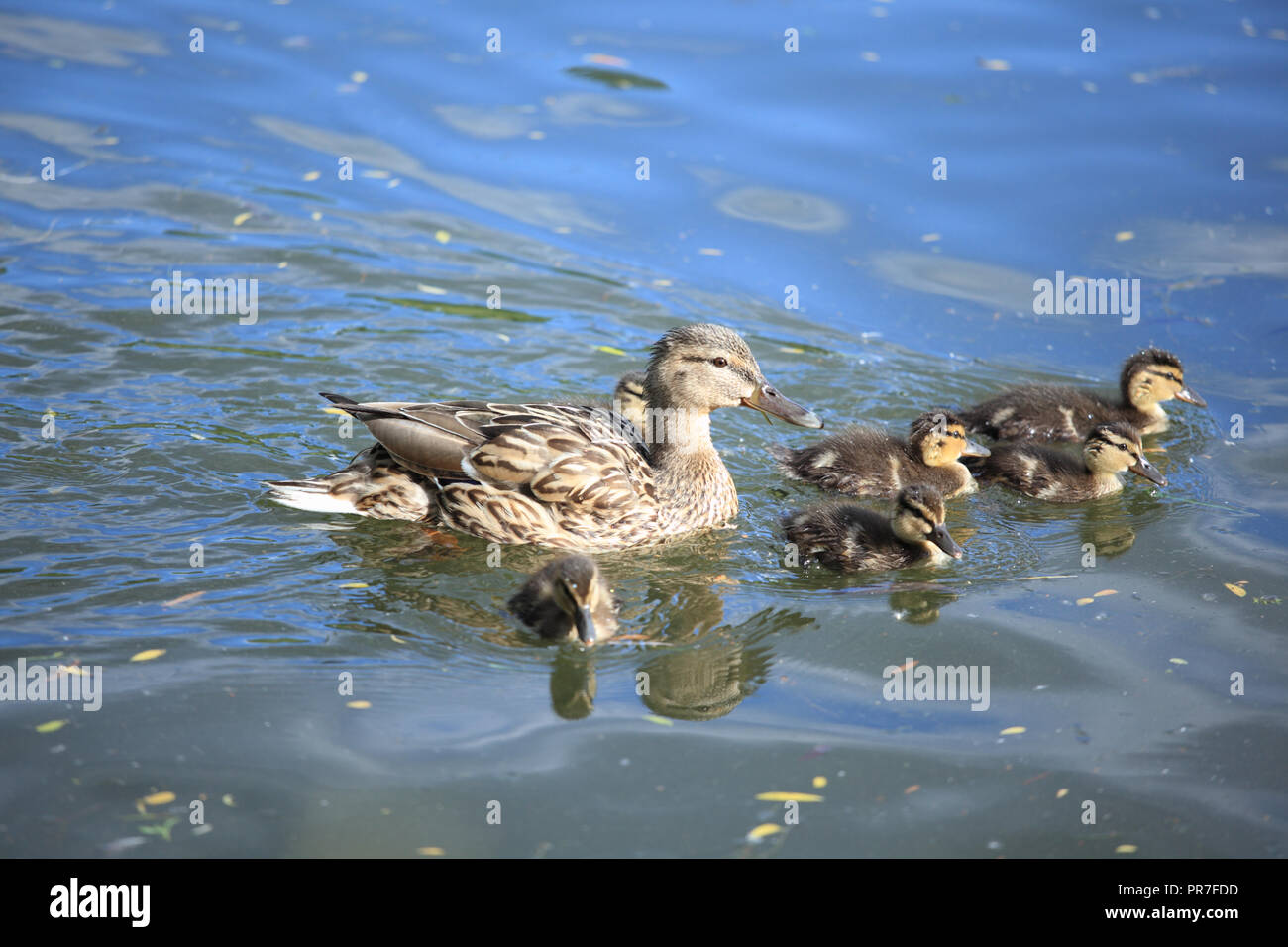
In 2018, wildlife photographer Brent Cizek captured a viral image of a female Common Merganser leading 76 ducklings across Lake Bemidji, Minnesota. This extraordinary sight was a result of "creching," a natural behavior where multiple broods merge under the care of a single experienced female to improve survival rates through collective protection.
The Viral Discovery at Lake Bemidji
The story of the "duck with 76 ducklings" began in the summer of 2018 when Brent Cizek, a photographer based in Minnesota, set out on Lake Bemidji. While navigating the waters in a small boat, he spotted a female Common Merganser (Mergus merganser) that appeared to be followed by an impossibly long train of offspring. Initially, Cizek struggled to count them, but through a series of high-resolution photographs, the final tally reached 76.
As of 2026, this image remains one of the most iconic examples of avian parenting captured in the 21st century. The sight of a single mother seemingly supervising dozens of chicks resonated globally, sparking both humor and genuine scientific curiosity. However, for ornithologists and wildlife experts, the image was more than just a charming fluke; it was a perfect visual representation of a complex biological strategy known as brood amalgamation.
Lake Bemidji, located in northern Minnesota, provides the ideal habitat for this phenomenon. The lake’s clear waters and abundant fish population support the high caloric needs of a growing Merganser population. The 2018 event was not an isolated incident of large broods in the region, but the sheer number of 76 set a recorded benchmark that continues to be discussed in wildlife circles today.
Identifying the Species: The Common Merganser
To understand how one duck could lead 76 ducklings, it is essential to identify the species and its specific nesting habits. The Common Merganser is a large, streamlined duck known for its "saw-bill," which is specialized for gripping slippery fish. Unlike Mallards, which are "dabbling" ducks, Mergansers are diving ducks.
Physical and Behavioral Traits
Common Mergansers are striking birds. The females, such as the one in the famous photo, possess elegant rusty-cinnamon heads with shaggy crests and greyish bodies. They are highly skilled hunters, capable of diving deep to catch small fish, crustaceans, and aquatic insects.
Nesting Habits
The nesting behavior of the Common Merganser is a primary driver of the large brood sizes seen in the wild. They are cavity nesters, meaning they seek out hollow trees or holes created by woodpeckers to lay their eggs. Because suitable nesting cavities can be scarce, competition is high. This competition often leads to a behavior called "dump nesting," where multiple females lay eggs in the same cavity. While a typical clutch size for a single female is between 9 and 12 eggs, a dump nest can easily contain 20 or more.
The Science of Brood Amalgamation (Creching)
The central question most people ask when seeing 76 ducklings with one mother is: "Are they all hers?" The biological answer is a definitive no. A single female duck is physically incapable of laying and incubating 76 eggs. Instead, what Cizek photographed was a crèche.
What is a Crèche?
In the world of ornithology, a crèche is a collective brood where ducklings from several different mothers come together under the supervision of one or a few adult females. This is common among several species of waterfowl, including Eiders, Shelducks, and Mergansers.
How Crèches Form
Crèches typically form shortly after the ducklings hatch and make their way to the water. Ducklings are precocial, meaning they are born relatively mature and mobile. They can walk, swim, and feed themselves almost immediately after leaving the nest. Because they do not rely on their mothers for food—only for protection and guidance—it is easy for different broods to mix.
When multiple families of ducks encounter each other on a lake, the ducklings may become confused or simply gravitate toward the largest group or the most "confident" female. In some cases, younger or less experienced mothers may abandon their broods to the care of a more dominant female, allowing the younger mothers to head to safer areas to molt (the process of shedding and regrowing feathers, during which they cannot fly).
Why This Strategy Works: Evolutionary Advantages
From an evolutionary perspective, the "duck with 76 ducklings" is a masterclass in survival. While it may look like an overwhelming task for the adult female, the system provides several benefits that increase the likelihood of the ducklings reaching adulthood.
The Dilution Effect
The primary advantage of a large crèche is the dilution effect. Predators, such as snapping turtles, large fish (like Muskellunge or Northern Pike), and birds of prey, are a constant threat to young ducklings. In a group of 76, the statistical probability of any single duckling being the victim of a successful attack is significantly lower than in a group of 10.
Collective Vigilance
While the "lead" female is responsible for spotting threats, having dozens of sets of eyes in the water increases the chances of detecting a predator early. When one duckling dives or scatters in alarm, the others quickly follow suit.
Energy Conservation for Mothers
For the mothers who leave their ducklings in a crèche, the benefit is self-preservation. Raising a brood is energy-intensive and dangerous. By "babysitting" her ducklings out to a more experienced female, a mother can focus on her own health and feather regrowth, ensuring she survives to breed again the following year.
Comparing Crèching Behaviors Across Waterfowl
Not all duck species exhibit crèching to the same extent. While it is a hallmark of the Common Merganser, other species have different approaches to communal parenting.
| Species | Typical Brood Size | Crèching Tendency | Primary Nesting Type |
|---|---|---|---|
| Common Merganser | 9–12 | Very High (Up to 70+) | Cavity (Trees) |
| Mallard | 8–13 | Low/Occasional | Ground |
| Common Eider | 4–6 | High (Crèches are standard) | Ground (Coastal) |
| Canada Goose | 2–8 | Moderate (Gang broods) | Ground |
| Wood Duck | 10–15 | Moderate (Due to dump nesting) | Cavity (Trees) |
As the table illustrates, species that use cavity nests or live in high-density aquatic environments are more likely to exhibit large-scale crèching. The Common Merganser stands out because of the massive scale these groups can reach, as evidenced by the 2018 Lake Bemidji sighting.
Environmental Factors and Conservation in 2026
In 2026, the health of Merganser populations and their ability to form large crèches is closely tied to water quality and habitat preservation. For a crèche of 76 ducklings to survive, the body of water must be exceptionally productive.
Habitat Requirements
Common Mergansers require clear water because they hunt by sight. Siltation and water pollution can hinder their ability to find fish, which would make maintaining a large group of ducklings impossible. Furthermore, the availability of old-growth trees with nesting cavities is vital. Forestry management practices that preserve dead or hollow trees near shorelines are essential for the continuation of these species.
The Role of Climate
In the years leading up to 2026, changes in ice-out dates on northern lakes like Bemidji have shifted the timing of Merganser nesting. Earlier springs can lead to longer growing seasons for ducklings, but they can also cause mismatches between hatching and the peak availability of prey fish. Observing the "76 ducklings" phenomenon helps researchers track how these birds adapt to fluctuating environmental conditions.
Ethical Wildlife Observation and Photography
The viral nature of the "76 ducklings" photo also brings up important questions about how humans interact with wildlife. Brent Cizek was praised for using a long telephoto lens and a quiet approach to capture the moment without distressing the birds.
Guidelines for Waterfowl Observation
- Maintain Distance: Use binoculars or high-zoom cameras. If the birds change their behavior (e.g., swimming away rapidly or making alarm calls), you are too close.
- Avoid Feeding: Human food is nutritionally poor for ducklings and can lead to "angel wing" deformity or dependency on humans.
- Respect Nesting Sites: During the spring, stay away from known nesting cavities to prevent mothers from abandoning their eggs.
- Boating Safety: If you are in a motorized boat and see a large brood, cut your engine or slow down to a "no-wake" speed to avoid separating the ducklings or causing them to exhaust themselves.
Frequently Asked Questions
Can one duck really hatch 76 eggs?
No, it is biologically impossible for a Common Merganser to hatch 76 eggs. Their bodies are not large enough to cover that many eggs to provide the necessary warmth for incubation. The 76 ducklings seen in the viral photo were the result of several different broods merging together after they had already hatched.
Why did the other mothers leave their ducklings?
There are several reasons. Sometimes, female ducks lose their broods to a more aggressive or "attractive" female during a territorial dispute. In other cases, the mothers may be physically exhausted and leave the brood to an experienced "crèche leader" so they can focus on their own survival and molting process.
Do all the ducklings in a crèche survive?
Unfortunately, no. Ducklings face high mortality rates from predators, weather, and disease. However, being part of a large crèche significantly improves an individual duckling's odds of survival compared to being in a small, isolated brood, thanks to the "safety in numbers" principle.
Is this behavior unique to Minnesota?
While the famous photo was taken in Minnesota, crèching is a natural behavior for Common Mergansers across their entire range, which includes much of North America, Europe, and Asia. You can see similar, though perhaps smaller, crèches in any healthy freshwater lake or river system where Mergansers thrive.
What should I do if I see a large group of ducklings?
The best action is to observe from a distance and enjoy the sight. Do not attempt to count them by getting closer, as this can cause the group to scatter and leave individual ducklings vulnerable to predators. If you are a photographer, follow ethical guidelines by using long lenses and avoiding any movement that alters the birds' natural behavior.
How long do the ducklings stay together?
Ducklings usually stay in these crèches until they are ready to fledge (fly), which typically takes about 60 to 70 days for Common Mergansers. As they grow older and more independent, the large groups may naturally splinter into smaller sub-groups before they eventually head south for migration.
Practical Recommendation for Wildlife Enthusiasts
If you are interested in seeing phenomena like the "duck with 76 ducklings," the best time to visit northern lakes in the United States or Canada is between late June and early August. Focus on lakes with high water clarity and forested shorelines. Always bring a pair of high-quality binoculars (8x42 is a standard recommendation for birding) and a field guide to help identify the different species of waterfowl and their unique behaviors.
By understanding the science of crèching, we can appreciate these wildlife moments not just as "cute" internet content, but as sophisticated survival strategies that have allowed species like the Common Merganser to thrive for millennia.