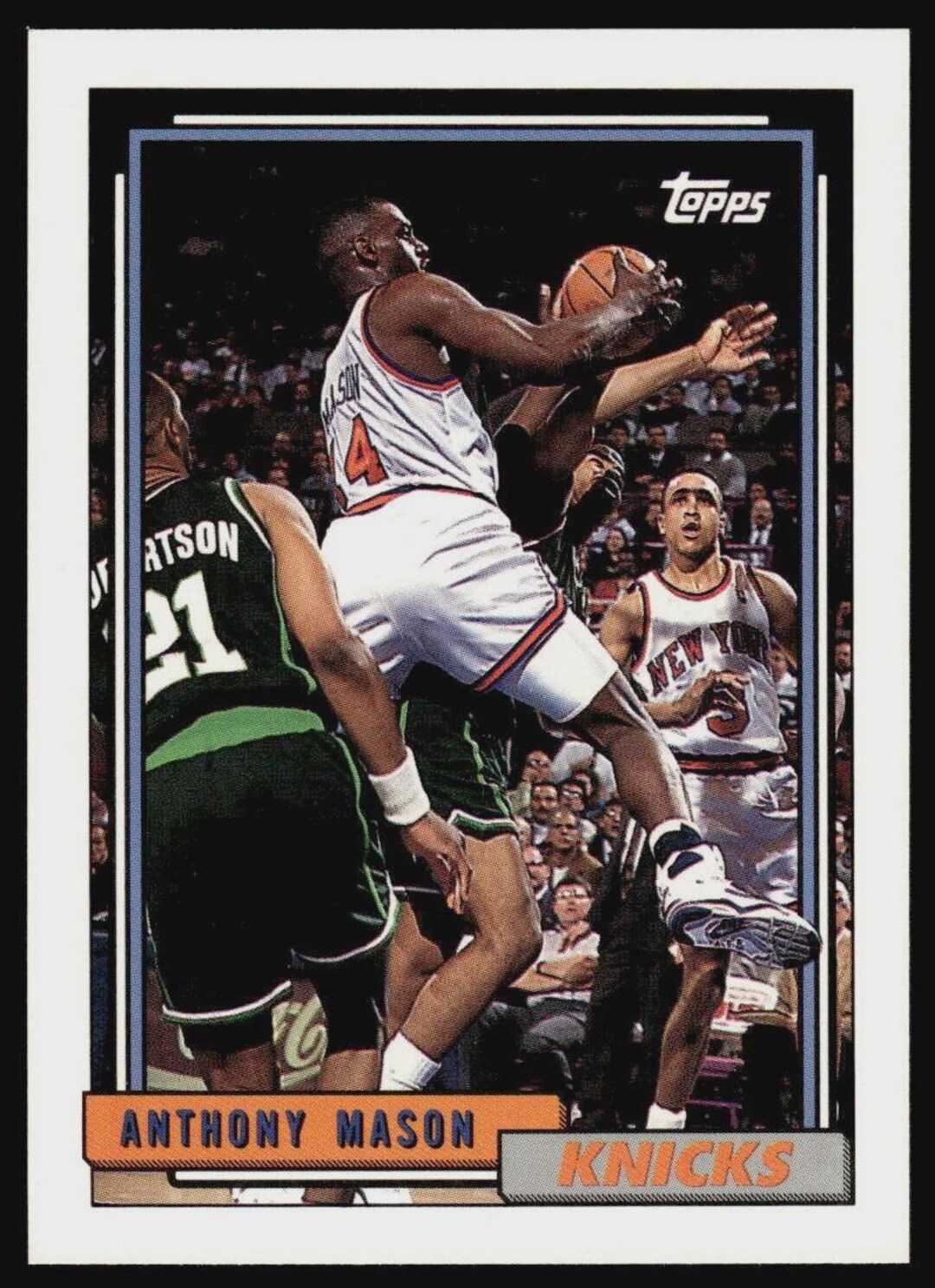
Anthony Mason, born in 1966, was a powerhouse forward for the New York Knicks whose physical presence and unique skill set defined the grit of 1990s NBA basketball. A vital component of the "Bruise Brothers" era, he combined the strength of a defensive enforcer with the ball-handling finesse of a point guard.
Standing at 6 feet 7 inches and weighing 250 pounds of pure muscle, Anthony Mason was the embodiment of the "New York style" of basketball. Born on December 14, 1966, in Miami, Florida, Mason’s journey to NBA stardom was far from conventional. While many stars are heralded from their teenage years, Mason had to grind through minor leagues and international circuits before finding his home at Madison Square Garden. By the time he reached his peak with the New York Knicks in the mid-1990s, he had become one of the most versatile and feared players in the league.
As we look back from the perspective of 2026, Mason’s influence on the "point forward" position and the defensive identity of the Knicks remains a cornerstone of franchise history. His ability to defend multiple positions while initiating the offense provided a blueprint for the modern versatile big man.
The Early Years and the Long Road to the NBA
Anthony Mason’s basketball journey began at Springfield Gardens High School in Queens, New York, which provided him with the "city game" toughness that would later define his professional career. Despite his obvious talent, he chose to play collegiate basketball at Tennessee State University. During his four years there (1984–1988), he showcased the scoring and rebounding ability that would eventually catch the eyes of NBA scouts.
Mason was selected by the Portland Trail Blazers in the third round of the 1988 NBA Draft (53rd overall). However, his path to the hardwood of the NBA was not immediate. He was waived by Portland and spent time playing in the Continental Basketball Association (CBA) and overseas in Turkey and Venezuela. These years were foundational; playing in the "trenches" of international and minor league basketball hardened his resolve and forced him to diversify his game.
After brief, unremarkable stints with the New Jersey Nets and the Denver Nuggets, Mason’s career trajectory changed forever in 1991 when he signed with the New York Knicks. It was under the tutelage of head coach Pat Riley that Mason’s specific brand of basketball found its perfect environment.
The Knicks Era: Becoming a New York Icon (1991–1996)
When Pat Riley took over the Knicks in 1991, he sought players who could execute a grueling, physical defensive scheme. Anthony Mason, alongside Patrick Ewing and Charles Oakley, formed one of the most intimidating frontcourts in the history of the sport. This era of Knicks basketball was characterized by "no easy baskets," and Mason was the primary enforcer.
The 1994 NBA Finals Run
The 1993–1994 season was perhaps the most significant in Mason’s Knicks tenure. With Michael Jordan in his first retirement, the Eastern Conference was wide open. The Knicks battled through a grueling seven-game series against the Chicago Bulls and an equally physical series against the Indiana Pacers to reach the NBA Finals.
Mason’s role in these playoffs was critical. While Ewing provided the scoring and rim protection and Oakley provided the veteran rebounding, Mason was the "Swiss Army Knife." He was often tasked with guarding the opponent's best player, regardless of whether that player was a quick small forward or a powerful power forward. Though the Knicks ultimately fell to the Houston Rockets in seven games, Mason’s performance solidified his reputation as an elite defender.
1995 NBA Sixth Man of the Year
In the 1994–1995 season, Mason’s contributions were formally recognized when he won the NBA Sixth Man of the Year Award. Coming off the bench, he provided an immediate infusion of energy, defense, and playmaking. He averaged 9.9 points and 8.4 rebounds per game, but statistics alone could not capture his impact. His ability to handle the ball and bring it up the court—a rarity for a man of his size in that era—allowed Pat Riley to run unique offensive sets that confused opposing defenses.
The "Point Forward" Revolution and Defensive Versatility
Anthony Mason was a pioneer of the "point forward" role. While the term was popularized by players like Paul Pressey and Scottie Pippen, Mason brought a different dimension to it because of his sheer bulk. He possessed the handles of a guard and the passing vision of an elite playmaker, coupled with the strength to back down any defender in the post.
Defensive Impact
Defensively, Mason was a nightmare for opponents. He was one of the few players in the league who could effectively switch onto a point guard in a pick-and-roll situation and stay in front of them, only to return to the paint on the next possession to wrestle with a 7-foot center. His lateral quickness at 250 pounds defied the physics of the time. This versatility allowed the Knicks to play an aggressive, trapping style of defense that smothered opponents.
Cultural Identity and the "Mase" Persona
Beyond his play, Mason became a cultural icon in New York. He was famous for his haircuts, which often featured words or intricate designs shaved into the side of his head—most famously "NY" or "Knicks." He represented the blue-collar, "nothing-given-everything-earned" attitude of the city. To the fans at Madison Square Garden, Mason wasn't just a player; he was a reflection of New York itself: tough, uncompromising, and relentlessly hardworking.
Career Statistics and Milestone Comparisons
To understand Mason's value, one must look at his consistency across different teams. While his years with the Knicks were his most famous, his subsequent years with the Charlotte Hornets and Miami Heat saw him reach even higher statistical peaks.
| Period | Team | PPG | RPG | APG | Notable Achievement |
|---|---|---|---|---|---|
| 1991–1996 | NY Knicks | 9.9 | 7.7 | 2.6 | 1995 Sixth Man of the Year |
| 1996–2000 | Charlotte Hornets | 13.4 | 10.0 | 4.8 | All-NBA Third Team (1997) |
| 2000–2001 | Miami Heat | 16.1 | 9.6 | 3.1 | 2001 NBA All-Star |
| 2001–2003 | Milwaukee Bucks | 8.5 | 6.5 | 2.6 | Veteran Leadership |
Note: Statistics represent averages during the specified tenures. In 1996-97, Mason led the NBA in minutes played (43.1 per game), a testament to his incredible conditioning.
The Post-Knicks Years: Charlotte, Miami, and Milwaukee
In 1996, Mason was traded to the Charlotte Hornets in exchange for Larry Johnson. While many Knicks fans were devastated, the move allowed Mason to transition from a high-level role player into a primary star. In Charlotte, his playmaking reached its zenith. During the 1996-1997 season, he averaged 16.2 points, 11.4 rebounds, and 5.7 assists per game. These numbers earned him a spot on the All-NBA Third Team and the All-Defensive Second Team.
In 2000, Mason reunited with Pat Riley in Miami. Despite being 34 years old, Mason had one of his most productive seasons, earning his first and only All-Star selection in 2001. He proved that his game—built on intelligence, positioning, and strength—could age gracefully even as his raw athleticism began to wane. He finished his career with the Milwaukee Bucks, retiring in 2003 with over 9,000 points and 7,000 rebounds to his name.
The Passing of a Legend and His Lasting Legacy
The basketball world was shocked when Anthony Mason passed away on February 28, 2015, at the age of 48, due to complications from congestive heart failure. His death prompted an outpouring of grief from former teammates, opponents, and fans who remembered him as one of the fiercest competitors to ever step onto the hardwood.
In 2026, Mason’s legacy is viewed through the lens of how the NBA has evolved. The "positionless" basketball seen in today's league owes a debt to players like Mason. Current stars who are expected to defend multiple positions and facilitate the offense from the frontcourt are walking the path that Mason cleared thirty years ago.
The Impact on Future Generations
Mason’s sons, Anthony Mason Jr. and Antoine Mason, both pursued basketball careers, carrying forward the family name in the sport. Beyond his biological family, Mason’s influence is seen in the "Knicks culture." Whenever the franchise goes through a resurgence, the benchmark for "Knicks basketball" is always the physicality and heart displayed by the 1990s teams—a standard Mason helped set.
Frequently Asked Questions
What was Anthony Mason's primary position?
While listed as a forward, Mason was essentially a hybrid. He played both small forward and power forward, but his unique ball-handling skills often saw him acting as a "point forward," bringing the ball up the court and initiating offensive sets. This versatility was his greatest asset in the NBA.
How did Anthony Mason's birth year (1966) influence his career?
Born in 1966, Mason came of age during the peak of 1980s basketball and entered the NBA just as the league was transitioning into its most physical era. His age meant he was physically mature and experienced by the time he joined the Knicks in 1991, allowing him to immediately fit into Pat Riley's demanding system.
Did Anthony Mason ever win an NBA Championship?
Mason never won an NBA Championship. His closest attempt was in 1994 with the New York Knicks, where they reached the NBA Finals but lost in seven games to the Houston Rockets. Despite the lack of a ring, he is widely regarded as one of the best players of his era to never win a title.
What made Anthony Mason so difficult to guard?
His combination of size and skill was nearly unprecedented. If a team put a small, quick defender on him, Mason would use his 250-pound frame to overpower them in the post. If a team put a traditional "big man" on him, Mason would take them to the perimeter and use his superior dribbling and passing to blow past them or create for others.
How many All-Star games did Anthony Mason play in?
Anthony Mason was selected for the NBA All-Star Game once, in 2001, while playing for the Miami Heat. Although he had several All-Star-caliber seasons with the Knicks and Hornets, the depth of the forward position in the Eastern Conference during the 90s made it difficult to secure a spot.
Final Recommendation for Fans and Historians
For those looking to understand the true essence of 1990s basketball, studying the career of Anthony Mason is essential. He was more than a stat sheet; he was a tactical advantage and a cultural force. To truly appreciate his impact, one should watch full game replays of the 1994 Eastern Conference Finals.
Witnessing Mason’s defensive intensity and his ability to orchestrate an offense under pressure provides a masterclass in basketball versatility. For modern players, Mason serves as a reminder that being "undersized" or "unconventional" is not a barrier to success if paired with elite conditioning and a relentless work ethic. His journey from the CBA to the NBA All-Star game remains one of the most inspiring "grind-to-greatness" stories in professional sports.