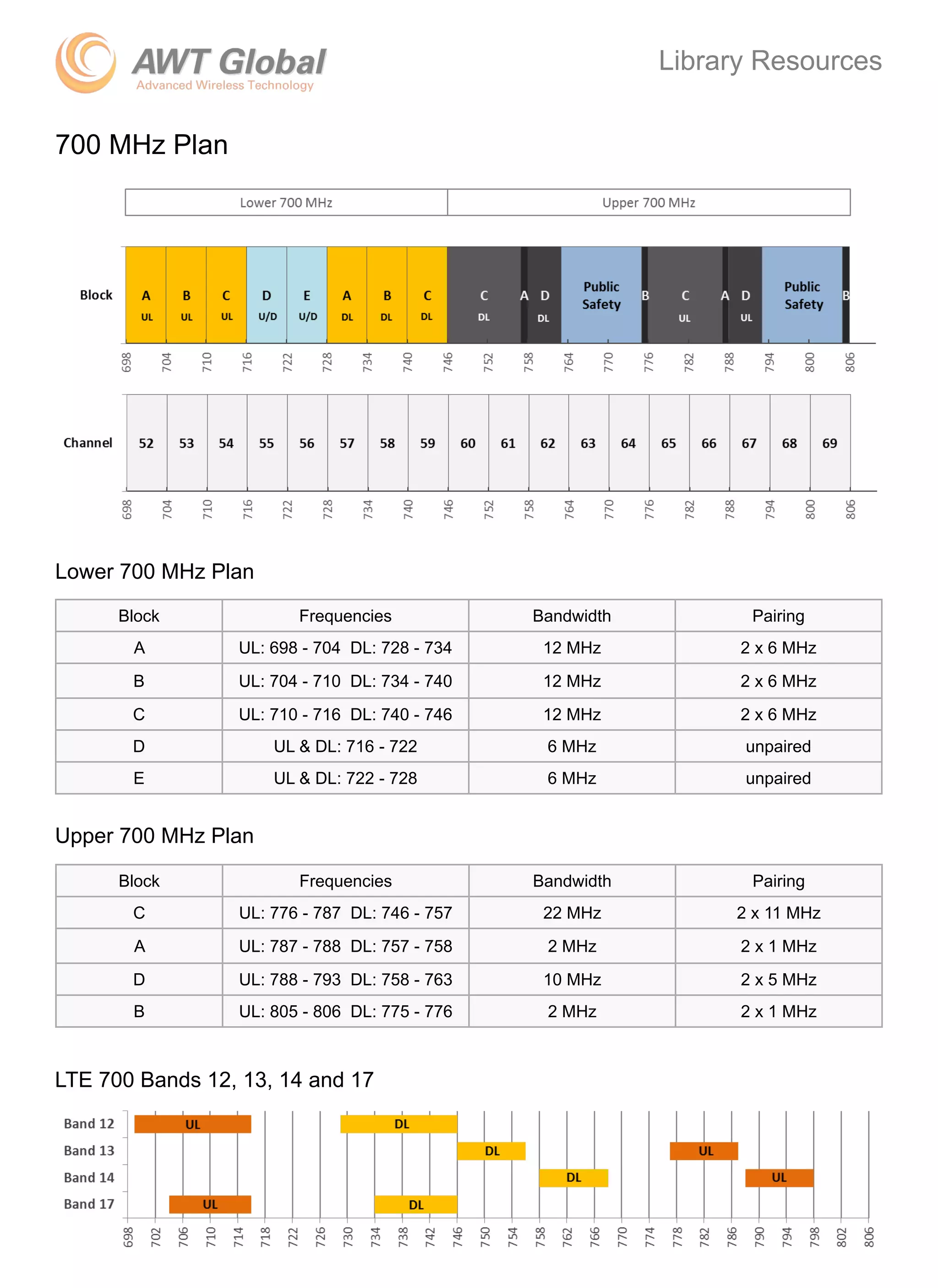
The 700 MHz spectrum band, spanning the 698–806 MHz frequency range, is the cornerstone of modern mobile telecommunications. Originally used for analog UHF television, its reallocation to mobile services—known as the "Digital Dividend"—provided the essential low-band coverage required for 4G LTE and today’s 5G networks, offering unparalleled signal propagation and indoor penetration.
The Historical Pivot: The Digital Television Transition
To understand the 700 MHz band, one must look back to the early 21st century when television broadcasting underwent its most significant transformation since the introduction of color. For decades, the 700 MHz range was occupied by UHF television channels 52 through 69. These frequencies were highly coveted because of their "beachfront" status—a term used by engineers to describe spectrum that travels long distances and passes through solid objects like brick, concrete, and foliage with minimal signal loss.
The transition from analog to digital television (DTV) was the catalyst for change. Digital signals are far more spectrally efficient than analog signals, meaning more data can be transmitted in less bandwidth. By migrating broadcasters to a tighter range of frequencies, governments worldwide were able to "free up" the 700 MHz band for other uses. In the United States, this culminated in the 2009 DTV transition. This move was not merely a technical upgrade; it was a strategic economic decision to fuel the burgeoning mobile internet revolution.
The reallocation of this spectrum allowed for the creation of wide-area coverage that previous higher-frequency bands (like 1900 MHz or 2100 MHz) could not achieve economically. Without the 700 MHz band, the rapid expansion of mobile broadband into rural areas would have been prohibitively expensive, requiring three to four times the number of cell towers to cover the same geographic footprint.
The 2008 FCC Auction (Auction 73) and Market Shaping
In 2008, the Federal Communications Commission (FCC) conducted Auction 73, one of the most significant spectrum auctions in history. It raised nearly $19 billion and effectively drew the map for the modern American wireless landscape. The auction divided the 700 MHz band into several "blocks," each with different technical rules and geographic footprints.
The Lower 700 MHz Blocks (A, B, and C)
The Lower blocks were targeted primarily at regional and national carriers. Block A faced significant challenges due to potential interference from television Channel 51, which required sophisticated filtering and guard bands. Block B was eventually dominated by AT&T, providing them with a massive low-band footprint. The fragmentation of these blocks initially led to "interoperability" issues, where devices designed for one carrier's 700 MHz band could not access another's, a problem that took years of regulatory pressure to resolve.
The Upper 700 MHz Block C
This block was the "crown jewel" of the auction. It consisted of a massive 22 MHz nationwide license. Verizon Wireless won this block for approximately $4.7 billion. Notably, the FCC attached "open platform" requirements to this block, mandating that the winner allow customers to use any device and any application of their choosing on the network. This was a radical shift at the time and paved the way for the era of unlocked smartphones and mobile app ecosystems.
The Upper 700 MHz Block D and Public Safety
Block D was originally intended to be a public-private partnership for a national public safety network. However, it failed to meet its reserve price in the 2008 auction. This failure led to years of legislative debate, eventually resulting in the Middle Class Tax Relief and Job Creation Act of 2012, which cleared the path for the First Responder Network Authority (FirstNet).
FirstNet and the Role of Band 14
One of the most critical developments in the history of the 700 MHz band is the establishment of Band 14. Following the communication failures of the September 11 attacks, it became clear that first responders needed a dedicated, interoperable high-speed data network.
In 2017, the U.S. government awarded AT&T the contract to build and maintain FirstNet using the 20 MHz of 700 MHz spectrum (Band 14). While this spectrum is dedicated to public safety, AT&T is permitted to use the excess capacity for its commercial customers when it is not needed by first responders. This "priority and preemption" model ensures that during a crisis, police, fire, and EMS personnel have immediate access to the bandwidth they need, while in normal times, the spectrum contributes to the overall capacity of the national 5G and LTE infrastructure.
As of 2026, FirstNet has become the gold standard for public safety communications globally, demonstrating how low-band spectrum can be leveraged for critical infrastructure and national security.
Technical Characteristics: Why 700 MHz Matters
The physics of the 700 MHz band define its value. In the world of RF (radio frequency) engineering, lower frequencies have longer wavelengths. These longer waves are better at "diffracting" or bending around obstacles and passing through physical barriers.
| Feature | 700 MHz (Low-Band) | 3.5 GHz (Mid-Band) | 28 GHz (High-Band/mmWave) |
|---|---|---|---|
| Propagation Range | Excellent (Up to 20+ miles) | Moderate (1-3 miles) | Poor (City blocks) |
| Indoor Penetration | High (Deep into buildings) | Moderate | Very Low (Blocked by glass/walls) |
| Typical Bandwidth | 5-20 MHz blocks | 40-100 MHz blocks | 400-800 MHz blocks |
| Primary Use Case | Wide-area coverage & Rural | Capacity & Speed (Urban/Suburban) | Ultra-high speed (Hotspots) |
| Deployment Cost | Lower (Fewer sites needed) | Moderate | High (High site density) |
Because of these characteristics, 700 MHz is often referred to as the "Coverage Layer." In 2026, even as we deploy advanced 5G and look toward 6G, this band remains essential for maintaining a "baseline" of connectivity. When your phone shows five bars inside a shopping mall or a parking garage, it is almost certainly connected to a low-band frequency like 700 MHz.
Global Standardization: The APT700 Initiative
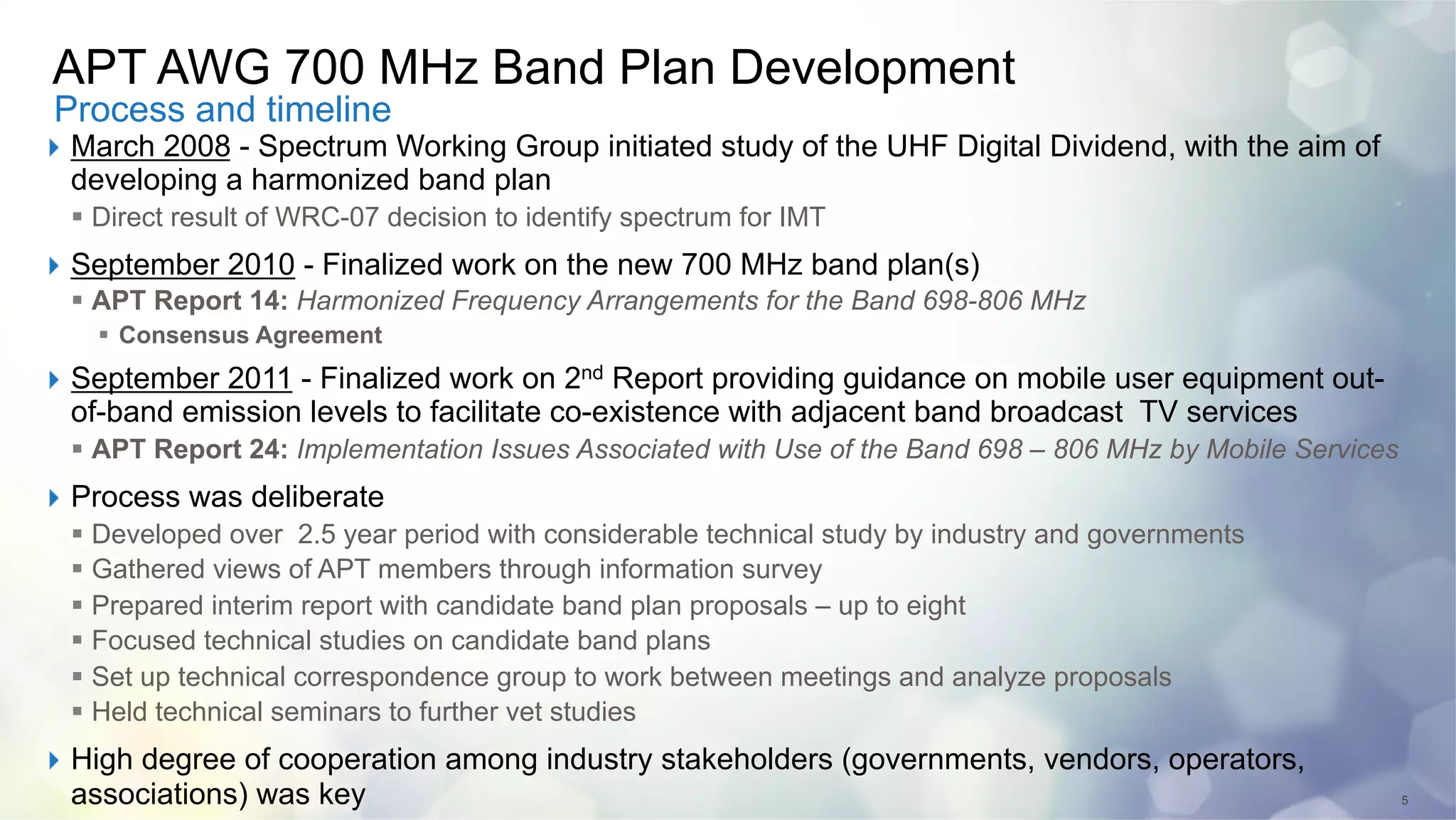
While the United States was an early adopter, the 700 MHz band is a global phenomenon. The Asia-Pacific Telecommunity (APT) developed a band plan known as APT700 (Band 28). This plan has become the most widely adopted 700 MHz configuration in the world, used across Asia, Latin America, and Europe.
Global harmonization is vital for the telecommunications industry because it creates "economies of scale." When manufacturers like Apple, Samsung, or Qualcomm can build a single chip that supports the 700 MHz band used in both Brazil and France, the cost of devices drops for everyone. By 2026, Band 28 has become a staple in almost every mobile device manufactured globally, ensuring that international roaming is seamless and that affordable smartphones can still access high-quality 4G and 5G networks.
Current Status (2026): The Foundation of Low-Band 5G
As of 2026, the 700 MHz spectrum has been almost entirely transitioned to 5G technologies using a method called Dynamic Spectrum Sharing (DSS). This allows carriers to run both 4G LTE and 5G NR (New Radio) on the same frequency block simultaneously.
While the "high-speed" headlines of 5G usually focus on mid-band (C-Band) or mmWave, the 700 MHz band provides the "signal backbone." It allows 5G icons to appear on phones in rural areas and provides the necessary uplink for devices to communicate with the network. In 2026, the integration of 700 MHz with carrier aggregation (combining multiple bands) allows users to enjoy the coverage of low-band with the added speed of mid-band when available.
Furthermore, the 700 MHz band is the primary driver for the Internet of Things (IoT). Technologies like NB-IoT (Narrowband IoT) and LTE-M utilize these frequencies to connect millions of sensors, smart meters, and agricultural monitors that are often located in hard-to-reach or remote areas.
The Future: 6G and Spectrum Evolution
Looking beyond 2026, the 700 MHz band will remain relevant even as 6G research intensifies. The industry is currently exploring several paths for the future of this spectrum:
- Spectrum Refarming: Eventually, 4G LTE will be sunset, just as 2G and 3G were. This will allow the entire 700 MHz band to be dedicated to 6G, which will offer even higher spectral efficiency and lower latency.
- Sub-1 GHz for 6G: 6G is expected to require a multi-layer approach. The 700 MHz band will likely serve as the "coverage and reliability" layer for 6G, supporting mission-critical applications that require a "never-drop" connection.
- Enhanced Satellite Integration: There is ongoing work in 2026 to better integrate terrestrial 700 MHz networks with Low Earth Orbit (LEO) satellites. This "Non-Terrestrial Network" (NTN) approach could allow standard smartphones to connect directly to satellites in areas where no cell towers exist.
- Green Energy and Efficiency: Because 700 MHz requires fewer base stations to cover an area, it is inherently more energy-efficient than higher bands. Future network updates will focus on "zero-load" power states for 700 MHz equipment, reducing the carbon footprint of national networks.
Frequently Asked Questions
Does the 700 MHz band cause interference with my TV?
In 2026, this is no longer a common issue. Following the DTV transition, television stations were moved to lower frequencies (below 698 MHz). While "LTE interference" filters were common a decade ago, modern televisions and mobile towers are equipped with sophisticated filters to ensure that mobile signals do not bleed into the remaining broadcast TV bands.
Can any smartphone use the 700 MHz band?
Almost all smartphones released after 2015 support at least one 700 MHz band (such as Band 12, 13, 14, 17, or 28). In 2026, any 5G-capable device will support multiple variations of this band to ensure global compatibility. If you are using a device in the US, it will likely use Band 12 (T-Mobile/AT&T) or Band 13 (Verizon).
Is 700 MHz faster than 5 GHz Wi-Fi?
Generally, no. The 700 MHz band is designed for coverage, not raw speed. Because the available bandwidth in the 700 MHz range is relatively narrow (usually 5 to 20 MHz), it cannot match the speeds of 5 GHz or 6 GHz Wi-Fi, which use much wider channels. However, the 700 MHz signal will travel much further and pass through walls that would completely block a Wi-Fi signal.
Why is 700 MHz called "Beachfront Property"?
The term refers to the high value and limited supply of the spectrum. Like land on a beach, there is only so much of it, and everyone wants it. Its ability to provide massive coverage with minimal infrastructure makes it the most cost-effective and valuable spectrum for any wireless carrier to own.
What is the difference between Band 12 and Band 17?
Historically, Band 17 was a subset of Band 12. AT&T used Band 17, while T-Mobile and other regional carriers used Band 12. This caused compatibility issues early on. However, through regulatory intervention and technical updates (MFBI - Multi-Frequency Band Indicator), modern networks and devices treat them as essentially the same, ensuring that a Band 12 device can work on a Band 17 network and vice-versa.
Recommendation for Users and Businesses
For consumers, when purchasing a device in 2026, ensure it is "Full-Band 5G Compatible" to take advantage of the 700 MHz coverage layer, especially if you live in a rural area or work in a large concrete building. For businesses deploying IoT solutions, 700 MHz-based LTE-M or NB-IoT remains the most reliable choice for long-term deployments, as these bands are guaranteed to be supported by carriers well into the 2030s. As we move toward 6G, the 700 MHz band will continue to be the invisible infrastructure that keeps the world connected when all other signals fail.