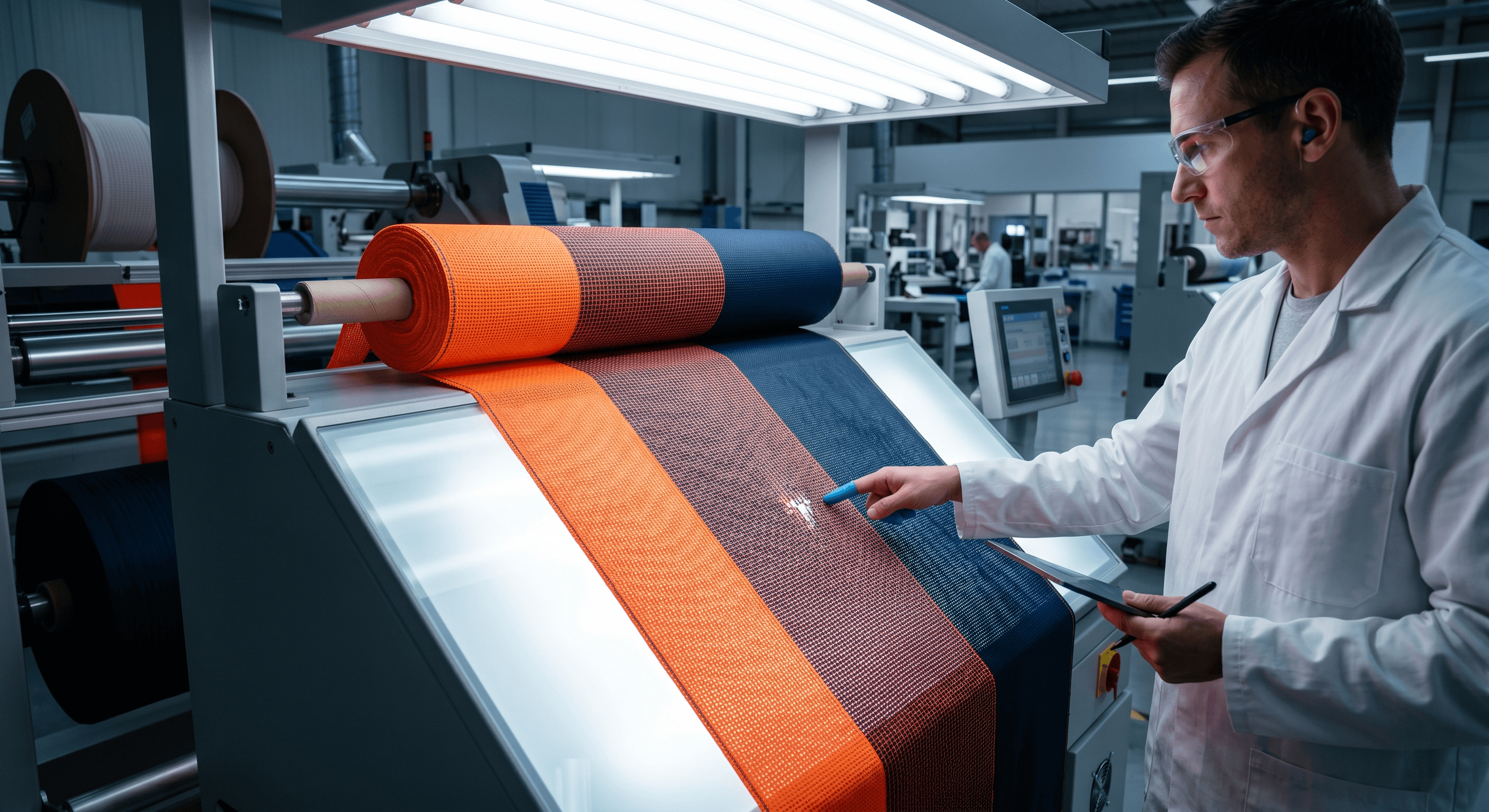
The 4-point system is the globally recognized standard for inspecting and grading fabric quality, specifically defined under ASTM D5430 - 07. It assigns penalty points based on the size and severity of defects found within a fabric roll. By calculating the total points per 100 square yards, manufacturers determine if a shipment meets the required quality threshold for garment production.
Understanding the Foundations of the 4-Point System
In the textile industry of 2026, quality remains the most significant variable in supply chain management. The 4-point system, often referred to as the "American National Standard," provides a systematic, objective method for evaluating fabric. Unlike subjective visual assessments, this system uses a mathematical framework to quantify imperfections, ensuring that both the buyer and the seller have a shared language regarding what constitutes "First Quality" or "Second Quality" material.
The primary objective of the 4-point system is to identify defects in the fabric before it reaches the cutting table. In garment manufacturing, a single defect missed during inspection can result in a ruined garment, leading to significant financial losses. By utilizing this system, quality control (QC) teams can calculate a "point per 100 square yards" (or meters) value, which serves as the ultimate metric for acceptance or rejection.
While other systems like the 10-point system exist, the 4-point system is the most widely adopted due to its simplicity and its alignment with international trade standards. It is used across various fabric types, including knits, wovens, and technical textiles, making it a versatile tool for the modern global textile market.
The Point Allocation Logic: How Defects Are Scored
The core of the 4-point system lies in how penalty points are assigned to specific defects. The length of the defect, whether it occurs in the warp (lengthwise) or weft (widthwise) direction, dictates the number of points. It is important to note that no more than 4 penalty points can be assigned to any single linear yard of fabric, regardless of the number of defects within that yard.
Linear Defect Scoring
Defects are measured by their longest dimension. The grading scale is as follows:
- 1 Point: Defects up to 3 inches (75 mm) in length.
- 2 Points: Defects over 3 inches but not exceeding 6 inches (150 mm).
- 3 Points: Defects over 6 inches but not exceeding 9 inches (230 mm).
- 4 Points: Defects over 9 inches (230 mm).
Holes and Openings
Holes are treated with higher severity because they represent a total structural failure of the fabric. They are graded based on their diameter:
- 2 Points: Holes or openings of 1 inch (25 mm) or less.
- 4 Points: Holes or openings larger than 1 inch (25 mm).
The Maximum Point Rule
One of the most critical rules in the 4-point system is the "Cap" rule. No single linear yard can be penalized more than 4 points. If a single yard contains three different 1-point defects and one 2-point defect (totaling 5 points), the inspector must record only 4 points for that yard. This prevents a single highly problematic area from mathematically skewing the entire roll's quality metrics beyond a reasonable limit, though the roll might still be rejected based on the frequency of such yards.
Calculating the Final Grade: The Formula
Identifying defects is only the first half of the process. To determine if the fabric roll is acceptable, the total points must be normalized to a standard area, usually 100 square yards. This allows for a fair comparison between rolls of different lengths and widths.
The Standard Calculation Formula
In 2026, while many digital inspection systems automate this, the fundamental manual formula remains:
Points per 100 Sq. Yards = (Total Penalty Points × 3600) / (Inspected Length in Yards × Fabric Width in Inches)
The number 3600 is a constant derived from the number of square inches in a square yard (36 inches × 100 yards).
Step-by-Step Example
Imagine you are inspecting a roll of denim that is 120 yards long and 60 inches wide. After a thorough inspection, your team finds a variety of defects totaling 45 penalty points.
- Multiply points by 3600: 45 × 3600 = 162,000.
- Multiply length by width: 120 × 60 = 7,200.
- Divide the results: 162,000 / 7,200 = 22.5 points per 100 square yards.
In most standard commercial agreements, a score of 40 points or less per 100 square yards is considered "First Quality." In this example, the fabric would pass inspection.
Standard Inspection Procedures and Environment
To ensure the 4-point system is applied accurately, the physical environment of the inspection must be standardized. Variable lighting or improper machine speeds can lead to "missing" defects or inconsistent grading.
The Inspection Frame
Fabric is typically passed over an inspection frame, also known as a "perch." This frame includes a translucent glass panel with backlighting and overhead lighting. The fabric should move at a pace that allows the human eye (or high-speed cameras in automated systems) to detect imperfections without fatigue. For manual inspection, a speed of 15 to 20 yards per minute is generally recommended.
Lighting Requirements
The ASTM D5430 standard suggests that lighting should be sufficient to see defects clearly. In 2026, most facilities use LED arrays that mimic natural daylight (D65 standard). Both transmitted light (from behind the fabric) and reflected light (from the front, usually at a 45-degree angle) are used to identify different types of defects like thin spots, holes, and surface stains.
Roll Selection (The 10% Rule)
In large-scale production, it is rarely feasible to inspect 100% of the fabric unless requested by the buyer. The industry standard is to inspect at least 10% of the total shipment. These rolls should be selected at random from different parts of the production lot to ensure a representative sample. If the 10% sample reveals high point counts, the inspector may increase the sampling to 20% or even 100%.
| Defect Type | Length / Size | Points Assigned |
|---|---|---|
| Minor Linear Defect | Up to 3 inches | 1 Point |
| Medium Linear Defect | 3 to 6 inches | 2 Points |
| Major Linear Defect | 6 to 9 inches | 3 Points |
| Critical Linear Defect | Over 9 inches | 4 Points |
| Small Hole | 1 inch or less | 2 Points |
| Large Hole | Over 1 inch | 4 Points |
| Maximum per Yard | Any combination | 4 Points (Max) |
Common Fabric Defects Identified in the 4-Point System
A skilled inspector must be able to categorize defects as they appear. Defects are generally divided into two categories: those in the warp (vertical) and those in the weft (horizontal).
Warp Defects
- Broken Ends: A vertical line caused by a missing yarn.
- Tight Ends: A yarn that is under too much tension, causing a puckered line.
- Reed Marks: Vertical streaks caused by a damaged loom reed.
- Oil Stains: Often caused by machinery, these appear as vertical spots.
Weft Defects
- Slubs: Thick, lumpy spots in the yarn.
- Broken Picks: A horizontal gap where a filling yarn is missing.
- Shading: A variation in color from one side of the fabric to the other (selvedge-to-selvedge) or from the beginning to the end of the roll. Shading is often penalized heavily because it makes it impossible to match garment panels.
- Bow and Skew: Distortion in the fabric grain. While not always assigned points under the 4-point system unless they exceed a percentage (usually 2-3%), they are critical for quality assessment.
Acceptance Criteria and Industry Thresholds
The question of "what is a passing score?" depends entirely on the end-use of the fabric and the agreement between the buyer and the seller. While the 40-point rule is common, different sectors have varying tolerances.
- High-End Luxury Goods: Brands in the luxury segment often set a threshold as low as 15 to 20 points per 100 square yards.
- Mass Market Apparel: Standard retailers typically accept between 28 and 40 points.
- Home Textiles/Upholstery: Because upholstery panels are large, the tolerance for defects is much lower; even a single 4-point defect can ruin a sofa cushion.
- Industrial Textiles: For hidden components or industrial bags, scores of 50-60 might be acceptable.
If a roll exceeds the agreed-upon limit, it is classified as "Second Quality." In 2026, many contracts include "debit notes," where the supplier must provide a discount or replacement for any rolls classified as seconds.
The Role of Technology and AI in 2026
As of 2026, the 4-point system has transitioned from a purely manual task to a hybrid process. Artificial Intelligence (AI) and machine vision cameras are now integrated into inspection frames. These systems use deep learning algorithms to detect defects in real-time, automatically assigning points based on the ASTM D5430 logic.
Benefits of Automated 4-Point Inspection:
- Consistency: Unlike human inspectors, AI does not suffer from eye fatigue or "inspection blindness" during long shifts.
- Data Integration: The point counts are instantly uploaded to Enterprise Resource Planning (ERP) systems, allowing brands to track supplier quality over time.
- Mapping: Digital "defect maps" are created for each roll. These maps allow automated cutting machines to strategically place garment patterns to avoid the 4-point defects, significantly reducing waste.
Despite these advancements, the human element remains vital. QC managers still perform audits on automated results to ensure the AI hasn't misclassified a natural fabric characteristic (like a flax seed in linen) as a defect.
Limitations of the 4-Point System
While the 4-point system is robust, it is not without flaws. One primary limitation is that it does not account for the type of defect, only its size. A 4-inch oil stain and a 4-inch slub both receive 2 points, even though an oil stain might be impossible to remove, whereas a slub might be acceptable in a rustic linen garment.
Furthermore, the system does not explicitly penalize "continuous defects" (defects that run for many yards) differently than a series of sporadic defects, other than the cumulative point count. Most buyers add a separate clause stating that any continuous defect exceeding 3 yards results in an automatic rejection of the roll, regardless of the overall point count.
FAQs about 4-Point Fabric Inspection
How do you handle defects that occur on the selvedge?
Generally, defects within 1 inch (25 mm) of the selvedge (the edge of the fabric) are ignored, as this area is typically not used in the garment cutting process. However, if the selvedge defect causes the fabric to pull or creates tension issues across the width of the roll, it may be penalized.
Is the 4-point system different for knit fabrics?
The logic of point allocation (1, 2, 3, or 4 points based on size) remains the same for knits. However, inspectors must be more careful with "runs" or "ladders" in knits, which can expand rapidly. In knit inspection, a "dropped stitch" is almost always treated as a 4-point defect because of its potential to unravel the entire garment panel.
What happens if the total points are exactly 40?
This is typically the "borderline" case. In standard practice, if the contract specifies "maximum 40 points," then 40 is acceptable. However, most quality managers will flag such rolls for a secondary review. If a shipment has several rolls sitting right at the limit, it indicates a lack of process control at the mill.
Can the 4-point system be used for finished garments?
No, the 4-point system is specifically designed for roll-form fabric inspection. Finished garments are inspected using the AQL (Acceptable Quality Level) system, which focuses on the number of defective units in a sample size rather than the measurement of individual fabric flaws.
Why is 3600 used in the 4-point formula?
The formula calculates points per 100 square yards. One square yard is 36 inches long by 36 inches wide, which equals 1,296 square inches. However, the formula uses "100 square yards" as the base. 36 inches (1 yard) multiplied by 100 yards equals 3,600 linear inches. This constant allows the width (in inches) and length (in yards) to be reconciled into the 100-square-yard unit.
Does the system account for fabric width variations?
Yes, the width is a variable in the denominator of the calculation. This means that for the same number of defects, a narrower fabric will have a higher point count than a wider fabric. This is fair because a defect in a narrow fabric represents a larger percentage of the total usable surface area.
Practical Recommendation for Implementation
For manufacturers and fashion brands in 2026, the most effective way to utilize the 4-point system is to establish a three-tier inspection protocol. First, ensure that the fabric mill provides a 4-point inspection report with every shipment. Second, conduct an internal 10% random audit upon receipt of the goods to verify the mill's accuracy. Third, integrate digital defect mapping so that the cutting room can bypass the identified defects. This multi-layered approach minimizes "surprises" during the sewing process and ensures that fabric waste is kept to an absolute minimum, protecting both the environment and your bottom line.