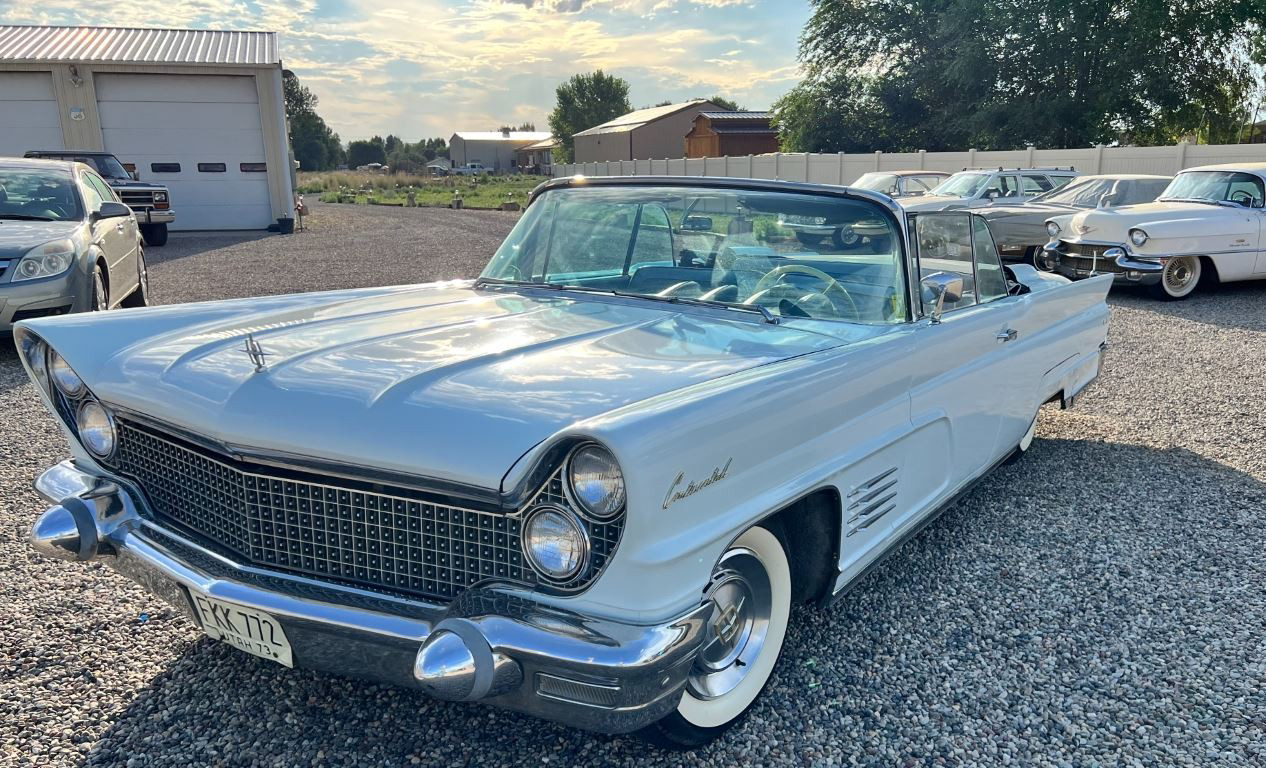
The 1960 Lincoln Mark V represents the final and most refined iteration of the second-generation Continental Mark series, which began with the ultra-luxurious Mark II in 1956. Built during a transitional era of American automotive design, total production for the 1960 Mark V model year reached 2,044 units across four distinct body styles, showcasing hand-finished craftsmanship, flamboyant styling cues, and rare variants that continue to command high interest among vintage luxury car collectors.
The Evolution of the Continental Mark Series: From Mark II to Mark V
To fully understand the production figures and variants of the 1960 Lincoln Mark V, one must examine the corporate strategy that birthed the vehicle. Following the immense financial losses of the hand-built 1956–1957 Continental Mark II, Ford Motor Company realized that the standalone Continental division was economically unsustainable under its original manufacturing model. For the 1958 model year, management integrated Continental into the Lincoln division to lower production costs while retaining ultra-luxury styling and appointments.
This corporate restructuring resulted in the massive 1958 Continental Mark III, followed by evolutionary updates for the 1959 Mark IV and the final 1960 Mark V. While the chassis, massive unibody-derived framework, and general silhouette remained largely consistent between 1958 and 1960, each model year brought distinct exterior trim, grille styling, and interior upholstery options.
The 1960 model year served as a corrective response to the polarizing, heavily ornamented styling of the 1958 models. Under the direction of Lincoln-Mercury styling chief Elwood Engel, designers toned down the exaggerated "slant-eyed" quad headlights and reduced the excessive rear fin styling, resulting in a cleaner, more commanding presence. This visual refinement marked the conclusion of the oversized "Glamour Bird" and massive Lincoln era, as Ford prepared to completely downsize and reinvent the Continental nameplate for the revolutionary 1961 model year.
Official 1960 Lincoln Mark V Production Numbers by Body Style
Unlike mass-market vehicles of the era that saw hundreds of thousands of units roll off assembly lines, the 1960 Lincoln Mark V was an exclusive, low-volume luxury offering. Production took place exclusively at the Wixom Assembly Plant in Michigan, a facility specifically engineered for precision manufacturing of premium unibody vehicles.
Total production for the 1960 model year amounted to 2,044 units. This figure represents a significant decline compared to the 1958 Mark III (which benefited from pent-up luxury demand with over 3,000 units sold) and the 1959 Mark IV, reflecting both the steep price tag—hovering around $7,000 to $7,500 brand new—and buyer anticipation of upcoming automotive trends.
The production breakdown across the four official body styles for 1960 highlights consumer preferences of the era, heavily favoring traditional closed sedans and coupes over open-air motoring:
| Body Style / Model | Body Code | Original Factory Price (USD) | 1960 Production Total |
|---|---|---|---|
| Four-Door Sedan | Model 53A | $7,047 | 1,192 |
| Two-Door Hardtop | Model 58A | $6,762 | 570 |
| Two-Door Town Car | Model 58B | $7,501 | 243 |
| Two-Door Convertible | Model 57A | $7,495 | 39 |
(Note: Production figures are based on official Lincoln-Mercury historical production ledgers archived by the Lincoln and Continental Owners Club.)
Analysis of Body Style Rarity
Examining these figures reveals critical insights for modern collectors and historians. The Four-Door Sedan was the volume leader, accounting for more than half of all Mark V production. Its popularity stemmed from its formal roofline, executive presence, and spacious rear cabin, making it a preferred choice for corporate leaders and affluent families.
Conversely, the Two-Door Convertible is the undisputed holy grail of the 1960 Mark V lineup. With only 39 units ever manufactured, finding an authentic Mark V convertible requires verification of serial numbers, as unscrupulous restorers have occasionally converted hardtops into open-top variants due to the vast disparity in collector value.
Exploring the 1960 Lincoln Mark V Variants and Trims
Rather than offering a sprawling matrix of performance tiers or equipment packages, Lincoln structured the Mark V as a single, comprehensively equipped luxury tier. Every vehicle left the factory with power steering, power brakes, a power-adjustable front seat, power windows, and a sophisticated ventilation system. Differentiation among variants relied primarily on roof design, interior luxury appointments, and special roof treatments.
The Standard Two-Door Hardtop and Four-Door Sedan
The standard hardtop and sedan models featured a traditional steel roof structure paired with wraparound panoramic windshields and massive rear glass. These variants established the clean-lined side profile of the 1960 model year, characterized by a sharp, uninterrupted chrome accent strip running from the front fender all the way to the rear tail fins.
The Town Car Variant (Model 58B)
The Town Car is one of the most distinctive and collectible variants of the 1960 Mark V lineup. Distinguished by its formal, padded black leather-grained vinyl roof and unique rear-door configuration (on four-door variations of previous years) or distinct roof notch (on the 1960 two-door hardtop application), the Town Car was designed to evoke the bespoke elegance of coachbuilt European limousines.
In 1960, the Town Car was offered exclusively in special exterior paint colors—frequently featuring subtle metallic hues—and came standard with upgraded interior brocade fabrics, plush footrests in the rear compartment, and specialized exterior badging. With only 243 units produced, it represents an elite tier of mid-century American luxury.
The Convertible Variant (Model 57A)
The Mark V convertible utilized a heavy-duty hydraulic power top mechanism that folded neatly beneath a metal boot cover behind the rear seat. Structurally, the convertible required extensive underbody box-welding and frame reinforcements to compensate for the removal of the fixed roof, adding significant weight to an already substantial vehicle. This structural reinforcement explains why convertible production was strictly limited to 39 units, as manufacturing complexities and high production costs limited both consumer uptake and factory output.
Mechanical Specifications and Powertrain Architecture
Powering every variant of the 1960 Lincoln Mark V is a massive, Lincoln-exclusive MEL (Mercury-Edsel-Lincoln) V8 engine. This power plant was engineered specifically to haul the heavy unibody chassis with effortless, silent acceleration.
- Displacement: 430 cubic inches (7.0 liters)
- Configuration: Overhead Valve (OHV) V8
- Carburetion: Ford four-barrel downdraft carburetor
- Compression Ratio: 10.0:1
- Horsepower: 315 horsepower at 4,100 RPM
- Torque: 485 lb-ft at 2,200 RPM
- Transmission: Turbo-Drive 3-speed automatic transmission (utilizing a torque converter and planetary gearset)
The engine design prioritized low-end torque over high-RPM horsepower, ensuring that the heavy cruiser could accelerate smoothly from a dead stop without straining. However, the combination of a 430-cubic-inch engine, a vehicle curb weight exceeding 5,000 pounds, and primitive 1960s emission-free carburetion resulted in notoriously low fuel economy, typically averaging between 8 and 11 miles per gallon under normal driving conditions.
Identifying and Authenticating a 1960 Mark V
Due to the scarcity of these vehicles and their rising value in the vintage market, accurate identification using factory data plates and Vehicle Identification Numbers (VIN) is paramount for buyers, insurance assessors, and restorers.
The VIN on a 1960 Lincoln Mark V is stamped on a data plate attached to the driver-side door jamb and is structured using a specific alphanumeric coding system:
- First Digit (Year): "0" designates the 1960 model year.
- Second Digit (Assembly Plant): "Y" designates the Wixom, Michigan assembly plant.
- Third and Fourth Digits (Series/Body Style):
53= Four-Door Sedan57= Two-Door Convertible58= Two-Door Hardtop / Town Car
- Remaining Digits: Represent the consecutive unit production number, starting sequentially at 100001.
In addition to the VIN, the body plate includes codes for exterior paint colors, interior trim configurations, and production build dates. Buyers should cross-reference these codes against factory registries maintained by organizations like the Lincoln and Continental Owners Club to confirm factory authenticity.
Frequently Asked Questions
How many 1960 Lincoln Mark V cars were built in total?
Total production for the 1960 Lincoln Mark V across all four body styles reached exactly 2,044 units. This low production volume makes all variants rare sights at modern collector car auctions.
What is the rarest 1960 Lincoln Mark V variant?
The rarest variant is the Two-Door Convertible (Model 57A), with a verified production total of only 39 units. The Town Car two-door hardtop is also exceptionally rare, with just 243 units produced.
What engine came standard in the 1960 Lincoln Mark V?
Every 1960 Mark V was powered by a 430-cubic-inch MEL V8 engine producing 315 horsepower and 485 lb-ft of torque, paired with a three-speed Turbo-Drive automatic transmission.
Where were 1960 Lincoln Mark V vehicles manufactured?
All 1960 Mark V models were assembled at Ford Motor Company’s specialized Wixom Assembly Plant in Wixom, Michigan, which was purpose-built for the production of Lincoln and Continental luxury unibody vehicles.
How can I verify if a 1960 Lincoln Mark V is a true convertible?
You must inspect the VIN plate on the driver-side door jamb. The third and fourth digits must read "57" for a factory convertible. Additionally, check for factory frame reinforcement plates welded into the undercarriage, as clones or conversions lack proper structural bracing.
What caused the low production numbers for the 1960 Mark V?
The low production numbers were driven by high retail prices (ranging from $6,700 to over $7,500), fierce competition from Cadillac and Imperial, and consumer awareness that Ford was preparing a completely redesigned, smaller Continental for the 1961 model year.
Next Actions for Collectors and Enthusiasts
For those seeking to acquire, restore, or document a 1960 Lincoln Mark V, immediate verification of vehicle authenticity is the critical first step. Prioritize inspecting the structural unibody frame rails, rocker panels, and floorboards for rust, as these massive cars are prone to hidden corrosion beneath their thick sheet metal. Connect with marque-specific registries such as the Lincoln and Continental Owners Club to access factory build sheets, technical support, and verified production ledger data before finalizing any major acquisition.