Almabase is an integrated alumni management platform designed to bridge the gap between institutional databases and alumni engagement. By combining specialized CRM capabilities with robust event management, fundraising, and digital marketing tools, it allows advancement teams to centralize data, automate outreach, and increase donor participation through a seamless, user-friendly interface.
The Role of Almabase in Modern Alumni Relations
As of 2026, the landscape of educational advancement has shifted from sporadic outreach to data-driven, continuous engagement. Almabase has positioned itself as a critical "engagement layer" that sits atop traditional administrative systems. While many institutions rely on legacy databases for record-keeping, these systems often lack the flexibility required to manage modern, multi-channel event cycles and digital community building.
The primary objective of the Almabase events CRM is to provide a unified environment where every interaction—from an event registration to a newsletter click—is captured and reflected in the alumnus's profile. This eliminates the "data silos" that occur when institutions use third-party ticketing platforms that do not communicate with the central database. For advancement officers, this means having a real-time pulse on constituent interests, which is vital for identifying major gift prospects and planning relevant programming.
Core CRM Functionality for Advancement Teams
The CRM component of Almabase is specifically tailored for the needs of schools, colleges, and universities. Unlike generic CRMs, it understands the hierarchical nature of educational data, such as class years, majors, departments, and affinity groups.
Automated Data Enrichment and Hygiene
One of the most persistent challenges in alumni relations is "lost" constituents. Almabase addresses this through automated data enrichment. The platform integrates with social media networks, particularly LinkedIn, to help institutions update employer information, job titles, and location data without manual intervention. In 2026, this process is increasingly sophisticated, using verified public records to suggest updates to the advancement team, ensuring the mailing list remains accurate for regional event invitations.
Engagement Scoring and Segmentation
The software utilizes engagement scoring to quantify an individual’s relationship with the institution. Every action—attending a reunion, volunteering as a mentor, or opening an email—contributes to a score. This allows CRM administrators to segment their audience with high precision. For instance, an institution can create a segment of "highly engaged non-donors in the New York area" to target with a specific regional networking event invitation.
The "Golden Record" and Bi-directional Sync
Almabase is not intended to replace an institution's "system of record" (such as Blackbaud Raiser’s Edge, Salesforce, or Ellucian). Instead, it functions through a bi-directional sync. When an alumnus updates their contact information during an event registration on Almabase, that information is pushed back to the main database. This ensures that the central office always has the most current data without needing to perform manual imports and exports.
Comprehensive Event Management Suite
Events are often the primary touchpoint for alumni engagement, and the Almabase event module is built to handle the complexities of both small departmental gatherings and massive multi-day reunions.
Registration and Ticketing Architecture
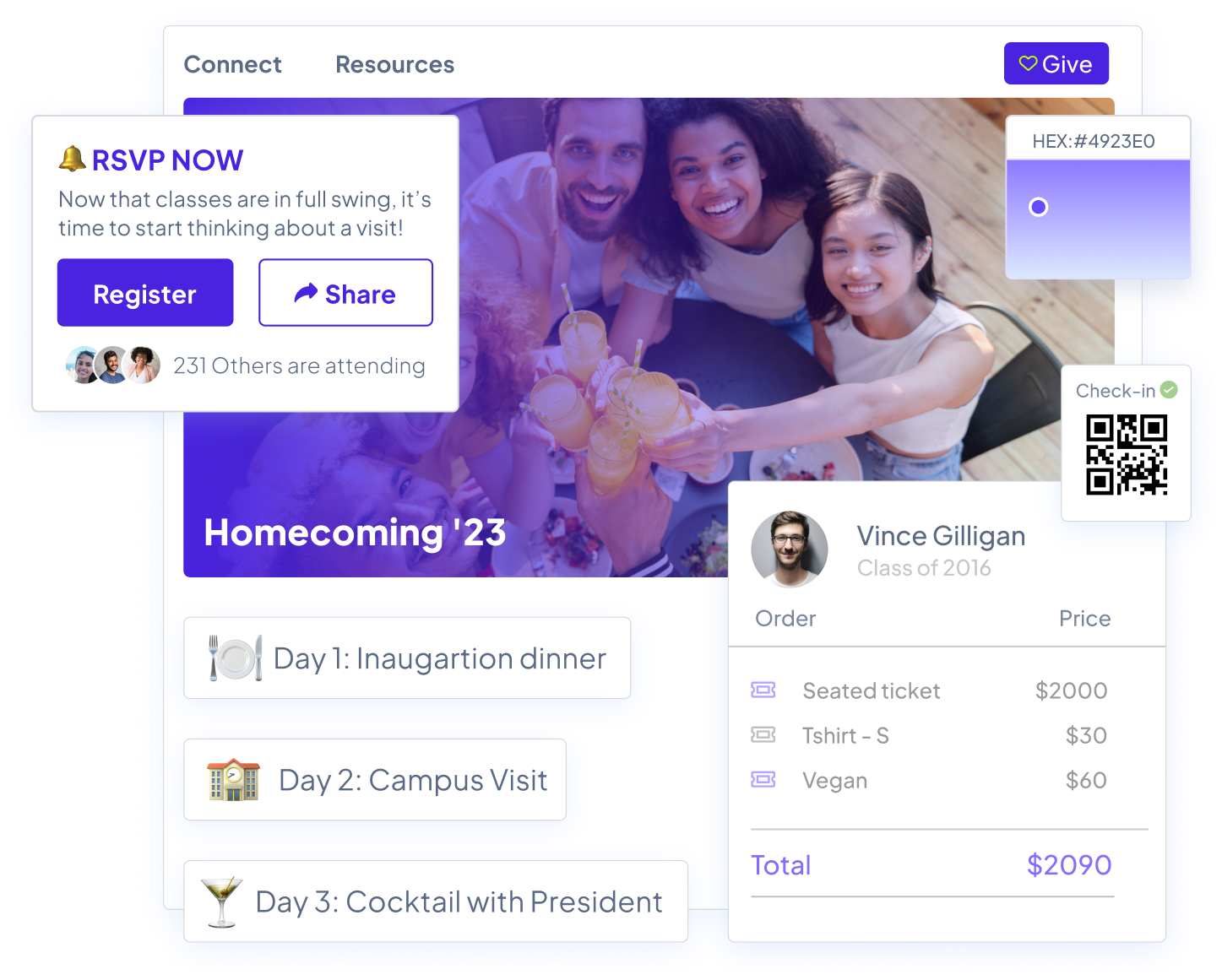
The registration flow is designed to be frictionless, supporting various ticket types, including early-bird pricing, tiered access, and "hidden" tickets reserved for VIPs or faculty. Because it is connected to the CRM, the system can automatically recognize a logged-in user and pre-fill their information, significantly reducing abandonment rates.
Furthermore, the platform supports "add-on" purchases, such as commemorative merchandise or optional donations, directly within the checkout flow. This integration of fundraising and events is a hallmark of the Almabase philosophy: every event is an opportunity to support the institution’s mission.
Mobile-First Attendee Experience
In 2026, the attendee experience is primarily mobile. Almabase provides digital tickets and QR codes for rapid check-in. Event organizers can use a dedicated check-in app to scan attendees at the door, which immediately updates the CRM. This real-time tracking allows organizers to see who has arrived and who is missing, enabling them to send "Sorry we missed you" or "Welcome to the event" messages automatically.
Virtual and Hybrid Event Integration
While in-person events remain a staple, hybrid components are now standard. Almabase integrates with major video conferencing and streaming platforms to manage virtual attendance. It handles the gatekeeping of links, ensuring that only registered and paid attendees can access the live stream, while also tracking "digital attendance" with the same weight as physical presence in the engagement score.
Technical Specifications and Integration Capabilities
The value of an events CRM is often defined by its ability to play well with other software. Almabase maintains a robust API and a library of native integrations.
| Feature Category | Description | Supported Systems / Details |
|---|---|---|
| Primary CRM Sync | Bi-directional data flow for constituent records. | Blackbaud Raiser’s Edge (NXT), Salesforce, Ellucian (Banner/Colleague). |
| Payment Gateways | Secure processing for tickets and donations. | Stripe, PayPal, Authorize.net, iATS Payments. |
| Email Marketing | Automated journeys and bulk communications. | Built-in editor; syncs with Mailchimp and Constant Contact. |
| Social Integration | Social sign-on and data enrichment. | LinkedIn, Facebook, Google. |
| Reporting | Real-time analytics and custom dashboards. | Exportable to CSV/Excel; visual engagement heatmaps. |
| Security | Data protection and privacy compliance. | SOC2 Type II, GDPR, CCPA compliant. |
Driving Participation through Targeted Communication
A CRM is only as good as the communication it enables. Almabase includes an integrated email marketing engine that allows teams to move away from "blast" emails toward personalized journeys.
Automated Event Workflows
The system can automate the entire communication lifecycle of an event. Once a user registers, they enter a workflow that includes:
- Instant Confirmation: An immediate receipt and calendar invite.
- Drip Reminders: Scheduled emails containing parking info, speaker bios, or pre-reading materials.
- Post-Event Follow-up: A survey sent two hours after the event ends, followed by a recording of the session for those who attended virtually.
Peer-to-Peer Engagement Tools
Almabase leverages the power of "social proof" by allowing alumni to see who else is attending an event (with privacy controls). It also includes tools for "Class Ambassadors" or "Table Captains" to invite their peers directly through the platform. This peer-to-peer approach is often more effective than institutional emails, as alumni are more likely to attend an event if they know their friends will be there.
Implementation and Operational Requirements
Deploying Almabase is a structured process that typically requires collaboration between the advancement office and the IT department.
The Onboarding Timeline
Most institutions can expect an onboarding period of 4 to 12 weeks, depending on the complexity of their data. The process begins with a "Data Audit" to ensure the existing records are clean enough for migration. Almabase provides dedicated implementation managers who oversee the mapping of fields between the school's legacy system and the Almabase CRM.
Staffing and Expertise
While the platform is designed for non-technical users, having a dedicated "Platform Admin" is a best practice. This person should understand the institution's data policy and how to build segments. Because the interface is intuitive, event coordinators can usually manage their specific events without needing deep technical knowledge, allowing the IT team to focus on high-level data strategy.
Cost Considerations
Almabase typically follows a SaaS (Software as a Service) pricing model. Costs are generally scaled based on the number of "addressable" alumni records in the database rather than the number of staff users. This encourages wide adoption across departments—such as athletics, various academic colleges, and the central alumni office—without incurring per-seat licensing fees.
Troubleshooting and Common Challenges
Even with a robust platform, technical and operational hurdles can arise. Understanding these in advance helps in creating a smoother experience.
- Sync Conflicts: Occasionally, a record may be updated in both the master database and Almabase simultaneously. In 2026, the platform uses a "rules-of-truth" engine where administrators define which system takes precedence for specific fields (e.g., the master database might be the truth for "Degree Year," while Almabase is the truth for "Current Email").
- Email Deliverability: Large-scale institutional emails can sometimes be flagged as spam. Almabase provides tools to set up SPF and DKIM records, which verify that the emails sent from the platform are authorized by the institution’s domain.
- User Adoption: The most common "failure" is not technical, but behavioral. If the staff continues to use separate spreadsheets for events, the CRM data becomes stale. Continuous training and making Almabase the "only" way to create an event page are necessary steps for success.
Frequently Asked Questions
Does Almabase replace my current database like Raiser's Edge?
No, Almabase is designed to complement your current system of record, not replace it. It acts as an engagement layer that provides a better user experience for alumni while syncing all collected data back to your primary database (e.g., Raiser's Edge, Salesforce, or Ellucian). This ensures your main database remains the "Single Source of Truth" while giving you modern tools for events and fundraising.
How does Almabase handle event payments and refunds?
Almabase integrates with major payment gateways like Stripe and PayPal. All transactions are processed through your own accounts, meaning the funds go directly to your institution. The platform handles various ticket types, discount codes, and add-on donations. Refunds can typically be initiated within the Almabase dashboard, which then updates the registration status and syncs the financial data back to your CRM.
Can we manage multi-day events like reunions with Almabase?
Yes, the platform is particularly strong for complex events like Reunions or Homecoming. You can create a "Main Event" with multiple "Sub-events" (e.g., a Friday night dinner, a Saturday morning campus tour, and a Sunday brunch). Attendees can register for the entire package or select individual sessions, and the CRM will track their attendance at each specific sub-event.
Is the platform mobile-friendly for both staff and alumni?
Absolutely. For alumni, the registration pages and digital directories are fully responsive and work on any mobile browser. For staff, Almabase provides a mobile check-in app that turns any smartphone or tablet into a scanner. This allows for rapid entry management and real-time attendance tracking without needing specialized hardware.
How secure is the data stored in Almabase?
Almabase adheres to industry-standard security protocols, including SOC2 Type II compliance. They use encryption for data at rest and in transit. Furthermore, the platform is built to help institutions comply with global privacy regulations such as GDPR and CCPA, providing tools for data deletion requests and consent management for email communications.
Final Recommendation
For educational institutions looking to modernize their advancement efforts in 2026, Almabase offers a compelling balance of CRM depth and event management flexibility. It is most effective for organizations that already have a primary database but struggle with the "last mile" of alumni engagement.
To get the most out of the software, institutions should prioritize the bi-directional sync setup during implementation. By ensuring that event data flows seamlessly into the central CRM, advancement teams can move beyond simple logistics and begin using their event programming as a powerful engine for donor identification and long-term constituent loyalty.