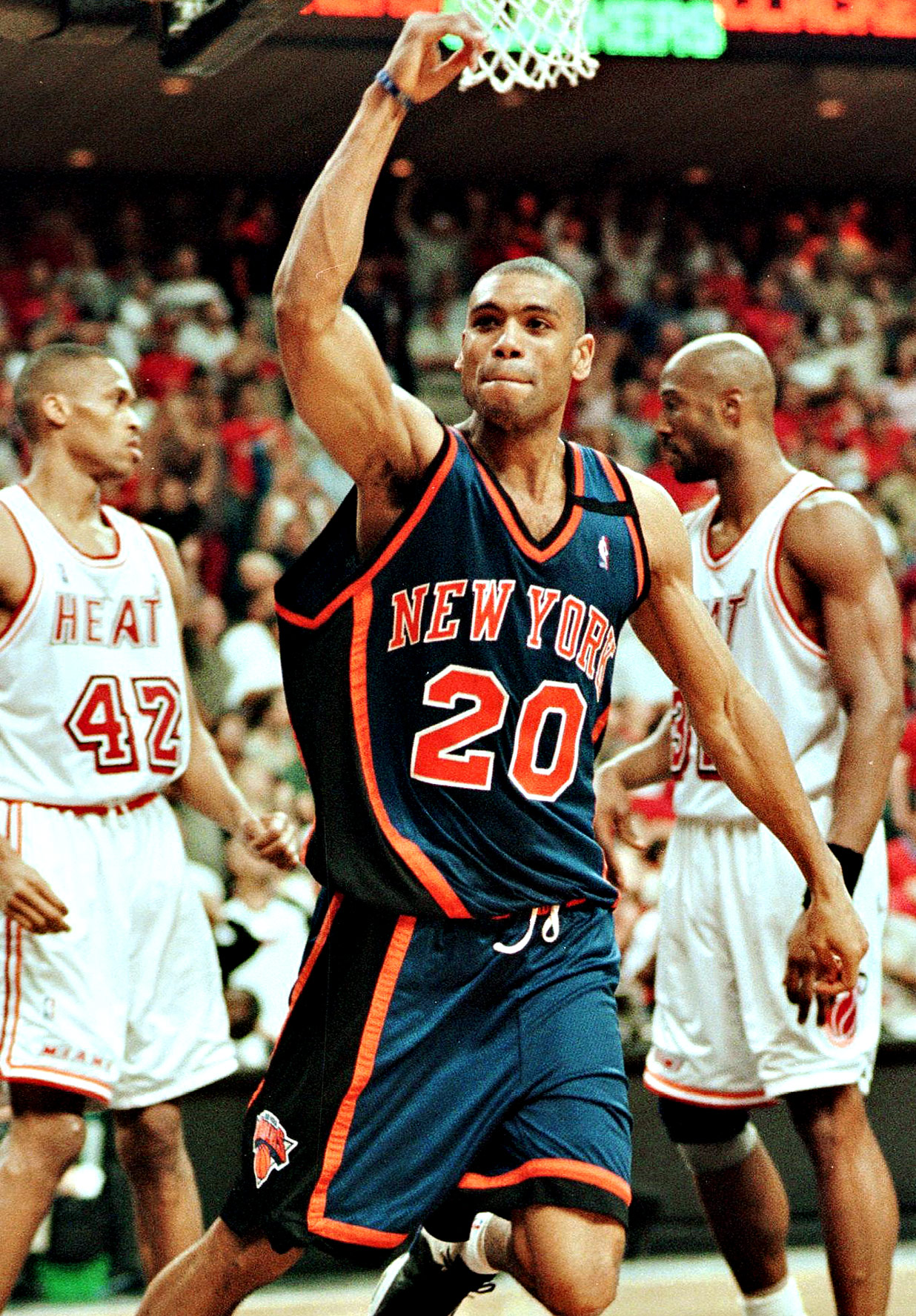
Allan Houston’s NBA career is defined by his tenure as one of the league’s most clinical shooting guards during the late 1990s and early 2000s, characterized by his fluid jump shot and pivotal role in the New York Knicks' late-90s resurgence. A two-time NBA All-Star, Houston played 12 seasons in the professional ranks, serving as a primary scoring option for both the Detroit Pistons and the New York Knicks, ultimately cementing his status as a foundational figure in Madison Square Garden history.
Early Life and Collegiate Success at Tennessee
Before transitioning to the professional level, Allan Houston emerged as a standout talent at the University of Tennessee. Under the tutelage of his father, head coach Wade Houston, Allan developed the fundamental mechanics that would later become his professional signature. His collegiate tenure was marked by prolific scoring and consistent performance, finishing his NCAA career as the Volunteers' all-time leading scorer. This trajectory naturally projected him as a high-lottery pick in the 1993 NBA Draft.
His time in Knoxville was not merely about scoring milestones; it provided a blueprint for the off-ball movement and quick-release mechanics that defined his professional ceiling. By the time he declared for the draft, scouting reports highlighted his superior shooting touch and basketball IQ, traits that allowed him to transition smoothly from college star to a professional contributor.
The Formative Years: Detroit Pistons (1993–1996)
Selected 11th overall by the Detroit Pistons in the 1993 NBA Draft, Houston entered a franchise in the midst of a rebuilding phase following the dissolution of the "Bad Boys" era. His initial seasons in Detroit were critical for his development. While the team struggled to find consistency, Houston’s individual output increased annually.
His third season with the Pistons, 1995–1996, proved to be his breakout year. During this campaign, he averaged 19.7 points per game, showcasing an ability to operate within complex offensive schemes. It was during this period that his reputation as a "pure shooter" solidified. He demonstrated an elite ability to navigate screens, find open spaces in perimeter defenses, and capitalize on defensive lapses with a high-arching, precise jump shot. Following this season, Houston became a highly sought-after free agent, leading to his monumental shift to the Atlantic Division.
Peak Performance: The New York Knicks Era
In 1996, Houston signed with the New York Knicks. This move paired him with center Patrick Ewing and defensive anchor Charles Oakley, creating a core that would define New York basketball for several years. The Knicks were an established contender, and Houston provided the perimeter scoring threat that had been largely missing from their tactical rotation.
The 1999 Playoff Run
The apex of Houston’s career occurred during the 1999 lockout-shortened season. As the eighth-seeded Knicks navigated a historic playoff path, Houston delivered one of the most iconic moments in franchise history. In the deciding game of the first-round series against the top-seeded Miami Heat, Houston hit a running jumper in the final seconds of the game to seal the series victory.
This performance served as a microcosm of his value: composure under pressure and the ability to execute difficult shots when the game was on the line. Throughout that postseason, he acted as the offensive engine, helping the Knicks reach the 1999 NBA Finals against the San Antonio Spurs. Though the Knicks eventually fell in the series, the run remains the definitive achievement of his tenure in New York.
Statistical Progression and Playing Style
Houston’s role evolved alongside the team's requirements. While he was capable of creating his own shot, he excelled as a secondary playmaker who could space the floor effectively. His shooting percentages—particularly from the free-throw line—were consistently among the league’s best.
| Season | Team | PPG | FG% | FT% |
|---|---|---|---|---|
| 1995-96 | Detroit | 19.7 | 45.3% | 82.3% |
| 1997-98 | New York | 18.4 | 44.9% | 88.7% |
| 1999-00 | New York | 19.7 | 48.3% | 83.8% |
| 2000-01 | New York | 18.7 | 45.1% | 90.9% |
| 2002-03 | New York | 22.5 | 44.5% | 91.9% |
The "Allan Houston Rule" and Salary Cap Legacy
The latter stages of Houston’s career are often discussed in the context of NBA collective bargaining history. Following a series of significant injuries, including chronic knee issues, his production declined while his salary remained substantial. The term "Allan Houston Rule" became a colloquialism in the NBA media following the 2005 Collective Bargaining Agreement.
The rule allowed teams to release one player and have that player's salary removed from their luxury tax calculations. While the provision was technically part of a broader negotiation, it became inextricably linked to Houston’s contract situation at the time. This historical footnote, however, should not overshadow his contributions on the court; rather, it highlights the changing landscape of NBA contract management and the physical toll that professional play exacted on elite scorers of his generation.
Retirement and Legacy in the NBA
Allan Houston officially retired from the NBA in 2005, following a final attempt at a comeback in 2007. His career total of 14,551 points places him among the most prolific shooters of his era. Beyond the statistics, he is remembered for his professional demeanor and his contributions to the culture of the New York Knicks during a period of intense public and media scrutiny.
His post-playing career has seen him remain involved with the Knicks organization in various capacities, including front-office roles and player development. By staying connected to the game, he has transitioned from a floor spacer and scoring threat into a mentor, ensuring that his technical understanding of the guard position is passed down to subsequent generations.
Frequently Asked Questions
What was Allan Houston’s primary strength as a player?
Houston’s primary strength was his jump shot, which featured a high release point and exceptional arc. This technical proficiency made him one of the most reliable perimeter scorers in the NBA during his prime, capable of scoring in both catch-and-shoot scenarios and off-the-dribble pull-ups.
How did the "Allan Houston Rule" affect the NBA?
The "Allan Houston Rule" (technically the amnesty provision of the 2005 CBA) allowed teams to waive a player and exclude their salary from the luxury tax. While named after the contractual situation surrounding Houston's late-career injuries, it fundamentally changed how NBA franchises managed long-term salary cap liabilities.
What are Allan Houston’s most notable career achievements?
Houston was selected as an NBA All-Star twice (2000 and 2001) and played an instrumental role in leading the New York Knicks to the 1999 NBA Finals. He is also recognized for his longevity as a top-tier scoring option, averaging over 20 points per game during three different seasons.
Did Allan Houston play for any team other than the Pistons and Knicks?
No. During his 12-year NBA career, Allan Houston played exclusively for two franchises: the Detroit Pistons (1993–1996) and the New York Knicks (1996–2005).
What is Allan Houston’s role in the league today?
As of 2026, Houston remains involved with the New York Knicks organization. His focus has largely shifted toward leadership and player development, leveraging his experience as a veteran guard to assist in the professional growth of younger players within the franchise.
Next Steps for Basketball Historians
For those seeking to understand the tactical evolution of the shooting guard position in the late 1990s, reviewing game footage from the 1999 Knicks playoff run is highly recommended. Analysis of his off-ball movement provides a masterclass in efficiency that remains relevant for modern basketball training. For further reading on the administrative side of his career, consult the NBA's archives on the 2005 Collective Bargaining Agreement documents to distinguish the facts of the "amnesty clause" from common media myth.