Auto insurance is a binding legal contract between a vehicle owner and an insurance provider designed to mitigate financial risks associated with traffic accidents, vehicle theft, and third-party liabilities. In exchange for regular premium payments, the insurer provides financial coverage for losses as specified within the policy, ensuring that a single incident does not lead to personal financial ruin.
Understanding the intricacies of auto insurance is essential for every driver, especially as vehicle technology and repair costs continue to rise in 2026. This guide breaks down the essential components, legal requirements, and strategic decisions involved in selecting and maintaining the right policy.
Understanding the Core Components of an Auto Insurance Policy
Before selecting a policy, one must understand the three fundamental pillars that determine the cost and effectiveness of the coverage: the premium, the deductible, and the policy limits.
The Premium
The premium is the amount of money you pay to the insurance company to keep your policy active. In 2026, premiums are typically paid monthly, semi-annually, or annually. This cost is determined by the insurance company’s assessment of your risk profile. Factors such as your driving history, the type of vehicle you own, and even your geographic location play a role in this calculation. If you stop paying your premium, the insurance company has the legal right to cancel your policy, leaving you uninsured and potentially in violation of state laws.
The Deductible
A deductible is the out-of-pocket amount you must pay toward a claim before the insurance company covers the remaining balance. For example, if you have a $500 deductible and sustain $2,500 in damages to your car, you pay the first $500, and the insurer pays the remaining $2,000. Generally, choosing a higher deductible leads to a lower monthly premium because you are assuming more of the initial financial risk. Conversely, a lower deductible increases your premium but reduces the immediate financial burden following an accident.
Policy Limits
Policy limits represent the maximum amount an insurance company will pay for a covered loss. These limits are often expressed as a series of numbers, such as 100/300/50. These figures represent $100,000 for bodily injury per person, $300,000 for bodily injury per accident, and $50,000 for property damage. If a claim exceeds these limits, the policyholder is personally responsible for the remaining balance, which is why financial experts often recommend limits that exceed the state-mandated minimums.
Mandatory vs. Optional Coverage Types
Auto insurance is not a singular product but a bundle of different coverages. Some are required by law in almost every jurisdiction, while others are optional but highly recommended depending on your vehicle's value and your personal assets.
Liability Coverage (The Legal Baseline)
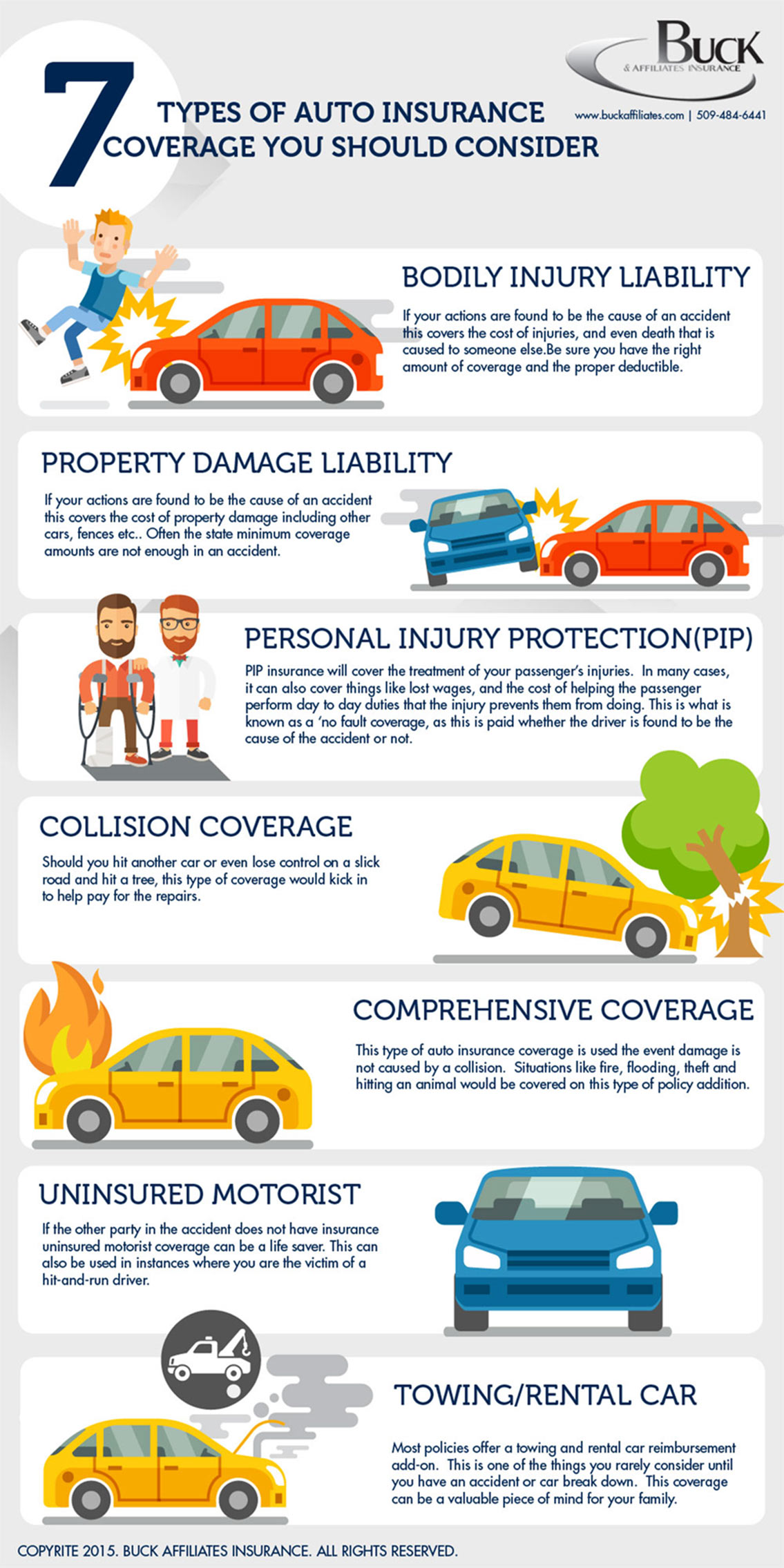
Liability insurance is the foundation of most auto policies and is mandatory in nearly every state. It does not cover your own injuries or vehicle damage; instead, it pays for the damages you cause to others.
- Bodily Injury Liability: This covers the medical bills, lost wages, and legal fees of the other party if you are found at fault in an accident.
- Property Damage Liability: This pays to repair or replace the other person's vehicle or property (such as a fence or building) that you damaged.
Collision and Comprehensive Coverage
Often referred to together as "physical damage coverage," these are typically optional unless you are financing or leasing your vehicle.
- Collision Insurance: This pays to repair your own vehicle after a crash, regardless of who was at fault. It covers accidents involving other cars or stationary objects like poles.
- Comprehensive Insurance: This protects against "acts of God" and non-collision events. This includes theft, vandalism, fire, hail, and hitting an animal. As we see more extreme weather patterns in 2026, comprehensive coverage has become increasingly vital for protecting vehicle investments.
Uninsured and Underinsured Motorist (UM/UIM)
Despite legal requirements, a significant percentage of drivers remain uninsured. UM/UIM coverage protects you if you are hit by a driver who has no insurance or whose policy limits are too low to cover your medical expenses. In many states, this also covers hit-and-run incidents where the other driver cannot be identified.
Medical Payments (MedPay) and Personal Injury Protection (PIP)
These coverages focus on the medical expenses of the driver and passengers.
- MedPay: A more limited coverage that specifically pays for medical and funeral expenses resulting from an accident.
- PIP: Common in "no-fault" insurance states, PIP is more robust. It covers medical bills regardless of who caused the accident and often includes coverage for lost wages and essential services (like childcare) that the injured person can no longer perform. Information regarding state-specific no-fault laws can be found via the National Association of Insurance Commissioners (NAIC).
Factors Influencing Your 2026 Auto Insurance Rates
Insurance companies use complex algorithms to predict the likelihood that a driver will file a claim. In 2026, these assessments have become more granular due to the integration of data and vehicle technology.
Driving Record and Telematics
Your history as a driver remains the most significant factor. Multiple speeding tickets or at-fault accidents signal high risk. However, by 2026, Telematics—the use of apps or in-car devices to monitor driving behavior—has become a standard way to adjust rates. Drivers who demonstrate safe habits (gentle braking, following speed limits, and avoiding late-night driving) can often secure significant "usage-based" discounts.
Vehicle Type and Repair Costs
The cost to insure a vehicle is directly tied to its replacement value and the cost of parts. As electric vehicles (EVs) and cars with Advanced Driver Assistance Systems (ADAS) become the norm in 2026, repair costs have risen. Calibrating sensors and replacing high-capacity batteries is more expensive than traditional bodywork, which is reflected in higher premiums for high-tech vehicles.
Credit-Based Insurance Scores
In many jurisdictions, insurers use a version of your credit score to help determine your premium. Statistics used by the Insurance Information Institute (III) suggest a correlation between credit management and insurance risk. While some states have banned this practice, it remains a common factor in most areas.
Geographic Location
Where you park your car matters. Urban areas with high rates of theft and traffic congestion typically have higher premiums than rural areas. Additionally, regions prone to natural disasters like floods or wildfires will see higher comprehensive insurance rates.
The Mechanics of the Claims Process
When an accident occurs, the insurance policy transitions from a theoretical protection to a practical financial tool. Navigating the claims process efficiently is key to a quick recovery.
- Immediate Documentation: Safety is the priority, but once the scene is secure, take photos of all vehicles involved, the surrounding area, and any relevant road signs. Exchange contact and insurance information with the other driver.
- Notification: Contact your insurance provider as soon as possible. Most major insurers in 2026 offer mobile apps that allow you to start a claim, upload photos, and even request a tow directly from the accident site.
- Adjuster Review: The insurance company will assign an adjuster to evaluate the damage. They may view the car in person or use AI-driven photo analysis tools to estimate repair costs.
- Determination of Fault: The insurer will review police reports, witness statements, and physical evidence to determine who was at fault. This determination affects whose liability insurance will pay for the damages.
- Settlement: Once the estimate is finalized, the insurer will issue payment for the repairs, minus your deductible. If the car is "totaled" (the repair costs exceed a certain percentage of the car's value), the insurer will pay you the Actual Cash Value (ACV) of the vehicle.
Comparison of Standard Coverage Types
| Coverage Type | Primary Function | Legal Status | Recommended For |
|---|---|---|---|
| Liability (BI/PD) | Pays for others' injuries/damage | Mandatory in most states | Every driver |
| Collision | Repairs your car after a crash | Optional (Mandatory for loans) | Newer cars (> $5,000 value) |
| Comprehensive | Covers theft, fire, weather | Optional (Mandatory for loans) | All drivers (high-risk areas) |
| UM/UIM | Protects against uninsured drivers | Mandatory in some states | High-traffic commuters |
| PIP / MedPay | Covers your medical expenses | Mandatory in no-fault states | Families and solo drivers |
| Gap Insurance | Covers loan balance vs. car value | Optional | New car owners with low down payments |
Strategies to Reduce Your Insurance Premiums
While insurance is a necessary expense, there are several verified methods to lower your costs without sacrificing essential coverage.
Bundling and Multi-Policy Discounts
Most insurance companies offer a "bundling" discount if you purchase multiple types of insurance from them, such as auto and homeowners or renters insurance. This can often lead to a 10% to 25% reduction in total premiums.
Increasing the Deductible
If you have a healthy emergency fund, increasing your deductible from $500 to $1,000 or $2,000 can significantly lower your monthly premium. However, you must be certain you can afford that out-of-pocket cost if an accident occurs.
Safety and Security Features
Equipping your vehicle with anti-theft devices, dash cameras, or advanced safety tech can sometimes trigger discounts. In 2026, many insurers provide credits for vehicles that have verified autonomous emergency braking and lane-departure warnings, as these features statistically reduce the frequency of claims.
Professional and Academic Discounts
Insurers often offer lower rates to members of certain professions (like teachers, first responders, or engineers) and to students who maintain a high GPA (the "Good Student Discount").
Frequently Asked Questions
Does auto insurance follow the car or the driver?
In most cases, auto insurance follows the car. If you lend your vehicle to a friend and they get into an accident, your insurance will typically be the primary coverage used to pay for the damages. However, there are nuances based on specific policy language and state laws regarding "permissive use."
What is the difference between "Full Coverage" and liability only?
"Full coverage" is a common industry term rather than a formal policy type. It generally refers to a policy that includes liability, collision, and comprehensive coverage. Liability-only insurance, which is the bare minimum required by law, does not provide any financial protection for your own vehicle.
How does a "total loss" work?
A vehicle is considered a total loss if the cost of repairs plus the salvage value exceeds the car's Actual Cash Value (ACV). In this scenario, the insurance company pays you the market value of the car (minus your deductible) rather than repairing it. For more details on vehicle safety and valuation, refer to the NHTSA.
Why did my premium go up even if I didn't have an accident?
Premiums can increase due to factors outside of your control, such as a general rise in regional accident rates, increased costs for medical care and vehicle parts, or changes in your credit score. In 2026, the complexity of vehicle electronics has broadly pushed repair costs—and subsequently premiums—higher across the industry.
What is Gap Insurance and do I need it?
Gap insurance covers the "gap" between what you owe on your car loan and the car's actual market value. Because new cars depreciate quickly, you might owe $30,000 on a car that is only worth $25,000. If that car is totaled, standard insurance only pays $25,000; Gap insurance covers the remaining $5,000.
Next Steps for Vehicle Owners
To ensure you have the best protection at the most competitive price, review your policy annually. Start by verifying that your coverage limits still protect your current net worth. Next, contact your agent to ask about new discounts, particularly those related to telematics or updated safety features on your vehicle. Finally, compare quotes from at least three different providers every two years to ensure your current rate remains competitive within the 2026 insurance market.