The additive inverse of a number is the value that, when added to the original number, results in a sum of zero. For any real number $a$, its additive inverse is represented as $-a$, satisfying the fundamental algebraic equation $a + (-a) = 0$. This concept is a cornerstone of arithmetic, algebra, and advanced group theory.
In mathematical systems, the additive inverse represents the "opposite" of a value. Whether you are dealing with simple integers, complex fractions, or multidimensional vectors, the characteristics of the additive inverse remain consistent: it is the unique element that neutralizes a value back to the additive identity, which is zero. Understanding these characteristics is essential for solving equations, simplifying expressions, and grasping the symmetry of the number line.
The Core Concept of the Additive Inverse
To understand the characteristics of the additive inverse, one must first understand the "additive identity." In any number system, the additive identity is the number that, when added to any other number, leaves that number unchanged. In the real number system, this identity is zero (0).
The additive inverse is defined specifically in relation to this identity. If you have a number $x$, its additive inverse is the number you must add to $x$ to reach 0. This relationship is often called the "Property of Opposites." While many people simply think of this as "changing the sign," the mathematical implications are much deeper, involving the structure of fields and groups in higher mathematics.
In the year 2026, educational standards continue to emphasize the additive inverse not just as a rule for subtraction, but as a fundamental property of "groups" in abstract algebra. By viewing subtraction as the "addition of an inverse," students and professionals can apply consistent rules across diverse mathematical landscapes, from computer science algorithms to quantum physics calculations.
Essential Characteristics of Additive Inverses
The behavior of additive inverses is governed by several distinct characteristics. These rules apply universally across the set of real numbers and extend into more complex mathematical structures.
1. The Sum Property
The most defining characteristic is that the sum of a number and its additive inverse is always zero. This is expressed as: $$a + (-a) = 0$$ This property is used to "cancel out" terms in algebraic equations. For example, if you have the equation $x + 5 = 12$, you apply the additive inverse of 5 (which is -5) to both sides to isolate $x$. The characteristic ensures that $5 + (-5)$ becomes 0, leaving the variable alone.
2. Uniqueness
For every real number, there exists exactly one additive inverse. There is no other number besides -7 that can be added to 7 to produce 0. In formal mathematics, this is proven by assuming two different inverses exist and showing they must be equal. This uniqueness is vital for the stability of mathematical logic; without it, algebraic solutions would be ambiguous.
3. Symmetry on the Number Line
On a horizontal number line, a number and its additive inverse are located at the exact same distance from zero, but in opposite directions. For instance, the number 4 is four units to the right of zero, while -4 is four units to the left. This geometric characteristic highlights the concept of absolute value. Both 4 and -4 have an absolute value of 4, meaning $|4| = |-4| = 4$.
4. The Inverse of the Inverse
One of the most important characteristics for simplifying expressions is the "double negative" property. The additive inverse of an additive inverse is the original number itself. Mathematically, this is written as: $$-(-a) = a$$ If you take the opposite of -5, you return to 5. This characteristic is a frequent source of error in student calculations, making it a primary focus for educators.
5. The Additive Inverse of Zero
Zero is a unique case in this system. The additive inverse of 0 is 0. This is because $0 + 0 = 0$. Zero is the only real number that is its own additive inverse. This characteristic reinforces zero’s role as the "neutral element" or identity of the system.
The Additive Inverse Across Different Sets
While we often learn these characteristics using whole numbers, they apply to every category within the real and complex number systems.
Integers and Natural Numbers
In the set of natural numbers ${1, 2, 3, ...}$, additive inverses do not exist within the set itself. This is why the set of integers was developed. By including 0 and negative numbers, mathematics creates a closed system where every element has an additive inverse.
Rational Numbers and Fractions
For any fraction $a/b$, the additive inverse is simply $-(a/b)$ or $(-a)/b$. For example, the inverse of $3/4$ is $-3/4$. The same characteristics apply: $$\frac{3}{4} + \left(-\frac{3}{4}\right) = 0$$ When working with rational numbers, the additive inverse is crucial for finding common denominators and performing complex fraction arithmetic.
Real and Irrational Numbers
Even transcendental and irrational numbers follow these rules. The additive inverse of $\pi$ is $-\pi$. The inverse of $\sqrt{2}$ is $-\sqrt{2}$. Even though these numbers have infinite non-repeating decimals, their relationship with their inverse remains perfectly symmetrical around zero.
Complex Numbers
In complex analysis, where numbers take the form $a + bi$ (with $i$ being the imaginary unit), the additive inverse is found by negating both the real and imaginary parts. The inverse of $3 + 2i$ is $-3 - 2i$. $$(3 + 2i) + (-3 - 2i) = (3 - 3) + (2i - 2i) = 0 + 0i = 0$$
Advanced Applications: Matrices and Vectors
The concept of the additive inverse extends beyond simple numbers into linear algebra, which forms the backbone of modern data science and 3D modeling in 2026.
Vector Additive Inverses
In physics and engineering, a vector represents both magnitude and direction. The additive inverse of a vector $\vec{v}$ is a vector $-\vec{v}$ that has the same magnitude but points in the exactly opposite direction. When you add a force vector to its additive inverse, the resultant force is zero (equilibrium).
Matrix Additive Inverses
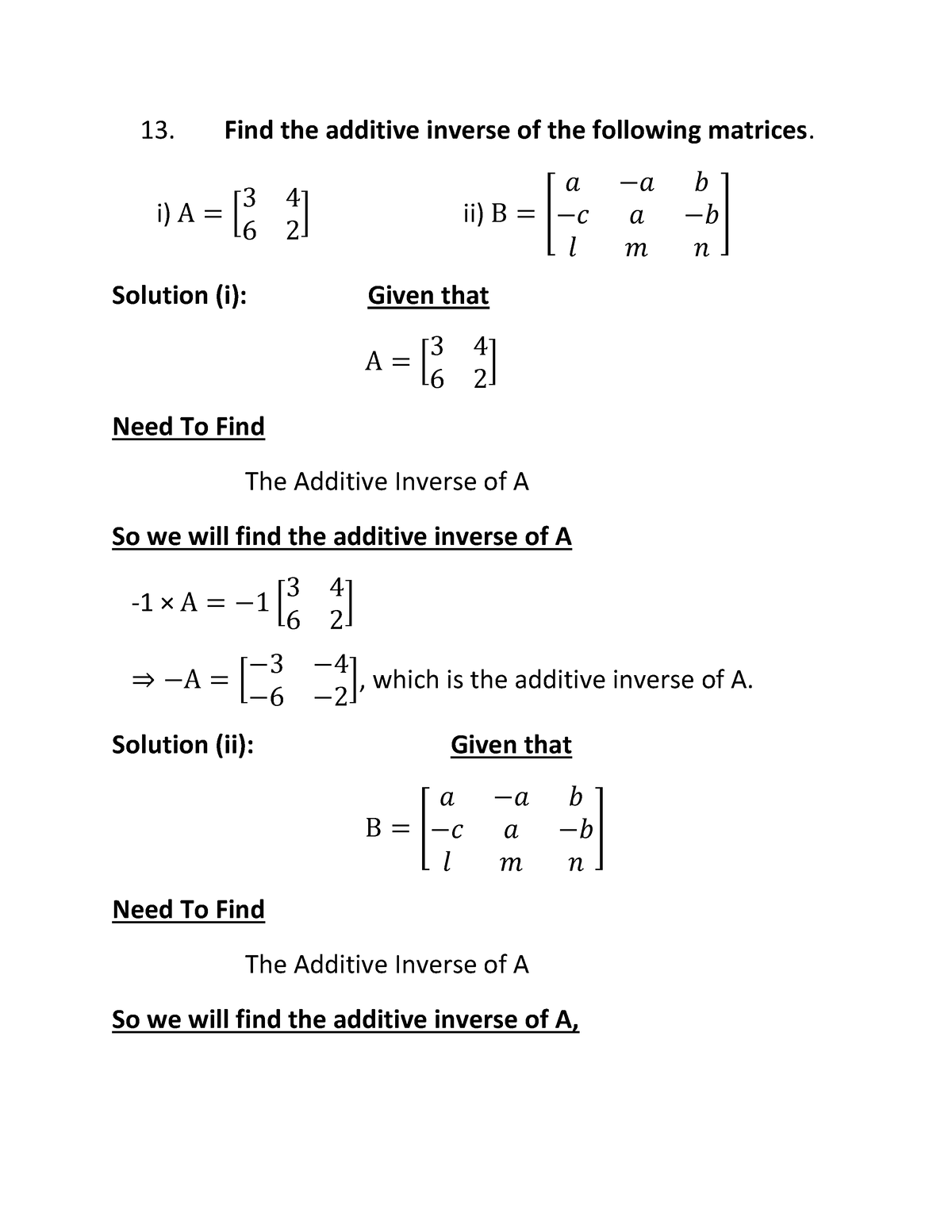
In matrix algebra, the additive inverse of a matrix $A$ is the matrix $-A$, where every individual element $a_{ij}$ is replaced by its additive inverse $-a_{ij}$. For example, if: $$A = \begin{bmatrix} 1 & -2 \ 3 & 0 \end{bmatrix}$$ Then: $$-A = \begin{bmatrix} -1 & 2 \ -3 & 0 \end{bmatrix}$$ The sum $A + (-A)$ results in the Zero Matrix, which is the additive identity for matrices.
Comparison of Inverse Types
It is common to confuse the additive inverse with the multiplicative inverse (reciprocal). The following table clarifies the distinctions between these two fundamental properties.
| Characteristic | Additive Inverse | Multiplicative Inverse |
|---|---|---|
| Operation | Addition ($+$) | Multiplication ($\times$) |
| Target Identity | 0 (Additive Identity) | 1 (Multiplicative Identity) |
| Formula | $a + (-a) = 0$ | $a \times (1/a) = 1$ |
| Visual on Number Line | Reflection across 0 | Change in scale/reciprocal position |
| Example (for 5) | $-5$ | $1/5$ or $0.2$ |
| Exception | None (Every real number has one) | 0 (Zero has no multiplicative inverse) |
| Self-Inverse | 0 is its own inverse | 1 and -1 are their own inverses |
Why Additive Inverses Matter in 2026
In contemporary technology and science, the characteristics of the additive inverse are applied in various ways that go beyond the classroom.
- Computer Science and Binary: Digital systems use "Two's Complement" to represent negative numbers. This is a practical application of the additive inverse characteristic that allows computers to perform subtraction using addition circuitry, which is more efficient.
- Financial Accounting: In modern ledger systems, every credit has a corresponding debit. This "double-entry" system relies on the principle that the sum of all accounts should be zero. The additive inverse allows for the representation of debt as a negative value, facilitating clear balance sheets.
- Signal Processing: Noise-canceling technology works by generating a sound wave that is the "inverse" (180 degrees out of phase) of the ambient noise. When these two waves meet, they sum to zero (or near-zero), demonstrating the additive inverse property in acoustics.
- Chemistry: In calculating the oxidation states of atoms in a neutral molecule, the sum of the oxidation numbers must be zero. This is an application of additive inverses used to predict how chemicals will react and bond.
Common Mistakes and How to Avoid Them
Even though the concept seems straightforward, several common pitfalls can lead to errors in calculation and logic.
- Confusing Sign with Operation: Many students see a minus sign and assume it always means "subtract." However, $-x$ simply means "the additive inverse of $x$." If $x$ is already negative (e.g., $x = -10$), then $-x$ is positive 10.
- Mixing up Inverse Types: As shown in the table above, the additive inverse (negative) and multiplicative inverse (reciprocal) are different. A common error is thinking the inverse of 5 is $1/5$ when the context requires an additive inverse.
- Incorrect Distribution: When finding the additive inverse of an expression like $(x - 5)$, one must negate the entire expression: $-(x - 5) = -x + 5$. Forgetting to distribute the negative sign to all terms is a frequent algebraic mistake.
Troubleshooting Numerical Problems
If you are struggling to identify the additive inverse in a complex problem, follow these verification steps:
- Identify the Value: Clearly define the number or expression you are starting with.
- Apply the Negation: Place the entire value inside parentheses and put a negative sign in front.
- Simplify: Distribute the negative sign. If the number is a fraction, negate only the numerator or the entire fraction, not both.
- Verify via Addition: Add your result to the original number. If the result is not exactly zero, an error occurred in step 2 or 3.
Frequently Asked Questions
Does every number have an additive inverse?
Yes, within the set of integers, rational numbers, real numbers, and complex numbers, every single element has a unique additive inverse. This includes zero, which is its own inverse. This universality is one of the most powerful aspects of the additive property.
Is the additive inverse always a negative number?
No. The additive inverse is only negative if the original number is positive. If you start with a negative number, like -8, its additive inverse is positive 8. It is more accurate to think of the additive inverse as the "opposite" rather than just "the negative."
How do additive inverses relate to absolute value?
A number and its additive inverse always have the same absolute value. The absolute value measures distance from zero on the number line, and since $a$ and $-a$ are equidistant from zero (just in different directions), $|a| = |-a|$.
Why is 0 its own additive inverse?
By definition, an additive inverse must sum with the original number to equal the identity (0). Since $0 + 0 = 0$, the number 0 satisfies the requirement for itself. No other number has this property because any non-zero number $x$ added to itself results in $2x$, not 0.
Can a matrix have an additive inverse if it isn't square?
Yes. Unlike multiplicative inverses (which require a square matrix and a non-zero determinant), additive inverses exist for any matrix of any dimensions. You simply negate every element in the matrix. As long as the two matrices have the same dimensions, they can be added to produce a zero matrix.
What is the additive inverse of a variable?
The additive inverse of a variable $x$ is simply $-x$. In algebra, this represents an unknown value that, when added to $x$, cancels it out. This is a fundamental tool used in the "Addition Property of Equality" to isolate variables in equations.
Final Recommendation for Learners
To master the characteristics of the additive inverse, focus on the concept of neutralization. Instead of memorizing "change the sign," visualize the number line and the symmetry it provides. When solving algebraic equations, always remember that subtracting a number is mathematically identical to adding its inverse. This shift in perspective—from subtraction to "addition of the opposite"—is the key to progressing from basic arithmetic to advanced calculus and linear algebra. For further study on how these properties form the basis of algebraic structures, resources like Wolfram MathWorld or the Mathematical Association of America provide deep dives into field axioms and group theory.