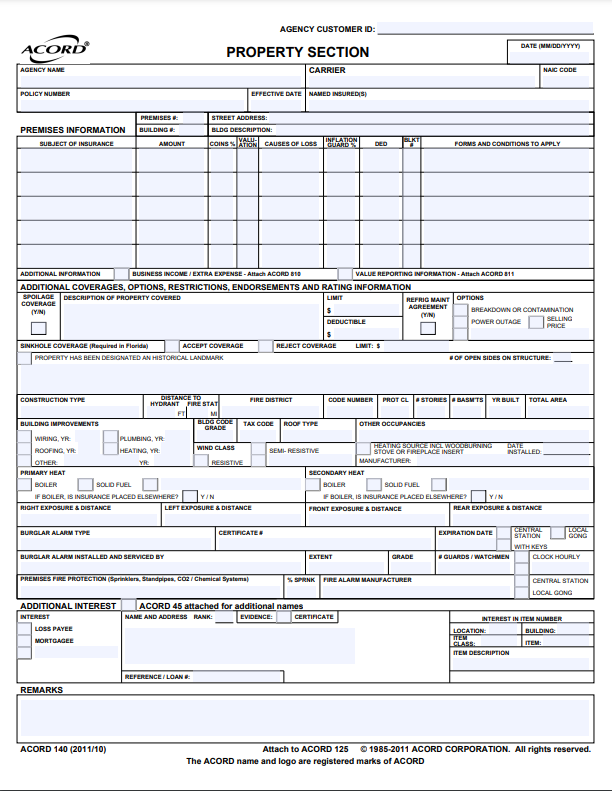
Commercial builders liability insurance in Texas relies on standard ACORD forms—primarily ACORD 25, ACORD 28, and the Texas-specific ACORD 855—to verify coverage limits, policy terms, and endorsement provisions. These forms provide proof of General Liability, Builder’s Risk, and Workers' Compensation coverage required by project owners, lenders, and general contractors under Texas law.
What Is an ACORD Certificate in Texas Commercial Construction?
In commercial construction, an ACORD certificate serves as standardized evidence that a builder, general contractor, or trade subcontractor holds active commercial insurance policies. Standardized by the Association for Cooperative Operations Research and Development (ACORD), these standardized templates streamline communication between policyholders, insurance brokers, project owners, and regulatory authorities.
While an ACORD certificate provides summary evidence of coverage, it is not an insurance policy itself and does not amend, extend, or alter the terms of the underlying contracts. In Texas, the administration and presentation of these forms are subject to strict regulatory standards enforced by the Texas Department of Insurance (TDI).
| Primary ACORD Documents | Details |
|---|---|
| ACORD 25 | Certificate of Liability InsuranceCovers CGL, Auto, Workers' Comp, Umbrella |
| ACORD 28 | Evidence of Commercial Property InsuranceCovers Builder's Risk / Structure Damage |
| ACORD 855 | Texas CGL Extension SupplementDetails exclusions, endorsements & limits |
Key ACORD Forms Used by Texas Commercial Builders
- ACORD 25 (Certificate of Liability Insurance): The most common form used to verify liability coverages, including Commercial General Liability (CGL), Commercial Auto, Excess/Umbrella Liability, and Workers' Compensation.
- ACORD 28 (Evidence of Commercial Property Insurance): Used to evidence property-based protections, primarily Builder’s Risk (Course of Construction) coverage, protecting physical structures, materials, and equipment during construction.
- ACORD 855 (Texas Commercial General Liability Extension Supplement): A critical, Texas-specific form created to provide deeper visibility into a contractor's CGL policy exclusions and endorsements that the basic ACORD 25 does not show.
Primary Coverages Required on Texas Builders Liability Certificates
Commercial construction projects across Texas—from urban developments in Houston and Dallas to infrastructure builds in Austin and San Antonio—carry substantial financial risks. Consequently, project owners, lenders, and general contractors require robust proof of insurance spanning several operational areas.
- Commercial Builder Coverage Stack
- CGL & Comp. Ops.
- Builder's Risk (Prop.)
- Workers' Comp & Auto
- Umbrella / Excess Liability
1. Commercial General Liability (CGL)
CGL protects builders against third-party bodily injury and property damage claims arising from ongoing construction operations. On an ACORD 25, general liability is listed with distinct limits:
- Each Occurrence Limit: The maximum paid for a single loss event (typically $1,000,000 to $2,000,000).
- General Aggregate Limit: The total policy payout cap across all incidents during the policy term.
- Products-Completed Operations Aggregate: Coverage for claims arising after project completion due to alleged construction defects or faulty workmanship causing bodily injury or third-party property damage.
2. Builder’s Risk (Course of Construction)
Evidenced on ACORD 28, Builder's Risk covers physical damage to the structure under construction, building materials on-site, materials in transit, and stored items. Policies are written on an "All-Risk" (Special Form) or "Named Perils" basis, safeguarding projects against fire, windstorm, theft, vandalism, and vehicle impact. Given Texas's susceptibility to severe hail, tornadoes, and coastal hurricanes, Builder’s Risk policies frequently include specific sub-limits or deductibles for windstorm and hail damage.
3. Workers' Compensation and Employers' Liability
Unlike most states, Texas does not statutorily require private employers to carry Workers' Compensation insurance (known as "non-subscribers"). However, in commercial construction, virtually all general contractors and commercial project owners mandate that every sub-tier contractor maintain statutory Workers' Compensation. Listing Workers' Compensation on the ACORD 25 demonstrates that injured crew members are covered under statutory benefits, protecting higher-tier parties from direct personal injury lawsuits filed by injured sub-contractor employees.
4. Umbrella / Excess Liability
Commercial construction agreements often mandate overall liability limits exceeding the standard $1,000,000 CGL per-occurrence cap. An Excess or Umbrella Liability policy provides additional policy limits layered above the primary CGL, Commercial Auto, and Employers' Liability policies. These supplemental limits are recorded in the central section of the ACORD 25 form.
Texas Legal Framework Governing ACORD Certificates
Texas maintains explicit statutory codes governing how insurance certificates are issued, interpreted, and managed. Understanding these laws protects builders and project owners from administrative penalties and legal exposure.
| Texas Insurance Compliance | Details |
|---|---|
| Texas Insurance Code Chapter 1811 | Prohibits certificates from altering policy terms.Restricts custom text that promises broader rights than the policy. |
| Texas Insurance Code Chapter 151 (Anti-Indemnity Act) | Restricts broad-form contractual indemnity obligations.Prevents shifting liability for a party's sole or active negligence. |
| Texas Civil Practice & Remedies Code (Statute of Repose) | Establishes time frames for construction defect liability.Demands sustained Completed Operations coverage over multi-year terms. |
Texas Insurance Code Chapter 1811
Enacted to prevent deceptive trade practices in contractual coverage verification, Texas Insurance Code Chapter 1811 governs the issuance and content of certificates of insurance. Key restrictions include:
- No Alteration of Policy Terms: A certificate cannot alter, extend, or amend the coverage provided by the underlying policy.
- Prohibition of Custom Demands: Certificate holders (such as general contractors or lenders) cannot force an agent to add non-standard wording to an ACORD certificate that purports to grant rights not contained within the actual policy.
- Informational Document Status: An ACORD certificate is strictly evidence of coverage on the date of issuance; it does not constitute an insurance contract between the insurer and the certificate holder.
Texas Anti-Indemnity Act (Chapter 151)
Under Texas Insurance Code Chapter 151, broad-form contractual indemnity provisions in construction contracts are generally void as a matter of public policy. A construction agreement cannot require a lower-tier subcontractor to indemnify, defend, or hold harmless a higher-tier party for damages caused by that higher-tier party’s own negligence.
This statute directly impacts Additional Insured endorsements requested on ACORD forms. Insurance carriers in Texas issue specific endorsements (such as ISO forms CG 20 10 and CG 20 37) that align with Chapter 151, limiting additional insured coverage to vicarious liability caused by the named insured's operations rather than the sole negligence of the certificate holder.
Texas Statute of Repose
The Texas Statute of Repose (governed under Texas Civil Practice and Remedies Code § 16.008 and § 16.009) establishes the firm window within which a party can file a lawsuit for construction defects or property damage. While residential construction limits were adjusted under Texas HB 2024 (2023 legislative session), commercial construction claims generally maintain a 10-year repose period from substantial completion. Consequently, commercial contracts typically mandate that builders maintain Products-Completed Operations coverage for several years post-completion, verified annually via updated ACORD certificates.
Detailed ACORD Form Comparison for Commercial Construction
Selecting and reviewing the appropriate ACORD documents ensures compliance across every stage of a commercial construction project.
| Document Form | Primary Purpose | Key Data Fields Displayed | Essential Texas Considerations |
|---|---|---|---|
| ACORD 25 | Certificate of Liability Insurance | CGL Limits, Auto Liability, Workers' Comp, Umbrella, Certificate Holder Name | Subject to Chapter 1811 rules; cannot promise cancellation notices unless mandated by policy endorsement. |
| ACORD 28 | Evidence of Commercial Property Insurance | Builder's Risk limits, covered location, coinsurance %, deductibles, loss payees | Confirms physical property coverage during construction; mandatory for commercial project lenders. |
| ACORD 855 | Texas CGL Extension Supplement | Details specific exclusions (e.g., subsidence, residential, action-over, explicit AI forms) | Created specifically for Texas to disclose restrictions that standard ACORD 25 certificates obscure. |
| ACORD 835 | Texas Certificate of Property Insurance | Property values, building specs, business personal property details | Used for completed commercial real estate structures post-occupancy rather than active construction sites. |
Understanding the ACORD 855: The Texas CGL Extension Supplement
Because standard ACORD 25 certificates offer high-level summaries, critical policy exclusions can remain hidden. To solve this transparency issue in Texas, insurance bodies introduced the ACORD 855 (Texas Commercial General Liability Extension Supplement).
| ACORD 855 Disclosure Highlights | Details |
|---|---|
| 1. Residential & Multi-Family Exclusions | Discloses prohibitions on condo, tract home, or apartment work. |
| 2. Earth Movement & Subsidence Limitations | Details exclusions for foundation movement or soil expansion. |
| 3. Subcontractor Liability Restrictions | Shows restrictions on sub-tier work or Action-Over exclusions. |
| 4. Specific Additional Insured & Waiver Endorsements | Confirms exact ISO form numbers attached to the CGL policy. |
The ACORD 855 requires the issuing agent to answer explicit questions regarding the builder's liability coverage, disclosing whether the policy contains restrictions such as:
- Residential Construction Exclusions: Prohibiting coverage if a commercial builder performs work on multi-family residential structures, mixed-use developments, or condominiums.
- Subsidence / Earth Movement Exclusions: Excluding claims resulting from soil movement, expansive clay, or foundation shifts—a frequent issue in Texas region soils.
- Action-Over / Injury to Employees Exclusions: Excluding liability coverage when a subcontractor's injured employee sues the general contractor or project owner.
- Contractual Liability Restrictions: Disclosing modifications to standard broad-form contractual liability protection.
Requiring an ACORD 855 alongside an ACORD 25 allows general contractors and commercial project owners to verify that a builder's insurance policy contains no hidden exclusions that could void coverage during a loss event.
Step-by-Step Guide to Requesting and Verifying Texas ACORD Certificates
Properly verifying insurance coverage protects all parties on a job site. Follow these steps to process ACORD documentation for commercial building projects in Texas:
- Step 1: Define Contractual Requirements (Specify limits & required ISO endorsements)
- Step 2: Collect Forms (Obtain ACORD 25, ACORD 28, and ACORD 855 directly from producer)
- Step 3: Cross-Check Limits & Policy Dates (Verify effective terms and per-project aggregate)
- Step 4: Confirm Endorsements (Verify Additional Insured & Waiver of Subrogation forms)
- Step 5: Verify Producer & Insurer Status (Check TDI licensing and AM Best ratings)
Step 1: Establish Specific Contract Requirements
Before work commences, detail all insurance specifications in the commercial construction agreement. Specify required limits (e.g., $1,000,000 Per Occurrence / $2,000,000 Aggregate), required endorsement form numbers (e.g., CG 20 10 10 01 for ongoing operations and CG 20 37 10 01 for completed operations), and whether an ACORD 855 is mandatory.
Step 2: Request Certificates Directly from the Insurance Agent
Always request that the ACORD certificate be issued and transmitted directly by the licensed insurance producer (agent or broker) listed on the form. Certificates delivered directly by a contractor or subcontractor can be outdated or unauthorized.
Step 3: Review Limits, Dates, and Operations Description
Review the ACORD 25 line by line:
- Verify that the Policy Effective Date is current and covers the planned construction timeline.
- Ensure the Per Project Aggregate box is checked under the CGL section if required by contract.
- Check that policy limits meet or exceed the contractually mandated minimums across General Liability, Auto, Excess, and Workers' Compensation.
Step 4: Validate Endorsements and Texas Anti-Indemnity Compliance
Examine the "Description of Operations" box and attached endorsement schedules. Confirm that:
- Additional Insured Status is supported by attached policy endorsements (such as ISO forms CG 20 10 and CG 20 37 or their equivalents).
- A Waiver of Subrogation in favor of the certificate holder is properly selected and supported by policy endorsement forms (e.g., CG 24 04).
- The wording complies with Texas Insurance Code Chapter 1811 by omitting non-standard promises regarding advance cancellation notices.
Step 5: Verify Insurance Carrier Financial Solvency
Check the insurer names listed at the top of the ACORD form under "Insurers Affording Coverage." Cross-reference these carriers with rating agencies such as AM Best to verify financial strength (aiming for an A- or higher rating) and confirm their authorized or eligible surplus lines status on the Texas Department of Insurance portal.
Common Compliance Mistakes and Pitfalls in Texas
Failing to properly structure or review ACORD certificates can expose commercial builders to uninsured liabilities. Avoid these standard errors:
1. Misrelying on ACORD 25 for Property Protection
A common mistake is accepting an ACORD 25 as proof of Builder’s Risk or property coverage. ACORD 25 is strictly designed for liability policies. Property protections for physical structures under construction must be documented using ACORD 28 (Evidence of Commercial Property Insurance).
2. Demanding Invalid Cancellation Notice Promises
Project owners often insist that the ACORD 25 state that the insurer will provide 30 days' written notice of cancellation to the certificate holder. However, under Texas Insurance Code Chapter 1811, an ACORD form cannot grant cancellation notice rights that do not exist within the policy itself. Standard policy provisions grant notice rights only to the primary named insured, unless a specific Notice of Cancellation to Third Parties endorsement is attached to the underlying policy.
3. Ignoring Completed Operations Exposure
Builders often discontinue verifying coverage once physical construction concludes. Because latent construction defect claims can surface years later, failing to obtain annual updated ACORD 25 certificates showing active Products-Completed Operations coverage throughout the applicable repose period leaves project owners and contractors vulnerable.
4. Overlooking Subcontractor Exclusions on ACORD 855
Accepting an ACORD 25 without reviewing the supplementary ACORD 855 can leave general contractors unaware of critical exclusions, such as Subcontractor Warranties (which void CGL coverage if the subcontractor fails to collect certificates from sub-tiers) or Exterior Insulation and Finish System (EIFS) exclusions common in commercial building policies.
Frequently Asked Questions
What is the difference between an ACORD 25 and an ACORD 855 in Texas?
The ACORD 25 provides a high-level summary of a commercial builder’s primary liability policies and coverage limits. The ACORD 855 is a Texas-specific supplement that discloses hidden exclusions, endorsements, and operational limitations (such as earth movement or residential work exclusions) present within the CGL policy that the ACORD 25 does not show.
Does an ACORD certificate grant legal rights to an Additional Insured in Texas?
No. Under Texas Insurance Code Chapter 1811, an ACORD certificate is strictly an informational document. Additional Insured status is conferred solely by the underlying insurance policy endorsements (such as ISO forms CG 20 10 or CG 20 37) attached to the policy, not by listing a party's name in the Certificate Holder box of an ACORD 25.
Is Workers' Compensation mandatory on Texas ACORD certificates for commercial projects?
While Texas state law does not mandate Workers' Compensation insurance for private employers, almost all commercial project owners and general contractors require subcontractors to provide an ACORD 25 demonstrating statutory Workers' Compensation coverage before entering a job site.
Why is ACORD 28 required for Builder's Risk insurance instead of ACORD 25?
ACORD 25 is engineered specifically to evidence third-party liability coverages (General Liability, Auto Liability, Employer's Liability). ACORD 28 (Evidence of Commercial Property Insurance) is designed to detail first-party property coverages, including Builder’s Risk policy limits, deductible structures, coinsurance clauses, and loss payee designations.
How does the Texas Anti-Indemnity Act affect Additional Insured endorsements on ACORD forms?
The Texas Anti-Indemnity Act (Insurance Code Chapter 151) voids contractual terms that require a contractor to indemnify another party for that party's sole negligence. Consequently, Additional Insured endorsements shown on Texas ACORD forms cover only vicarious liability stemming from the named contractor's actions, limiting broad-form indemnity transfers.
Practical Action Plan for Commercial Builders and Risk Managers
To maintain legal compliance and secure comprehensive liability protection across Texas commercial construction projects:
- Audit Standard Subcontracts: Update contractual insurance requirements to mandate both ACORD 25 and ACORD 855 forms from all performing subcontractors.
- Require Specific ISO Form Endorsements: Ensure construction agreements demand specific Additional Insured (CG 20 10 and CG 20 37) and Waiver of Subrogation (CG 24 04) endorsement numbers rather than relying on certificate text.
- Verify Builder's Risk Separately: Utilize ACORD 28 forms to verify first-party physical property damage coverage throughout the construction life cycle.
- Implement Annual Tracking: Establish an automated policy tracking system to harvest updated ACORD 25 certificates annually, maintaining proof of Products-Completed Operations coverage across Texas statutory repose periods.