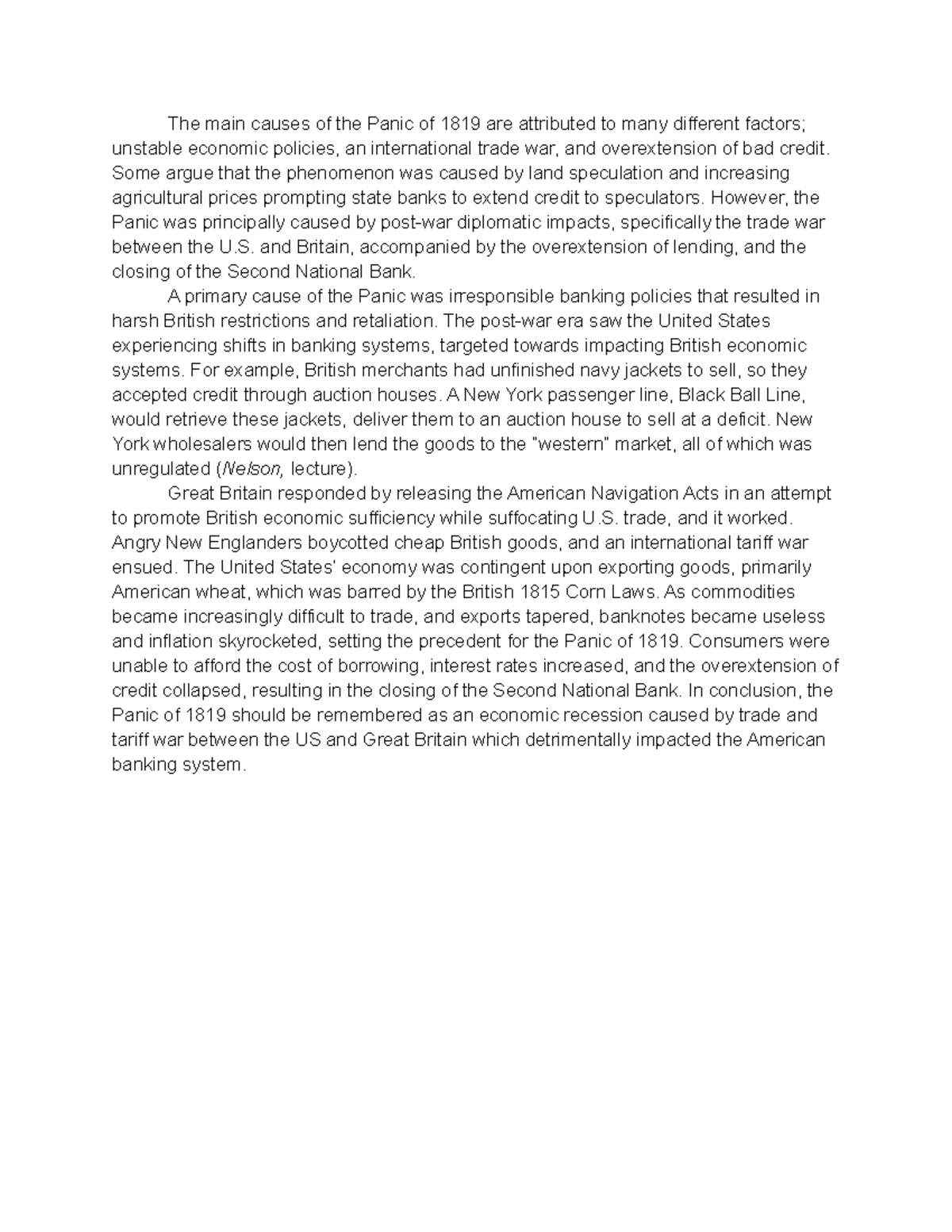
The Panic of 1819 was the first major peacetime financial crisis in the United States, characterized by widespread foreclosures, bank failures, plummeting agriculture and property prices, and severe unemployment. It marked the end of the post-War of 1812 economic expansion and inaugurated a prolonged period of economic depression.
Historical Context and Origins
To understand the definition and mechanics of the Panic of 1819, one must examine the economic landscape of the United States immediately following the War of 1812. The conflict had stimulated domestic manufacturing, driven up the prices of American agricultural commodities in European markets, and created an atmosphere of boundless optimism. As peace returned to Europe in 1815, foreign markets adjusted, yet American speculators, farmers, and merchants continued to operate under the assumption that high wartime demand and inflated pricing would persist indefinitely.
During this post-war boom, the federal government and state legislatures chartered dozens of new banks to fuel economic development. These institutions eagerly issued paper bank notes far in excess of the hard specie (gold and silver) they held in their vaults. Easy credit encouraged rampant land speculation in the newly opened territories of the American West and South. Citizens purchased thousands of acres from the federal government on credit through the Land Act of 1820's predecessors, often paying minimal down payments with the expectation that rising land values would cover future installments.
The structural vulnerability of the American financial system was compounded by the establishment of the Second Bank of the United States (BUS) in 1816. Tasked with stabilizing the currency and reining in the excessive issuance of paper money by state-chartered banks, the BUS initially engaged in loose lending practices of its own. However, facing mounting financial pressure and a drain on its specie reserves, the BUS sharply reversed course in 1818 and 1819. It instituted a sudden, aggressive contraction of credit, demanding that state banks redeem their paper notes in hard specie on demand. This abrupt tightening of the money supply triggered a cascading series of financial failures across the nation.
Core Mechanisms of the Financial Collapse
The operational mechanics of the Panic of 1819 unfolded through a domino effect that affected every sector of the American economy. When the Second Bank of the United States curtailed loans and demanded specie payments from state banks, those regional banks were forced to immediately call in their own loans to merchants, planters, and farmers. Borrowers who had leveraged their futures on easy credit found themselves entirely unable to secure cash.
- Second Bank of the United States restricts credit
- State banks demand immediate repayment of loans in specie
- Borrowers default; asset prices and land values plummet
- Widespread bank failures, factory closures, and urban unemployment
This sudden liquidity crisis initiated a sharp deflationary spiral. Commodity prices collapsed globally and domestically. For example, the price of cotton—then the nation's premier export—dropped precipitously on the Liverpool market, dragging down the value of Southern plantations and the enslaved labor force that operated them. Similarly, grain and tobacco prices plummeted, leaving Western and mid-Atlantic farmers without the revenue necessary to service their debts.
Real estate and land values followed suit. Millions of acres of western land purchased on credit reverted to the federal government because buyers could not meet their payment obligations. State-chartered banks, overwhelmed by defaults and runs by depositors demanding coin, closed their doors permanently. Manufacturing enterprises, which had briefly flourished behind protective wartime tariffs, buckled under the weight of falling consumer demand and the general scarcity of capital, leading to widespread factory shutdowns and massive urban unemployment.
Economic, Social, and Political Consequences
The fallout from the Panic of 1819 extended far beyond financial markets, fundamentally reshaping American social structures and political alignments. For the working class and urban poor, the crisis meant destitution. Soup kitchens and debtors' prisons filled rapidly in major commercial centers such as Philadelphia, New York, and Boston. The crisis exposed the harsh vulnerabilities of an increasingly market-driven economy, contrasting sharply with the agrarian ideal championed by Thomas Jefferson.
In response to the crisis, debtor relief movements gained immense popularity at the state level. Many state legislatures passed laws suspending debt collections, halting property foreclosures, or establishing state loan offices to issue paper currency to aid struggling citizens. These measures frequently brought debtors into sharp conflict with creditors and the judiciary, raising profound constitutional questions about the sanctity of contracts.
Politically, the panic catalyzed widespread resentment against financial institutions, particularly the Second Bank of the United States. Many ordinary citizens, farmers, and state politicians blamed the BUS for orchestrating the crash through its heavy-handed credit contraction. This populist animosity laid the groundwork for the later Jacksonian "Bank War" of the 1830s. Furthermore, the economic distress forced a re-evaluation of national economic policy, prompting intense debates over protective tariffs, the disposal of public lands, and the role of the federal government in regulating commerce and currency.
Comparative Overview of Early American Economic Panics
To appreciate the scale and unique characteristics of the 1819 crisis, it is helpful to compare it with subsequent nineteenth-century financial panics in the United States. While each crisis shared common elements of overexpansion and credit contraction, their underlying catalysts and recovery paths varied significantly.
| Crisis Year | Primary Catalyst | Key Financial Institution Involved | Major Social or Political Result |
|---|---|---|---|
| 1819 | Post-war speculation, land boom, and sudden credit contraction | Second Bank of the United States | Rise of debtor relief laws; populist hostility toward central banking |
| 1837 | Specie Circular, land speculation, and British capital withdrawal | State "Pet Banks" and defunct Second BUS | Independent Treasury System; prolonged five-year depression |
| 1857 | Railroad overexpansion, failure of the Ohio Life Insurance and Trust Co. | Commercial banks and investment houses | Growing sectional tensions between North and South over tariff policy |
| 1873 | Post-war industrial overbuilding, Franco-Prussian War financial shifts | Jay Cooke and Company (investment banking firm) | The "Long Depression," rise of organized labor movements |
Frequently Asked Questions
What was the primary cause of the Panic of 1819?
The primary cause was a combination of post-war overspeculation in western lands, reckless lending by state-chartered banks issuing paper money without adequate specie backing, and the sudden, aggressive tightening of credit by the Second Bank of the United States in an effort to stabilize its own reserves.
How did the Panic of 1819 affect American agriculture?
Farmers experienced a catastrophic drop in the prices of staple commodities such as cotton, grain, and tobacco. Because many had purchased land and equipment on credit during the post-war boom, the collapse in commodity prices made it impossible to pay debts, leading to widespread farm foreclosures and the forfeiture of western lands back to the federal government.
Did the federal government intervene to stop the Panic of 1819?
Under the prevailing political philosophy of the era, direct federal intervention in private economic matters was viewed with deep suspicion. President James Monroe and Congress did not enact sweeping economic rescue packages. Instead, relief efforts were left largely to state legislatures, which experimented with debt moratoriums and easy-money laws.
How long did the Panic of 1819 last?
The acute phase of the panic occurred between 1819 and 1821, but the broader economic depression lingered in various regions through the mid-1820s, permanently altering American attitudes toward banking, industrial labor, and state economic policy.
What role did the Second Bank of the United States play in the crisis?
While supporters argued the Second Bank acted responsibly to protect its own financial health and restore currency stability, critics maintained that its erratic policies—first encouraging loose lending and then abruptly calling in loans—directly triggered the deflationary crash.
Recommended Next Actions
For students, researchers, or history enthusiasts seeking to explore the Panic of 1819 further, consulting primary source documents offers invaluable insight. Reviewing congressional debates, contemporary newspaper accounts from 1819 to 1822, and records from the Second Bank of the United States housed in the National Archives provides direct evidence of how contemporaries experienced and interpreted the collapse. Examining state legislative records regarding debtor relief laws further illuminates the legal and social battles fought during America's first great economic depression.