To accurately report a bilateral ankle sprain in ICD-10-CM, you must assign two separate codes: one for the right ankle and one for the left ankle. There is no single "bilateral" code for this condition. For example, a sprain of the unspecified ligament in both ankles for an initial encounter is coded as S93.401A (right) and S93.402A (left).
The International Classification of Diseases, 10th Revision, Clinical Modification (ICD-10-CM) provides a highly specific framework for documenting injuries. When a patient presents with a bilateral ankle sprain—an injury occurring to the ligaments of both the right and left ankles—medical coders and clinicians must navigate the nuances of laterality, ligament specificity, and the timing of the encounter. As of 2026, the coding standards continue to emphasize maximum specificity to ensure clinical accuracy and appropriate reimbursement.
The Structure of ICD-10-CM Codes for Ankle Sprains
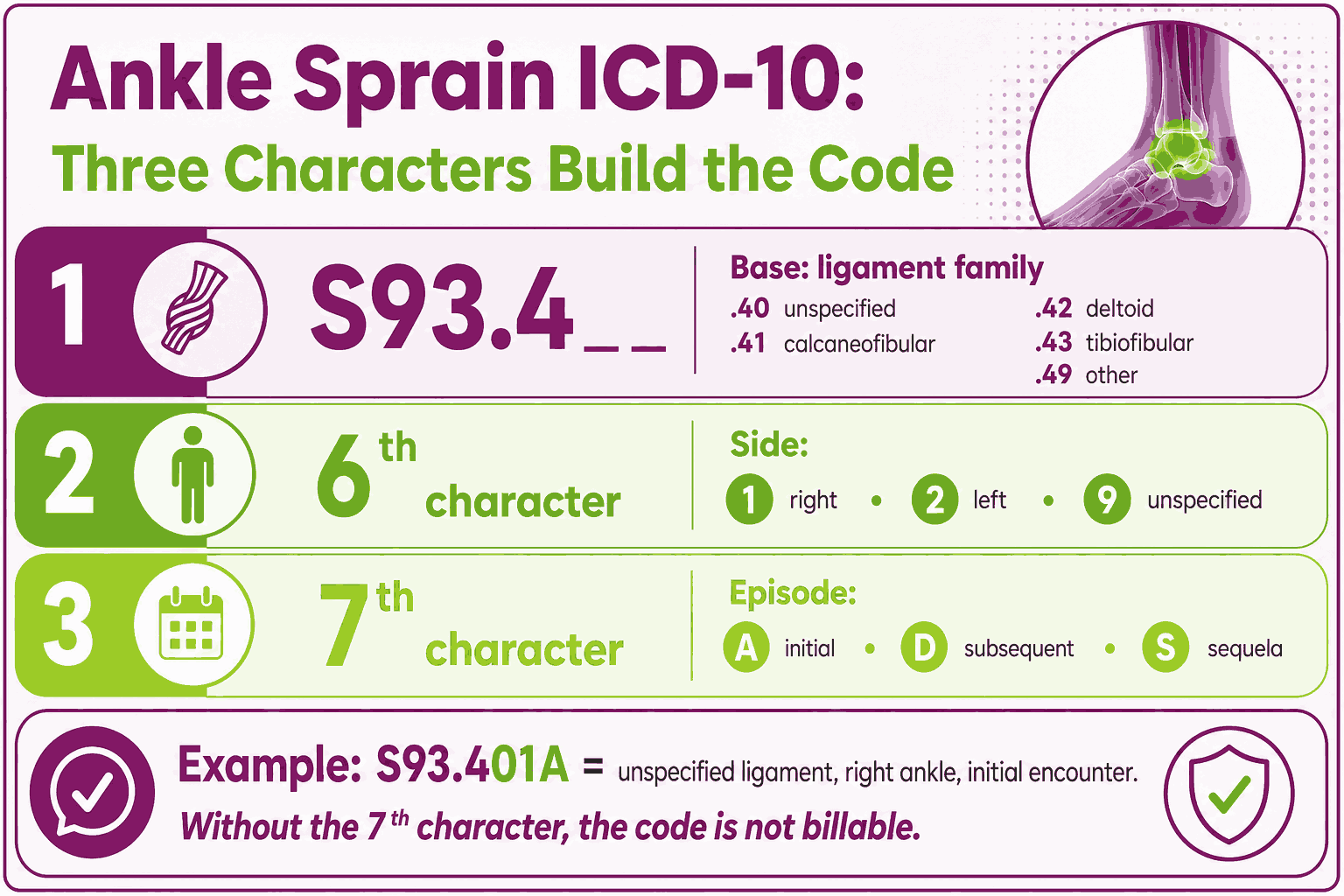
Understanding the classification of a bilateral ankle sprain requires a breakdown of how ICD-10-CM codes are constructed. Most codes in this category follow a seven-character structure. Each character adds a layer of detail that defines the nature of the injury.
Category and Subcategory (Characters 1-5)
All ankle sprain codes begin with the category S93, which denotes "Dislocation and sprain of joints and ligaments at ankle, foot and toe level." Within this category, the subcategory S93.4 is specifically dedicated to "Sprain of joints and ligaments of ankle."
To provide further detail, the fifth character identifies the specific ligament involved:
- S93.40: Sprain of unspecified ligament of ankle.
- S93.41: Sprain of calcaneofibular ligament.
- S93.42: Sprain of deltoid ligament.
- S93.43: Sprain of tibiofibular ligament.
- S93.49: Sprain of other ligament of ankle.
Laterality (Character 6)
The sixth character is crucial for bilateral conditions. Because the ICD-10-CM manual generally omits a "bilateral" option for specific ligamentous injuries in the ankle, the coder must specify which side is being treated.
- 1: Right ankle.
- 2: Left ankle.
- 9: Unspecified ankle.
Using the "9" for unspecified laterality is generally discouraged in 2026 medical billing, as it often leads to claim denials or requests for additional documentation. When both ankles are injured, you must use both "1" and "2" in separate code entries.
The Seventh Character Extension
The final character indicates the type of encounter. This is a mandatory component of the code.
- A (Initial encounter): Used while the patient is receiving active treatment for the injury (e.g., emergency department visit, initial evaluation, or surgical intervention).
- D (Subsequent encounter): Used for encounters after the patient has completed active treatment and is receiving routine care during the healing or recovery phase (e.g., follow-up visits, cast removal, or medication adjustment).
- S (Sequela): Used for complications or conditions that arise as a direct result of the injury after the acute phase has passed (e.g., chronic instability following a grade III sprain).
Why Bilateral Coding Requires Two Codes
A common question in medical administration is why a single code cannot suffice for bilateral injuries. In the ICD-10-CM system, bilateral codes exist for many chronic conditions (like glaucoma or certain types of arthritis), but they are rare for acute traumatic injuries.
The primary reason is the potential for variation in severity. A patient may suffer a Grade III (complete tear) sprain of the calcaneofibular ligament in the right ankle but only a Grade I (stretch) sprain of the deltoid ligament in the left ankle. By requiring separate codes, the system allows the medical record to reflect different types of sprains and different specific ligaments on each side. Even if the injuries are identical in severity and type, the rule of coding each side separately remains the standard.
Clinical Specificity: Identifying the Ligaments
To code a bilateral ankle sprain correctly, the clinician's documentation must specify which ligaments are involved. If the documentation simply states "bilateral ankle sprain," the coder is forced to use the "unspecified ligament" codes (S93.401A and S93.402A). However, precise clinical documentation allows for better data tracking and more accurate billing.
Calcaneofibular Ligament (S93.41-)
This is part of the lateral ligament complex. It is one of the most commonly injured ligaments in inversion sprains. If a patient rolls both ankles inward (inversion), they likely have bilateral calcaneofibular sprains.
Deltoid Ligament (S93.42-)
The deltoid ligament is located on the medial (inner) side of the ankle. Injuries here are less common and usually involve an eversion force (the foot rolling outward). A bilateral deltoid sprain would be coded as S93.421A and S93.422A.
Tibiofibular Ligament (S93.43-)
Often referred to as a "high ankle sprain," this involve the syndesmosis—the connective tissue between the tibia and fibula. These injuries generally require longer recovery times. For a bilateral high ankle sprain, the codes would be S93.431A and S93.432A.
Comprehensive ICD-10 Reference Table for Bilateral Ankle Sprains
The following table illustrates how to construct the codes for various bilateral scenarios during an initial encounter (7th character "A").
| Ligament Involved | Right Ankle Code | Left Ankle Code | Combined Coding Requirement |
|---|---|---|---|
| Unspecified Ligament | S93.401A | S93.402A | Report both codes |
| Calcaneofibular | S93.411A | S93.412A | Report both codes |
| Deltoid (Medial) | S93.421A | S93.422A | Report both codes |
| Tibiofibular (High Ankle) | S93.431A | S93.432A | Report both codes |
| Other (e.g., Talofibular) | S93.491A | S93.492A | Report both codes |
Documentation Requirements for 2026
To ensure that a bilateral ankle sprain is classified correctly, providers must include specific details in the clinical note. In the 2026 healthcare environment, automated auditing tools prioritize specificity. A robust medical record should include:
- Mechanism of Injury: How did the bilateral injury occur? (e.g., a fall from a height, a sports-related collision).
- Specific Laterality: Clear confirmation that both the right and left ankles were examined and found to be injured.
- Specific Ligament Identification: Documentation of tenderness over the lateral complex, the medial deltoid, or the syndesmosis.
- Encounter Phase: Whether this is the first time the patient is being seen for this injury or a follow-up.
- Associated Injuries: Any concurrent fractures (e.g., malleolar fractures) or tendon strains, as these would require additional codes from different categories (e.g., the S82 category for fractures).
Common Coding Errors to Avoid
When classifying bilateral ankle sprains, several errors can lead to claim rejections or inaccurate medical histories.
Using the "Unspecified" Side Code
Using S93.409A (unspecified side) is the most frequent error. While it technically exists in the ICD-10 manual, it does not inform the payer that the injury is bilateral. It simply indicates that the provider failed to record which side was hurt. In 2026, many insurance carriers will automatically flag this for "lack of medical necessity" or "incomplete documentation."
Forgetting the Seventh Character
ICD-10 codes for injuries are invalid without the seventh character. A code like S93.411 is incomplete. It must be S93.411A, S93.411D, or S93.411S. Without the extension, the code cannot be processed through billing systems.
Misidentifying the Joint
The ankle (S93) is frequently confused with the foot (S93.6) or the knee (S83). For example, a sprain of the tarsometatarsal joints of the foot uses a different subcategory entirely. If the injury is truly at the ankle joint, ensure the S93.4- sequence is utilized.
External Cause Codes (V00-Y99)
While not part of the S93.4 classification itself, bilateral ankle sprains often require "External Cause of Morbidity" codes to provide a complete picture. These codes describe how the injury happened and where it occurred. For instance, if the bilateral sprains occurred during a competitive basketball game, the primary diagnosis codes (S93.411A and S93.412A) would be supported by:
- Y93.67: Activity, basketball.
- Y92.321: Basketball court as the place of occurrence.
These additional codes help insurers understand the context of the injury, which is particularly important in workers' compensation or liability cases.
Frequently Asked Questions
Can I use a "Bilateral" modifier instead of two codes?
No. In ICD-10-CM coding for ankle sprains, you must use the specific codes for the right and left sides. While some procedures use the -50 modifier for bilateral services, diagnosis coding requires the discrete codes for each anatomical site when a single bilateral code is unavailable in the tabular list.
What if one ankle is an initial encounter and the other is a follow-up?
This is a rare scenario but can happen if a patient reinjures one ankle while still recovering from a previous injury on the other side. In this case, you would use the appropriate seventh character for each: "A" for the new injury and "D" for the healing injury.
Does the grade of the sprain change the ICD-10 code?
ICD-10-CM does not have separate codes for Grade I, II, or III sprains. The severity is captured through clinical documentation rather than the code itself. All grades are categorized under the same "sprain" codes (S93.4-), though the treatment plan documented in the record will vary significantly based on the grade.
How do I code chronic bilateral ankle instability?
Chronic instability is not an acute sprain. If the patient no longer has an active sprain but suffers from lasting instability, you would look at codes in the M24 category (Other specific joint derangements) or use the S-extension (Sequela) if the instability is a direct result of the previous sprains. Specifically, M24.271 and M24.272 (Disorder of ligament, right and left ankle) are often more appropriate for chronic conditions.
Is the "9th" character in S93.409 ever acceptable?
The only time a "9" for unspecified laterality is acceptable is when the medical record is completely silent on which side was injured and the provider is unavailable for clarification. However, in a professional setting, this is considered a failure of documentation and should be corrected by querying the provider rather than submitting an unspecified code.
Recommendation for Accurate Classification
To ensure the highest level of accuracy when classifying bilateral ankle sprains in 2026, always prioritize ligament specificity. Avoid the "unspecified" codes (S93.40-) whenever the clinical record mentions a specific structure like the calcaneofibular or deltoid ligament. Always report two separate codes to represent both sides, and verify that each code contains the mandatory seventh-character extension to reflect the current phase of care. This approach not only facilitates smoother billing but also ensures that the patient’s longitudinal medical record is an accurate reflection of their traumatic history.